
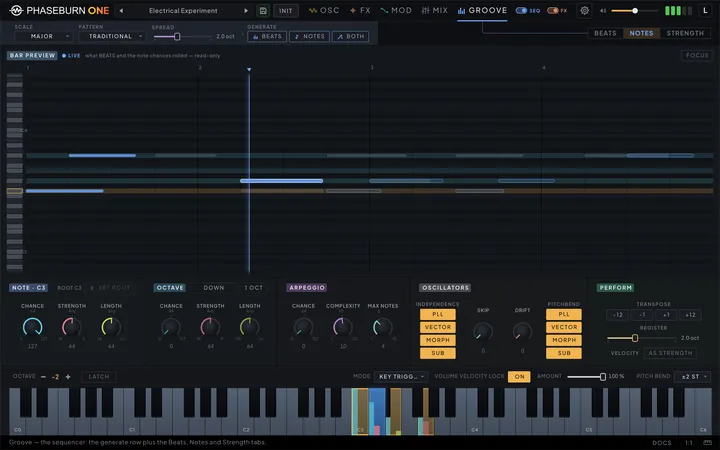
Phaseburn One’s sequencer does not play back a pattern you drew — it rolls dice you have weighted. You decide how likely a note is at every point in the bar and which pitches are in the running; the instrument performs a fresh take every bar. The whole system lives on the Groove page — its one outlying control, the SEQ switch, rides on the Groove nav tab itself — and all of it feeds the one voice built from the Phase-Locked Loop (PLL), VECTOR, MORPH and sub sources covered in the oscillators chapter (Chapter 2 — Oscillators).
One bar, one page
Learn where the three decisions live, and the rest of this chapter reads itself. The sequencer is one page — Groove — and one module runs the full width of its top: the GENERATE panel, holding the Scale and Pattern selectors, the SPREAD slider and the BEATS, NOTES and BOTH actions covered in the GENERATE chapter (Chapter 8 — Generate), with the three view tabs — Beats, Notes, Strength — pinned to its right-hand end. That module never changes shape, so the pick-a-scale-then-generate flow never leaves the page, and leaving Groove and coming back returns you to the tab — and the beat division — you were working on. Loading a preset is the one thing that moves that division for you: the grid opens on the first row the incoming pattern uses — 1/4 for a line on quarters, 1/16T for a triplet figure — so a fresh sequence never greets you with an empty row. A sound-only load (KEEP SEQ) keeps both the grid and your place in it.
Beats comes first and opens by default — the grid is where a pattern is built. It decides when: the probability grid with its 152 slots, the beat-link tool, and a row beneath the grid carrying the family and division buttons that choose the row you are editing plus the Undo, Vary and Clear All actions. Notes is the pitch side — and since KEY TRIGGER became the way in, the side you play: the root the phrase transposes around (in KEY TRIGGER the piano shows the temporary root a held key is playing from, snapping back on release), the bar preview across the top, the note pool with its per-note chances and preferences, octave randomization, the ARPEGGIO phrase controls, the OSCILLATORS module — the SKIP and DRIFT knobs that let individual oscillators gamble against the line, with the Independence and Pitchbend switch columns either side of them — and the PERFORM module: transpose first, the Register slider that reshapes the pool you already have, then the velocity As Strength switch (the Octave that voices the whole preset lives in the keyboard row under the pages). Strength decides how much each moment matters: the map of every bar position’s relative weight — beat one strongest in most grooves — that the probability, length and velocity systems target. Along the bottom of the Beats and Strength tabs run the GLOBAL, LENGTH, VELOCITY and POSITION modules, whose sliders set swing, legato and the length, velocity and position modifiers that decide how long notes ring and how they land.
Starting and stopping belongs to your hands or your host, by MIDI mode. In the default KEY TRIGGER a held note runs the sequencer and transposes it — the phrase starts from step 1 on your attack and stops with your release; in CHORD FOLLOW the held chord does the same while feeding the pool; in FREE RUN the DAW transport runs it, so bars roll when the project plays and stop when it stops — see Input modes (Chapter 10 — MIDI & Your DAW). Above all of them sits the SEQ switch on the Groove nav tab, visible and clickable from every page. Switching it off takes the whole Groove page with it: the page veils over behind a card naming the switch, the instrument stops rolling bars of its own, and SKIP and DRIFT stop acting on the notes you send — every oscillator sounds on every note, at the pitch it was given. Everything outside that page keeps running: the transport lock, the step modulators, tempo-synced LFOs and the MIDI notes you send. That is the setting for driving Phaseburn One from MIDI in your host. It is per-instance plugin state, saved into the project and recalled with it, untouched by preset loads — a track you drive from the piano roll stays that way through every patch you try (the cog menu’s New instances start with column decides how new instances start). Switching it off mid-bar releases the sounding sequencer note cleanly without cutting held MIDI notes; switching it back on re-anchors the bar to the host grid. On the Modulation page — which the veil does not cover — the NOTE STRENGTH module dims and wears a small SEQ OFF tag while the switch is off and nothing else can drive it; with the cog menu’s velocity-as-STRENGTH switch on it stays lit, because played notes feed it then. The Groove page’s own LENGTH, VELOCITY and POSITION modules no longer carry that tag — the page-wide veil says it for them. The running sequencer emits real note events into the same voice your keyboard plays — there is no separate sequencer sound.
The bar the grid draws is always four quarter notes long. An odd host meter masks its tail rather than stretching it — a sixteenth has to stay a sixteenth — so 3/4 and 6/8 both play the grid’s first three quarter notes and never reach the fourth, 7/8 plays three and a half, and meters longer than a 4/4 bar clamp back to the whole grid.
One distinction is worth knowing early. Every slider in the GLOBAL, LENGTH, VELOCITY and POSITION modules is a real host parameter your DAW can automate, and they appear in the table at the end of this chapter. The bar’s contents are not: the beat slots, the note pool, the strength map, the beat links and the style settings are pattern data. They travel with the preset and with your saved project, they can be rewritten in one gesture by GENERATE, VARY and CLEAR ALL, and they are undoable — but they are not automation targets, and they do not appear in your DAW’s parameter list.
Chances, not steps
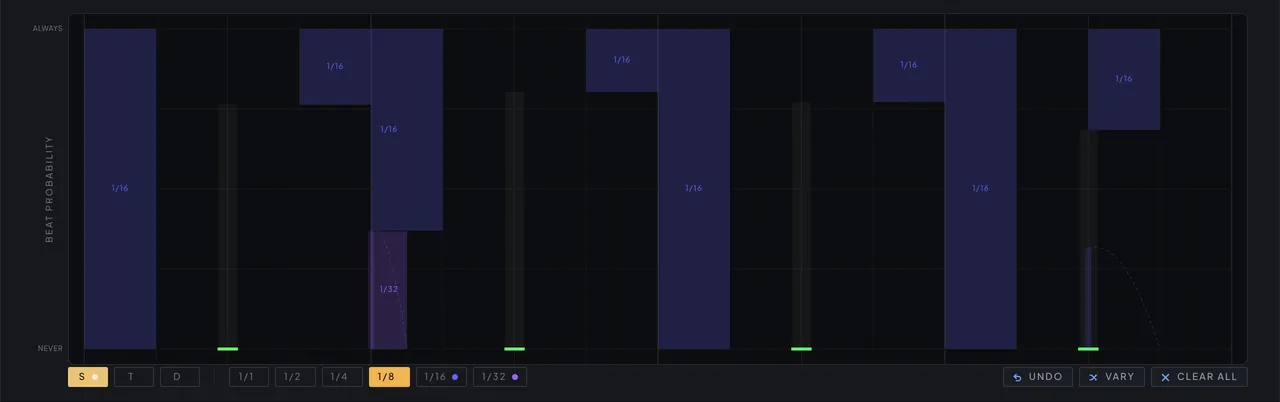
Program a line by deciding how much you want each hit, not whether it happens. The Beats tab — the grid names itself BEAT PROBABILITY down its left edge — edits one bar as a single grid of chances, one row at a time: in the row beneath the grid, the S, T and D buttons pick a family — straight, triplet or dotted — and the division buttons beside them pick which of that family’s rows you are editing. Every other row that holds anything stays visible as translucent shapes hanging from the top of the grid, so you can see what else claims each moment. Each shape is captioned with the division it belongs to — 1/16, 1/8T, 1/4D — and clicking one takes you straight to that row to edit it. Where several rows claim the same stretch the shapes stack, one band per contributing beat, so a mixed moment is still legible band by band; a band too small for its caption still highlights on hover and names itself in the help bar. The straight family runs six rows — one slot for a whole-note hit, two halves, four quarters, eight eighths, sixteen sixteenths, thirty-two thirty-seconds — sixty-three slots. The triplet family adds four rows, half- to sixteenth-note triplets — forty-five slots. The dotted family adds five rows, each holding as many dotted notes as can start inside the bar — forty-four slots, with odd counts like eleven dotted sixteenths because a dotted note is half again as long. That makes 152 slots, all live whether displayed or not, all competing for the same bar.
Raising a slot raises the odds that a note begins at that moment with that duration. Only a slot at exactly zero is off; anything above zero is a contender, however faint. When several slots want the same moment — the bar’s first sixteenth shares its downbeat with the first eighth, the first quarter and the whole note — one weighted draw picks a winner, and the winner plays out its full duration, silencing every other slot until it ends. Phaseburn One plays one voice, and the lottery is how that voice arbitrates 152 claims.
One moment, in plain numbers: put the bar’s first quarter-note slot at an 80% chance and the half-note slot above it at 10%, and leave everything else on that downbeat empty. Eight bars in ten now open with the quarter. One in ten the half note wins instead, and because a winner occupies its whole duration it rings straight through the second quarter’s territory. And in the tenth or so that remains, nothing fires — the downbeat is a rest. That is the entire grid in miniature: every start time is one draw among the divisions that want it, with silence taking whatever chance is left over. You never program the outcome, only the odds — and you can watch each draw land in the read-only bar preview at the top of the Notes tab, which shows the whole bar the moment it is rolled (see The bar preview (Chapter 7 — The Sequencer)).
Chance is a shared budget, not a private one. A slot that loses a draw still spends its share: until the span it wanted to fill has passed, its chance stays subtracted from the budget of every later draw. The grid balances itself — piling chance into one row drains the effective odds of the moments around it — which is why a groove keeps its character even when every row is busy.
Edits are reversible. Undo, in the same row, walks back up to ten steps: every generated groove, Clear All and link edit stacks the whole grid first — slot chances, links, the strength map, swing and note length — so a run of VARY presses is something you can walk out of. Loading a preset clears the stack.
In an odd host meter the stretch of grid past the end of the bar sits behind a dimmed panel, cut off by a line captioned OUT OF BAR, and its lanes grey out with it. Those slots keep whatever chance they hold — GENERATE always composes a full 4/4 bar, so its closing figures often land there — but nothing behind the cut is ever reached.
A fresh bar is rolled at every bar line, and the next bar is prepared while the current one plays, so edits land cleanly on the next downbeat. Every slot names itself after its row and position — “1/1 Beat 1” is the whole-note slot, “1/16 Beat 3” the third sixteenth, “1/8T Beat 1” the first eighth-note triplet — and the help line reads that name and the slot’s chance out while you drag it. Because CLEAR ALL, GENERATE, VARY and a link edit each land as a single change, a bar rolling underneath you can never catch a grid halfway through one.
Beat links

Build ratchets and fills that only exist when their anchor plays. A beat link is a forward connection between two slots, set on the Beats tab by picking a source beat and then its target: whenever the source actually wins its draw, the target is forced to play too, regardless of the target’s own roll. Links chain — connect A to B and B to C, and one lucky anchor drags a three-hit figure out with it.
The sharpest use is a target with zero chance of its own. A slot at zero never plays by itself, but as a link target it fires every time its source does — a ratchet that exists purely as a consequence. Give the source a middling chance and the figure appears in some bars and not others, always complete when it does. Generated fills work the same way: the beat generator writes its end-of-bar figures as links (see Vary (Chapter 8 — Generate)), so a fill arrives as one gesture instead of a scatter of independent gambles.
You edit one division at a time, but you see every link at once. An endpoint that lives in another division is drawn on the grid you are on as a semi-transparent ghost — at its true position in the bar, in its own division’s color — joined to its partner by a dashed arc that bows clear of the bars. Hover any linked slot and its whole chain lights up, ghosts included, so a sixteenth hanging off a quarter reads without switching rows.
One thing a link cannot do is put two beats on the same instant. Divisions overlap by design — the 1/8, the 1/16 and the 1/32 all start together on the downbeat — and “always plays” has no meaning if it points at two of them at once. So while you are choosing a target, any position already spoken for by the chain you are building is struck through and refuses the click, and the help bar names the beat that holds it. Pick the other one, or unlink the first.
Links reward restraint: they resolve recursively, so long chains turn a single win into a cascade that eats the rest of the bar — short chains of two or three beats stay groove-shaped. A forced beat enters the bar like any other note, so everything downstream still applies: it reads the strength map, rolls its own pitch from the pool, and takes length and position modifiers like its neighbors.
Links are also the sequencer’s slide machine. Push the Length slider in the GLOBAL module past full so consecutive notes overlap, raise the Legato slider off its Off detent, and a linked pair plays as a slide: the second hit glides out of the first without a new attack, along the legato path described in Glide and legato (Chapter 2 — Oscillators). An anchor with a zero-chance target one division later is the recipe for an acid figure that appears only in some bars and always slurs the same way.
Strength and dynamics
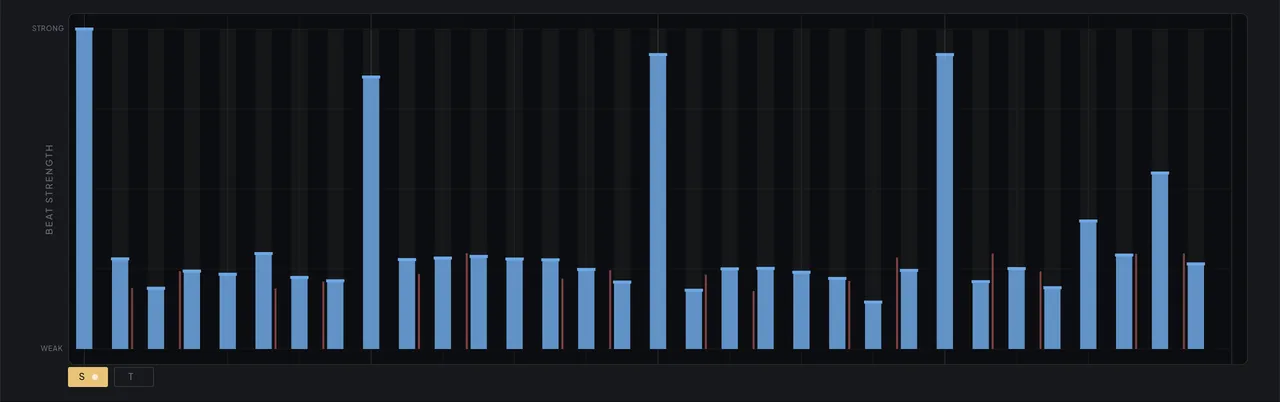
Give the bar a spine of accents, then let every other decision lean on it. The Strength tab — the grid reads BEAT STRENGTH down its left edge — holds one map of the bar: 96 positions, fine enough to give every straight and every triplet slot its own cell — edited in a straight view of thirty-two positions or a triplet view of twenty-four, with the other view shown as reference lines. Draw it by hand or start from one of fifteen built-in styles in the STYLE menu in the row above the grid, from 4/4 Standard and Backbeat through Polyrhythm 3:4, Reggae and Funk to Ambient and Driving.
Before the mechanics: what is strength for? It marks certain beats with a value, and the rest of the instrument reads the marks. Paint beat one strongest — the usual choice — and you can tell the root note to prefer strong beats, so the phrase keeps landing home on the downbeat while other pool notes fill the gaps. Aim the NOTE STRENGTH modulation route at a filter and every accented hit pushes the cutoff harder than a ghost does. Point a length modifier at Weak with some probability and weak beats randomly clip short while the accents ring on. None of this is loudness by itself: velocity follows the map only as far as the dedicated VELOCITY slider on this tab hands it over, so a map can drive selection, modulation and length while every note still lands at an even level.
Strength is a ranking, not a velocity curve. It is the relative strength of each beat position — beat one strongest in most grooves, the backbeats next, the gaps between them weakest — and most of what reads it does not read it as loudness at all; it targets it. Aim a modifier at strong beats and it fires only where the map reads high, aim it at weak beats and it works the ghosts. Five separate systems consult the ranking this way: note selection (pool notes can prefer strong or weak beats), octave randomization (which can be gated to strong beats), the length and position modifiers’ targeting, and the velocity modifiers. A sixth consumer, the NOTE STRENGTH modulation route (see the modulation chapter (Chapter 4 — Modulation)), skips the ranking altogether and feeds each note’s raw painted cell straight into a sound parameter for the note’s duration. Each note reads exactly one cell — the nearest one to its grid start, measured before swing and humanization shift it — so timing feel never changes which strength cell a note obeys.
Contrast is what gives the map meaning, but the targets never lose a timid map: every weak/any/strong target — length, position and velocity alike — is judged against the map’s own quietest and loudest cells among the beats that can actually play, stretched to the full range. Turned fully to Weak, a target reaches only the beats sharing the map’s weakest playable value; fully to Strong, only the beats sharing its strongest; between Any and an extreme its reach narrows linearly, so the knob sweeps from “every note” down to “just those beats”. A perfectly flat map carries no ranking at all, and every target simply matches every note. The exception is the note pool’s preferences, octave gating and the NOTE STRENGTH route, which read raw cell values — a grid hovering around the middle barely steers them, which is why the built-in styles are shaped with low floors and the GENERATE generator writes its grids the same way.
Dynamics come from two places, and they stack. The VELOCITY slider beside STYLE is the literal route: at 0% every note starts from the same flat hit, and as you raise it each note’s velocity slides toward a straight reading of its own strength cell, until at 100% the map you drew is the dynamic shape of the bar. It is the only control that hands strength to loudness directly — a flat map has no shape to hand over, so notes there land on a single mid velocity rather than falling silent.
The two velocity modifier slots in the VELOCITY module below the grid then work on top of whatever that leaves, at any slider setting, so accents keep breathing from bar to bar even when velocity is following the map exactly. One keys off beat strength, the other off note length; each has a weak/strong/any target, an amount above or below the base hit, and a probability. Amounts randomize “up to” the value you set. The length-keyed slot ranks notes by the length they will actually play — the base Length share bent by the length modifiers — against the other notes of the same bar, so a note a modifier just clipped short really is the “short” a Short-aimed target finds, and a bar of identical lengths matches the target wherever it points.
Choosing notes

Decide which pitches are allowed to happen — and when each one is welcome. The Groove page’s Notes tab holds the note pool: every note you enable carries a chance, a strength preference, a length preference and an octave placement. The root note is always present and serves as the fallback, so the line can never paint itself into silence. Every factory preset is made to play right around C3 — middle C — so one hand position auditions each one as its author heard it; the root itself can be any note, and a sound that lives in another register is put there with the preset’s Octave. For each note event the sequencer reads the beat’s strength, weighs every pool note — its chance scaled by how well this moment matches its preferences — and draws. A note that prefers strong beats is boosted up to double on accents and cut to a tenth on ghosts; a neutral note is indifferent. This is how one pool produces lines with grammar: stable tones land on the spine, passing tones fill the gaps.
You edit all of that on the keyboard along the bottom of the tab, and it sounds as you work: click or drag across the keys and each one you touch plays, always — there is no audition switch to remember. The selected key’s Chance, Strength and Length knobs sit in the NOTE module, the module the page is built around, and every key on the roll carries those same three values as three slim bars — chance at the left, strength in the middle, length at the right — painted in the same three colors as the knobs, washed out where a preference points down rather than up. Knob and bar are one reading.
You can fill the pool two ways, both from the GENERATE panel above. Pick one of seventeen scales — Major, Minor, the modes (Dorian, Phrygian, Lydian, Mixolydian, Locrian), Harmonic and Melodic Minor, both pentatonics, Blues, Whole Tone, Chromatic, Japanese, Arabic and Hungarian — and one of eight stability patterns that write the preferences per scale degree: Traditional (stable notes on strong beats, passing tones on weak), Jazz Melodic (sevenths and thirds prominent, the fourth avoided), Ambient, Bass Heavy, Melodic, Tension, Even and Pentatonic. With a concrete scale selected, changing either selector rewrites the pool immediately. Each selector’s first entry is Auto. Scale on Auto means any scale: it fills nothing by itself, but every GENERATE press rolls a scale to suit the groove, tints the roll’s in-scale keys with its pick and leaves the selector on Auto so the next press can roll again. Pattern on Auto works the same way — each press rolls a concrete pattern to voice with, and the selector never moves. Or press NOTES in the panel, which generates a multi-register voicing in the selected scale and pattern — neither selection is ever overwritten — see Note voicing (Chapter 8 — Generate). Either way, every per-note value stays editable afterwards.
The pool is octave-aware. The same pitch can sit in it at several octaves with independent settings — a low copy weighted toward grounding bass duty, an upper copy saved for climactic moments — so register becomes part of the probability story. On top of that, global octave randomization can shift the chosen note after selection: its own chance, strength and length conditions all have to pass, a direction control restricts the move to down, up or either, and a RANGE control caps the jump at one, two or three octaves.
The SKIP and DRIFT knobs in the OSCILLATORS module run a different gamble — individual oscillators sitting out a note or playing a different pool note than the voice — covered in Oscillator independence (Chapter 2 — Oscillators), along with the module’s other column of switches, which decides per oscillator whether the pitch wheel reaches it. They are the one part of Groove that also reaches the notes you play yourself, and like everything else on this page they stop when the SEQ switch does.
The bar preview
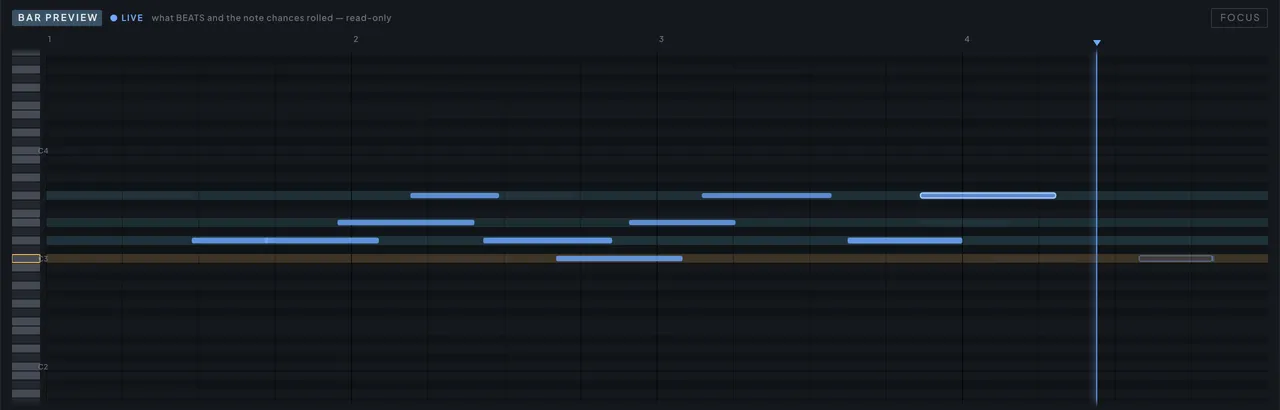
The top of the Groove page’s Notes tab is given to the bar preview — a piano-roll view of what the engine actually decided. Its header row says so: a dot reading LIVE while bars are rolling or STOPPED when they are not, the caption what BEATS and the note chances rolled — read-only (the pattern itself is edited on the Beats tab), and FOCUS. The whole bar is rolled the moment it begins, and the preview shows it immediately: every chosen note appears as a hollow outline at its pitch, position and length, and turns solid as the playhead sweeps past it. You see the dice land before you hear the result, then watch the line confirm it. When the bar turns over, the old one lingers as a grey ghost and melts away while the new roll draws in; stop the sequencer and the last bar freezes, dimmed, for inspection.
The caption means what it says: pitches, timing and lengths belong to the probability engines, so nothing in the grid responds to clicks — only the keyboard down its left edge does, and only to let you hear a pitch: press a key to audition it, drag along the keys to glide. What the grid does instead is close the loop with the settings around it. Rows glow with each pool note’s chance — in the same color the NOTE module’s Chance knob wears — so the pitches the dice favor are literally brighter; the root row is amber; when octave randomization is on, its landing rows carry a dashed guide, and you can watch notes jump register exactly where the guides said they might. Louder notes draw more opaque, and notes rolled on stronger beats draw taller. Oscillator independence shows its hand here too: when DRIFT sends an oscillator to a different pool note, a slim teal bar appears on that pitch’s row for the note’s duration, tethered to the main note by a dotted stem — the chord the gamble built, drawn as it sounds. Each satellite carries a small label naming the oscillator that drifted there — PLL, VEC, MOR or SUB, joined like VEC·MOR when several land on the same pitch — dim until the note sounds and omitted on bars too slim to label. The label always sits clear of the bar it names, flipping to its left near the right edge rather than printing over the teal. Wider notes also carry four small dots reporting each oscillator’s fate (lit plays the voice note, teal drifted, hollow sat out to SKIP). These marks only appear as each note fires, because that is when the engine rolls them: the outlines ahead of the playhead genuinely don’t know yet. The view scrolls vertically — it auto-centers on your pool, and small amber arrows point at anything sounding beyond the visible rows. Raise a note’s Chance and its row brightens; push Length preference up and the bars stretch — the preview is where those abstractions become visible rhythm.
Style patterns
Let the line break into arpeggios, rollers and stabs without programming any of them. After a bar’s notes are chosen, the phrase engine can seize runs of consecutive beats and overwrite their pitches with an idiom — a stutter, a climbing arpeggio, a snap to the octave and back. You do not pick the idiom: every bar rolls its own vocabulary, so one bar phrases in one dialect and the next may take another. What you shape is how far the phrasing goes.
Three controls in the ARPEGGIO module on the Notes tab do that shaping. Chance sets how often a phrase starts, and it is also the on/off switch: at zero the engine never intervenes and the sequencer plays the pitches the pool drew. Complexity is the character control. Every vocabulary carries twenty patterns ordered from simple to complex, and Complexity caps how deep into that list a roll may reach, so low values keep to two- and three-note figures while high values admit the long ornate runs — turn it down for a line that stays recognizable, up for one that keeps surprising you. Max Notes caps how many beats a single phrase may consume. A running phrase always completes before a new one may start, and phrases launch only from the bar’s first note, so an arpeggio always sets off from the downbeat.
Patterns are step sequences through the notes you enabled — relative moves like up one, down one, up three — wrapping into the next octave when they step past the edge of the pool. Because phrases draw only from your pool, one can never play outside your scale: it re-orders what you allowed rather than importing vocabulary, so even with most of the bar handed over to phrase idioms the harmony stays yours, and the rhythm is still whatever the probability grid decided.
Timing feel
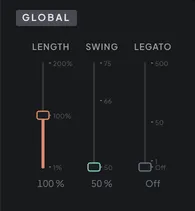
Make the bar lean before you reach for any effect. Three systems, all living in the modules below the beat grid, bend when and how long notes sound, without touching what plays.
Swing, a slider in the GLOBAL module, delays the second eighth of every eighth-note pair inside each quarter. At the neutral setting both eighths are equal; at a setting of 66 the first eighth takes 66 percent of its quarter note and the second squeezes into the rest — the classic shuffle lean. Swing moves playback timing only — accents are still read from the unswung grid.
Length, also in the GLOBAL module, sets the base duration of every sequenced note as a share of its slot. Below full, notes detach and the line turns staccato; past full, consecutive notes overlap — which is fuel for ties and, with the Legato slider raised off its Off detent, slides (see the next section). Two length modifier slots in the LENGTH module then bend duration per note: each has a target on the weak-to-strong continuum, an amount, and a probability, and amounts randomize “up to” the configured value so the articulation drifts from bar to bar. At their default targets the two slots aim one at clearly weak beats and one at clearly strong — shorten the ghosts and lengthen the anchors, and a static line starts phrasing itself.
Position modifiers, in the POSITION module, are the humanizers: two slots that shift notes off their grid positions. Each pairs a weak/strong/any target with a shift — negative pushes hits early, positive drags them late — plus a probability, again with “up to” randomization, so the push differs note to note and bar to bar. Position shifts happen after every decision has been made: they never change which slot won its lottery or which strength cell a note read, so the groove’s logic stays on the grid while its feel drifts off it.
When a groove feels stiff: strength-map contrast first, swing second, a length modifier aimed at weak beats third, and only then a touch of position shift — a little of each goes much further than a lot of one.
Playing it live
Treat the sequencer as an instrument you play, not a tape you start. The controls that matter on stage sit one layer up from the grids, most of them together in the PERFORM module on the Notes tab, in the order you reach for them: the transpose nudges at the top, the Register slider that reshapes the pool, and then the velocity As Strength switch that turns struck velocity into note strength — plus the Octave stepper that voices the whole preset, at the head of the keyboard row under every page. How an external keyboard drives the sequencer — MIDI Mode and Volume Velocity Lock — lives in the header’s cog menu, covered in Input modes (Chapter 10 — MIDI & Your DAW). There is no audition control among them: a key you click or drag on the roll always sounds.
Register works on the pool that is already on the piano roll — it generates nothing. It stretches or folds the pool’s pitch span around the root in whole octaves, so every note keeps its scale degree while the voicing opens out or collapses toward the middle. It is reversible while your hand is down — drag back to the centre and the pool returns exactly as it was, even though stretching merged notes — and it commits when you release, at which point the slider springs back to the centre because the pool simply is the new result. There is no undo between gestures.
Octave is the preset’s voicing: whole octaves applied to every note the voice receives — the pool, a played key, a CHORD FOLLOW chord — without moving a single note on the roll. It is what lets a preset play right around C3, middle C, whatever register the sound was built for: a bass that lives around C1 keeps its pool near C3 and sets Octave to −2, so the hand stays where a keyboard puts it and the sound stays where the author put it, and nobody has to guess the register the author meant. Everything pitch-tracked follows — filter and envelope key tracking, FOLD, the PLL reference — while the roll, the bar preview and MIDI OUT keep the notes as written, and the temporary root a held KEY TRIGGER key shows is unshifted too. Transpose and Octave sit together on purpose and do opposite things: Transpose moves the notes, Octave moves the sound. The cog menu’s Keyboard Octave is the other half of the story — it moves what you play, for this instance only, never what the preset carries (see Input modes (Chapter 10 — MIDI & Your DAW)). Author with Octave, perform with Keyboard Octave.
Legato — the slider in the GLOBAL module below the beat grid — makes overlapping notes glide instead of retriggering: raise it off its bottom Off detent and the envelope carries through while the pitch slides over the time you dial in, separate from the PLL’s always-on GLIDE — the interplay is described in Glide and legato (Chapter 2 — Oscillators). Since overlap is what triggers it, the note-length lane decides which steps slur. The VCA switch on the volume envelope goes further: lit, with Depth at 0, the voice holds permanently open and the sequencer re-pitches a continuous drone — run it when the level should come from somewhere else, like a host-side gate or the filter riding an LFO. See The volume envelope (Chapter 4 — Modulation).
Note priority decides which of several held MIDI keys owns the voice: the last played, the lowest or the highest. Last is what a sequencer-driven single voice wants, so it has no panel control — it is exposed to the host rather than drawn on the window. Set it from a preset or a host parameter and low priority with legato gives the classic bass-player setup — hold the root, hammer above it, always fall back home.
In FREE RUN the bar is phase-locked to the DAW timeline: the host transport is what starts and stops the sequencer, so there is nothing to arm before a take beyond the SEQ switch on the Groove tab. A transport start plays from the top: the DAW beginning playback hard-resets the sequencer to beat 1 of bar 1, the step modulators and LFOs restarting with it, rather than re-anchoring to wherever the host clock happens to read, so every take opens the same way. Once rolling, loop wraps and relocates re-seek instantly, anchored to the host’s bar lines — a take launched on a downbeat keeps the sequencer’s downbeat on the DAW’s bars throughout, and one launched mid-bar falls into line at the first wrap or relocate — and tempo changes rescale the playing bar in place. In the gated modes none of this anchoring applies: the phrase belongs to your note, starting from step 1 wherever in the bar you play it, while tempo and divisions still follow the host clock. External MIDI clock carries no position information, so under it the sequencer runs free on its own clock — see Clock and transport (Chapter 10 — MIDI & Your DAW).
A probabilistic bar regenerates on every loop wrap — and, in the gated modes, on every fresh attack — deliberately: no pass is ever a guaranteed repeat of the last. There is no seed control: the random stream is seeded from system entropy when the instrument loads, and for any given seed the generator’s decisions are deterministic. When a pass is the take, record it — a bounce is the only permanent copy.
The table below also carries the instrument-wide performance parameters: the three aftertouch routes (covered in Velocity and aftertouch (Chapter 4 — Modulation)), the pitch-bend range, the transport’s global volume, and the host bypass.
| Parameter | Range | Default | What it does |
|---|---|---|---|
| Global Volume | -inf dB – 12.0 dB | 0.0 dB | Master output level — the MASTER fader and the transport-bar volume; global, never moved by preset loads. |
| Bypass | Off / On | Off | Standard host bypass switch; the DAW uses it to take the instrument out of the signal path. |
| Pitch Bend Range | 0 … 24 (25 steps) | 2 | How far the pitch-bend wheel reaches — ±2 st by default, up to ±24 st; 0 ignores the wheel. Per instance. |
| AT Dest 1 | None – Master EQ High Gain | None | The aftertouch route: the parameter channel pressure pushes while you press into a held key. |
| AT Amount 1 | -100 – +100 | 0 | Depth and direction of the aftertouch route — negative values pull the target down. |
| Note Length % | 1 % – 200 % | 95 % | Base length of every sequenced note as a share of its slot; past full, notes overlap into ties and slides. |
| Len Mod 1 Target | -100 – 100 | 0 | Which beats length modifier 1 aims at, from weak through any to strong, judged against the strength map's own quiet-to-loud range. |
| Len Mod 1 Amount | 0 % – 200 % | 100 % | The length the modifier bends notes toward; each hit randomizes up to it from the base. |
| Len Mod 1 Prob | 0 – 127 | 0 | Chance per note that length modifier 1 fires at all. |
| Len Mod 2 Target | -100 – 100 | 0 | Which beats length modifier 2 aims at, from weak through any to strong, judged against the strength map's own quiet-to-loud range. |
| Len Mod 2 Amount | 0 % – 200 % | 100 % | The length the modifier bends notes toward; each hit randomizes up to it from the base. |
| Len Mod 2 Prob | 0 – 127 | 0 | Chance per note that length modifier 2 fires at all. |
| Vel Strength Follow | 0 % – 100 % | 0 % | How far velocity tracks the strength map: 0% keeps every note at the flat base hit, 100% reads each note's strength cell across the full range. The modifiers below still apply. |
| Vel Strength Target | -100 – 100 | 0 | Which beats the strength-keyed velocity modifier hits, judged against the map's own quiet-to-loud range. |
| Vel Strength Amount | -99 – +27 | 0 | Velocity push above or below the base hit when the strength modifier fires; randomized up to the value. |
| Vel Strength Prob | 0 – 127 | 0 | Chance per note that the strength velocity modifier fires. |
| Vel Length Target | -100 – 100 | 0 | Which beats the length-keyed velocity modifier hits — ranked by the length each note actually plays this bar. |
| Vel Length Amount | -99 – +27 | 0 | Velocity push above or below the base hit when the length modifier fires; randomized up to the value. |
| Vel Length Prob | 0 – 127 | 0 | Chance per note that the length velocity modifier fires. |
| Note Mod Dest | None – Master EQ High Gain | None | NOTE STRENGTH destination — the parameter each sequenced note's painted strength pushes for its duration. |
| Note Mod Amount | -100 – +100 | 0 | NOTE STRENGTH amount — how far the note's strength value pushes the destination (±1, bipolar). |
| Vel Mod Dest | None – Master EQ High Gain | None | VELOCITY module destination — the parameter the sounding note’s velocity drives. |
| Vel Mod Amount | -100 – +100 | 0 | VELOCITY module amount — how far full velocity pushes the destination (±1, bipolar). |
| Pos Mod 1 Target | -100 – 100 | 0 | Which beats humanizer 1 nudges, from weak through any to strong, judged against the strength map's own quiet-to-loud range. |
| Pos Mod 1 Shift | -50 % – +50 % | 0 % | How far humanizer 1 moves a hit off the grid — negative plays early, positive drags late. |
| Pos Mod 1 Prob | 0 – 127 | 0 | Chance per note that humanizer 1 fires. |
| Pos Mod 2 Target | -100 – 100 | 0 | Which beats humanizer 2 nudges, from weak through any to strong, judged against the strength map's own quiet-to-loud range. |
| Pos Mod 2 Shift | -50 % – +50 % | 0 % | How far humanizer 2 moves a hit off the grid — negative plays early, positive drags late. |
| Pos Mod 2 Prob | 0 – 127 | 0 | Chance per note that humanizer 2 fires. |
| Swing | 50 – 75 | 50 | Delays the second eighth of every pair toward a shuffle lean; the bottom of the travel is straight time. |
| Legato | Off / On | Off | When on, overlapping notes glide into each other without retriggering the envelope. |
| Legato Time | 1.0 ms – 500.0 ms | 50.0 ms | How long a legato transition takes to reach the new pitch — separate from the PLL's GLIDE. |
| Legato Vel Lock | Off / On | Off | Legato Vel Lock — whether a slurred note keeps the held note's velocity. No panel control and the engine leaves it off; kept so old automation and presets load. |
| Note Priority | Last · Low · High | Last | Which held key owns the voice when several are down: the last played, the lowest or the highest. Host automation and presets only — no editor control, and it ships on Last. |
| Osc Skip | 0 – 1 | 0 | Per-note chance that a targeted oscillator sits out, thinning the tone from note to note. Acts on played notes too — and stops with the SEQ switch. |
| Osc Drift | 0 – 1 | 0 | Per-note chance that a targeted oscillator plays a different pool note than the voice. Acts on played notes too — and stops with the SEQ switch. |
| MIDI Mode | Key Trigger · Chord Follow · Free Run | Key Trigger | What your keys do — KEY TRIGGER plays the sequencer, CHORD FOLLOW feeds it your chord, FREE RUN lets it run on its own. Per instance; presets never change it. |
| Volume Velocity Lock | Off / On | On | Volume Velocity Lock — every note arrives at the same loudness, and only the loudness: Vel› amounts, the VELOCITY source and MIDI out still follow your touch. On by default. |
| Velocity Amount | 0 % – 100 % | 100 % | How much of your velocity applies everywhere it is read — envelopes, the VELOCITY source, MIDI out: 100% full dynamics, 0% flattens to the resting hit. Per instance. |
| Velocity As Strength | Off / On | Off | Play velocity as note STRENGTH: how hard you strike drives the strength route and per-note targeting — even while velocity itself is locked. Saved with the preset. |
| Preset Octave | -3 · -2 · -1 · 0 · 1 · 2 · 3 | -2 | The preset's voicing in whole octaves — every note the voice plays shifts, while the roll, bar preview and MIDI OUT stay put. How a sound stays playable around C3. |
| Keyboard Octave | -3 · -2 · -1 · 0 · 1 · 2 · 3 | 0 | OCT ± for this instance, reached from your host (automation or MIDI learn — no panel control): incoming keys shift by whole octaves before Key Trigger or Chord Follow see them. |