Phaseburn One · v0.1.0 early access

PHASEBURN ONE

One voice, built around a Phase-Locked Loop (PLL) — a control circuit borrowed from radio engineering, turned into an oscillator. Keep the loop tight and it locks: solid, weighty bass with analog character. Loosen it and it hunts, glides and overshoots into sirens, growls and living drones — and a four-knob loop lab lets you bend the servo itself.

Free while in beta · €149 at launch

VST3 · CLAP · macOS · Windows

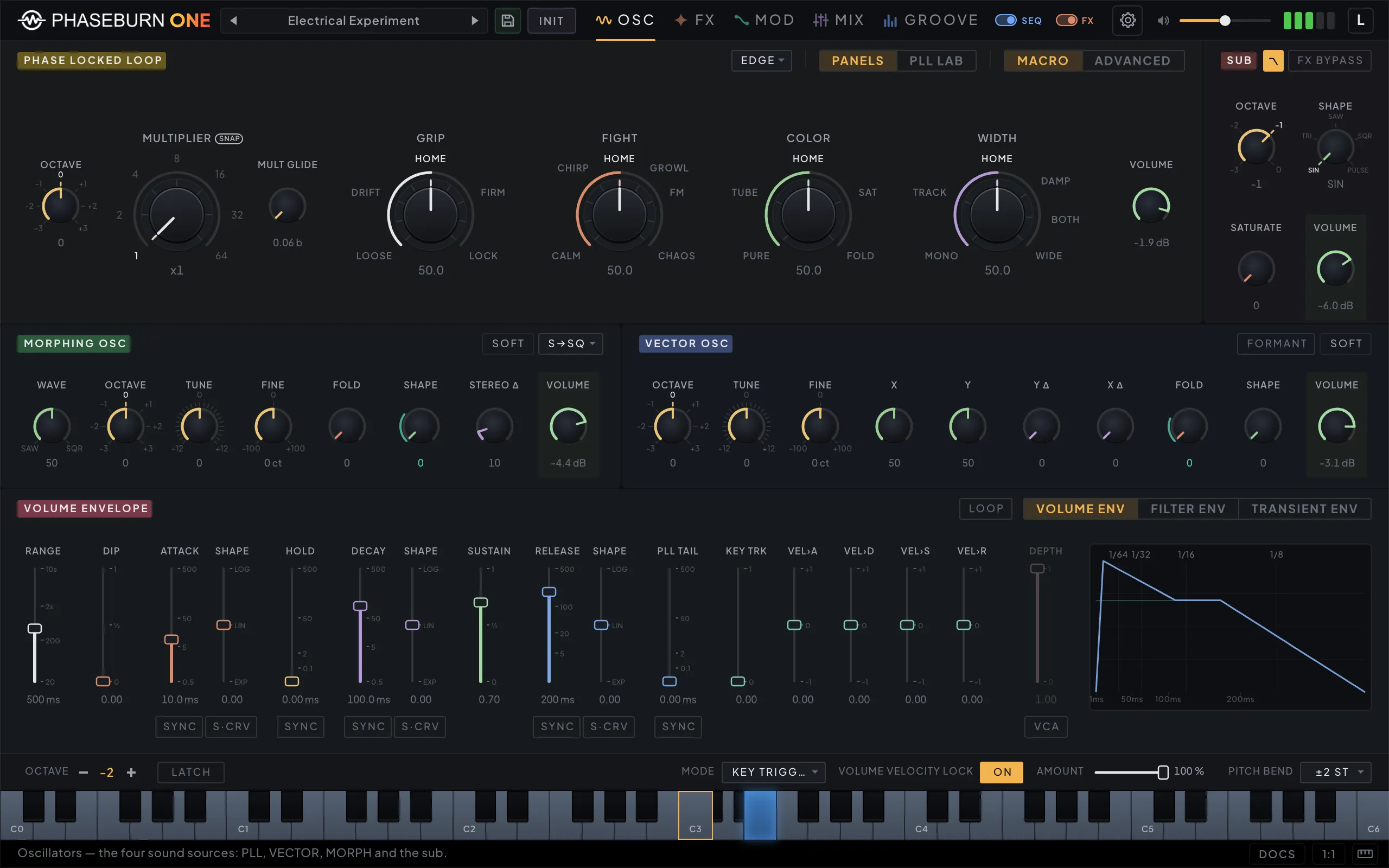
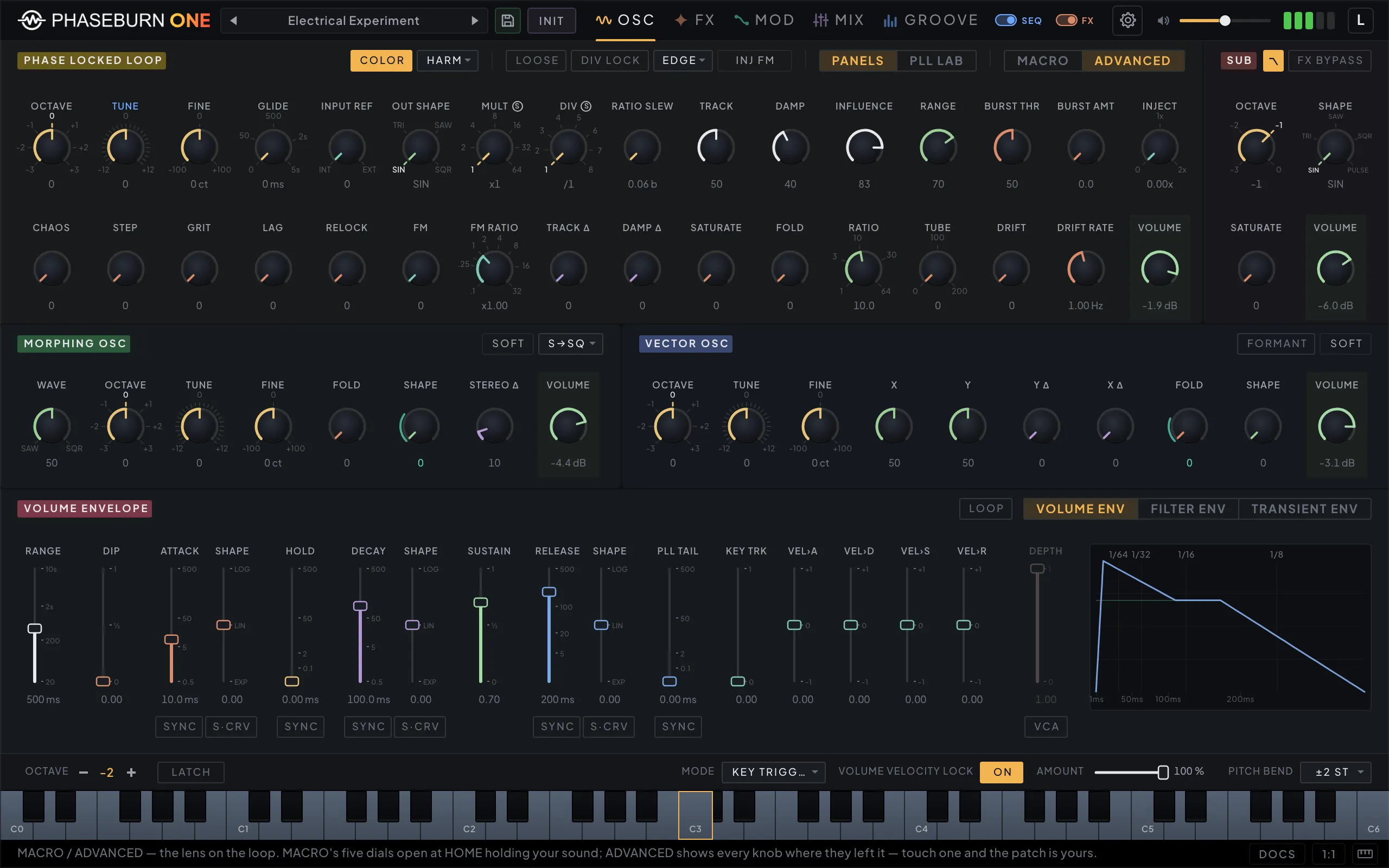
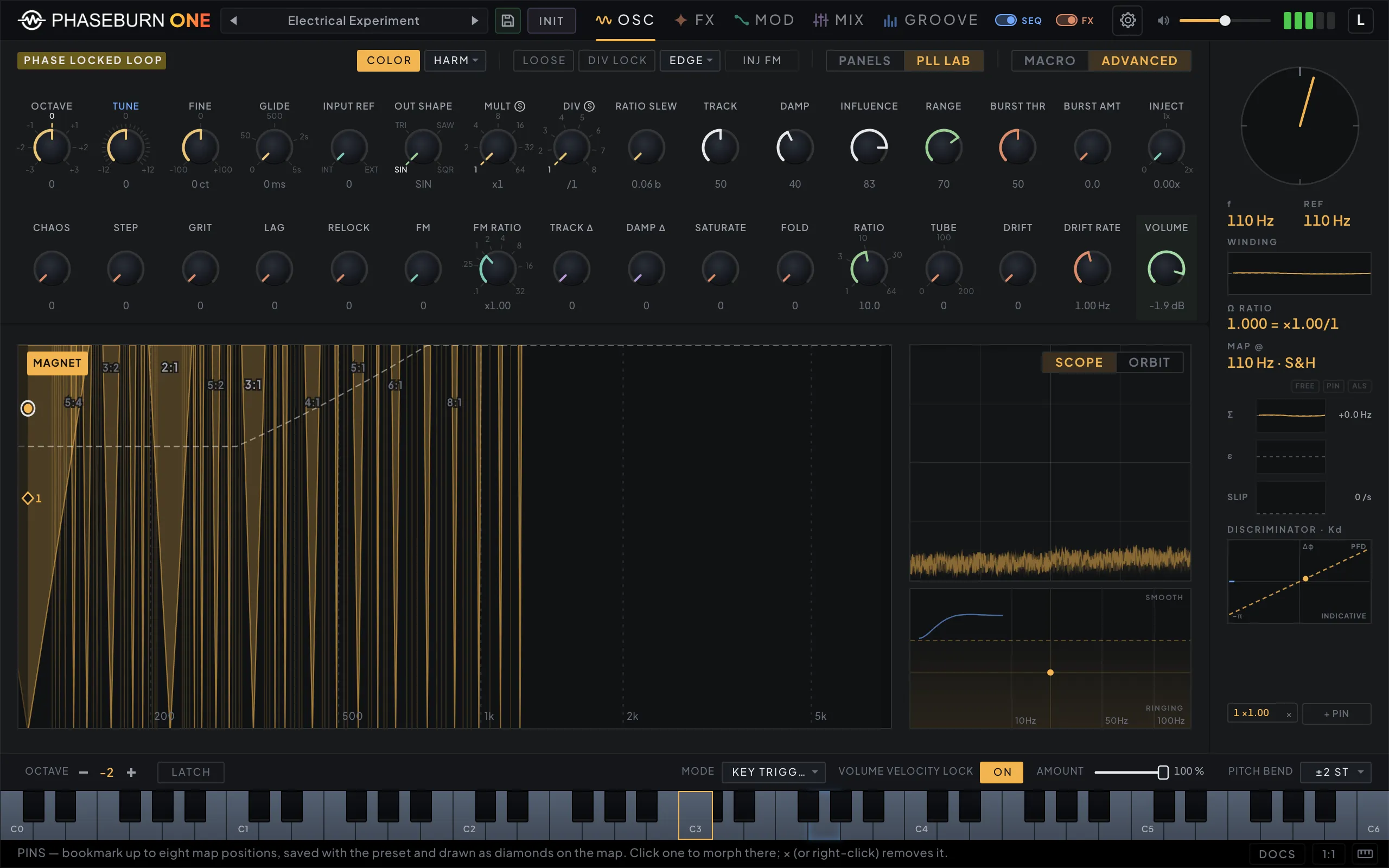
Phaseburn One oscillators page: Phase-Locked Loop, MORPH and Vector Phase Shaping panels with color-coded knobs
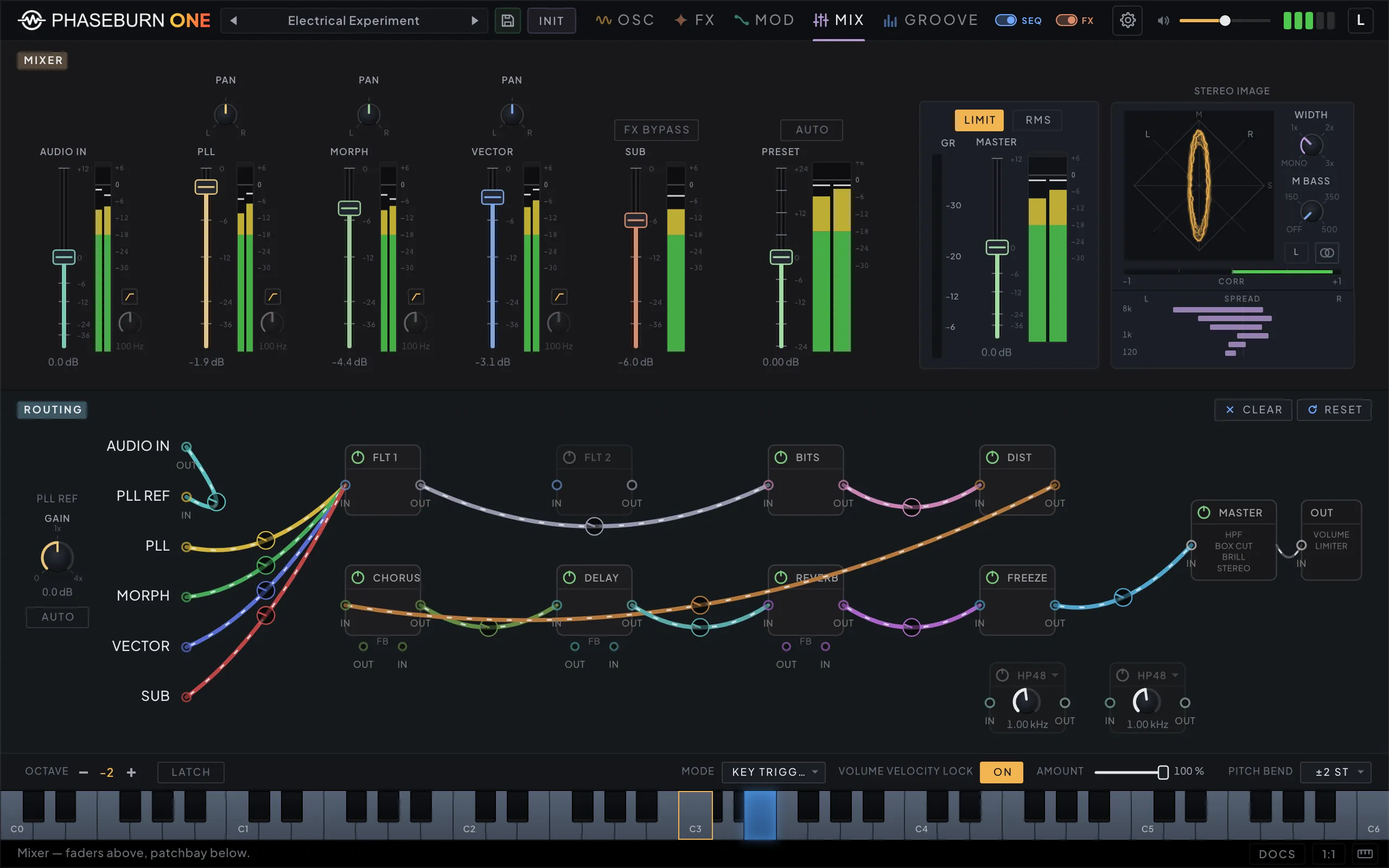
Phaseburn One mixer page: per-module channel faders, a goniometer stereo-image scope, and a routing patchbay where modules are connected by patch cables
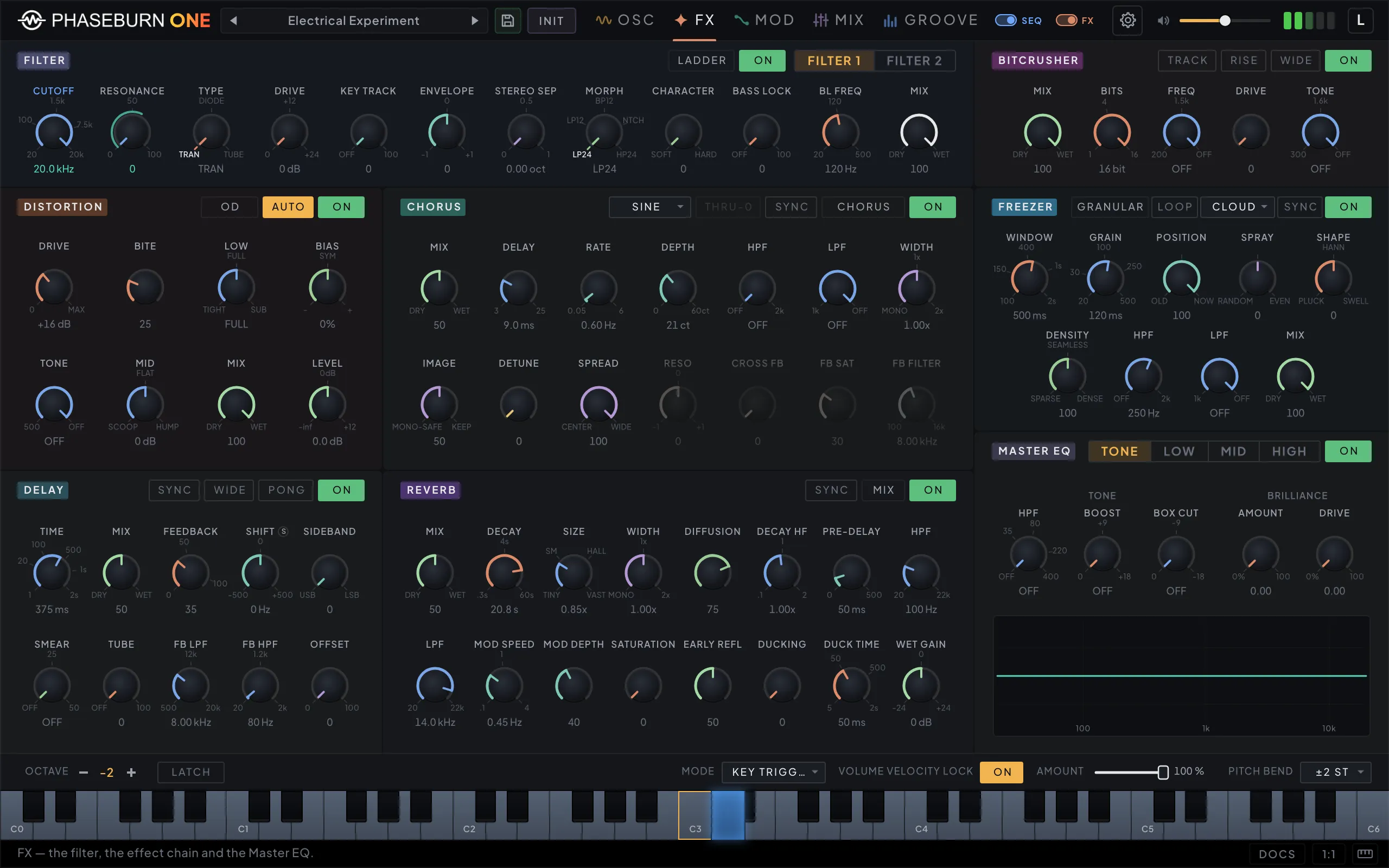
Phaseburn One FX page: filter, chorus, delay, reverb, distortion, bitcrusher and granular freezer sections
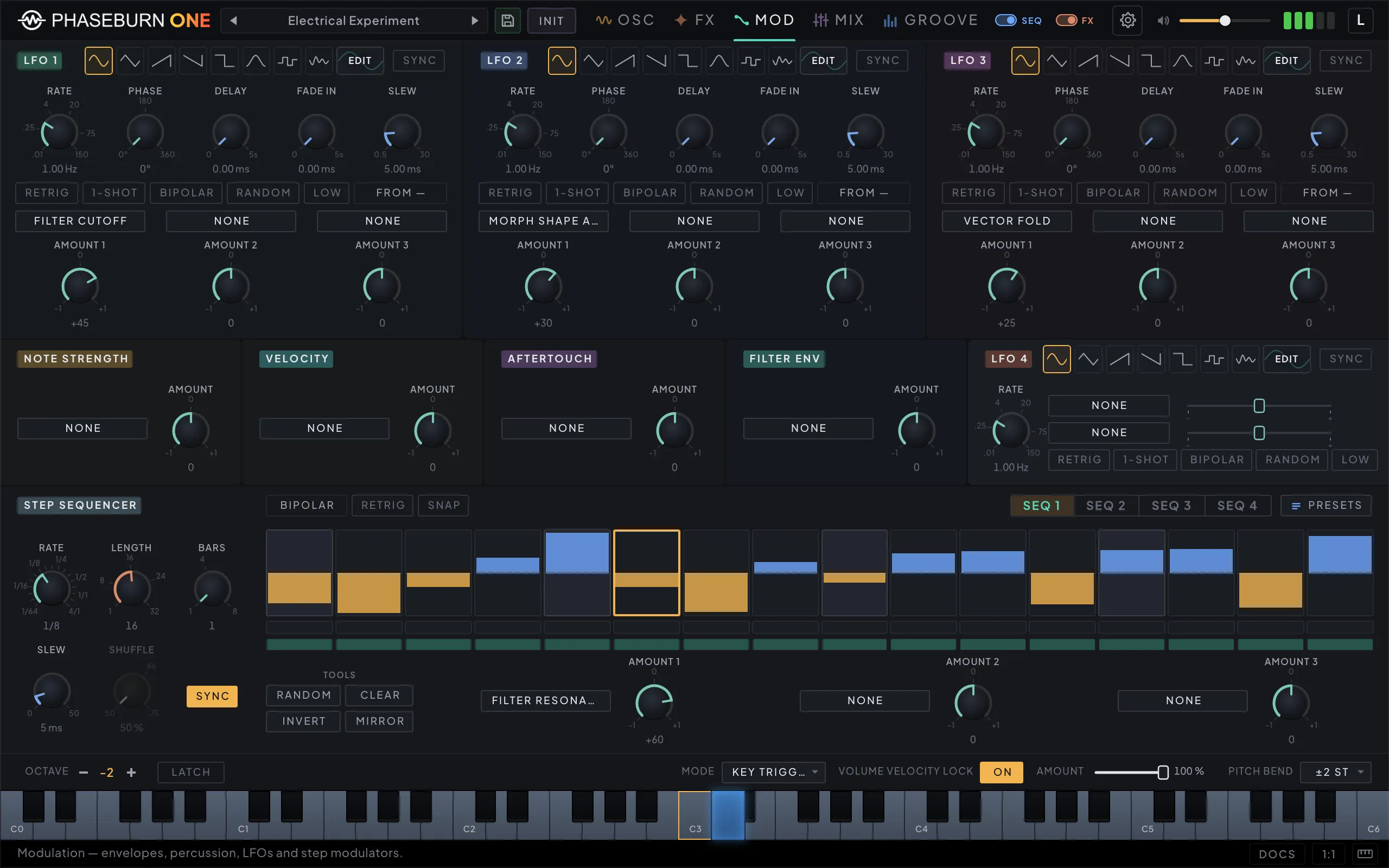
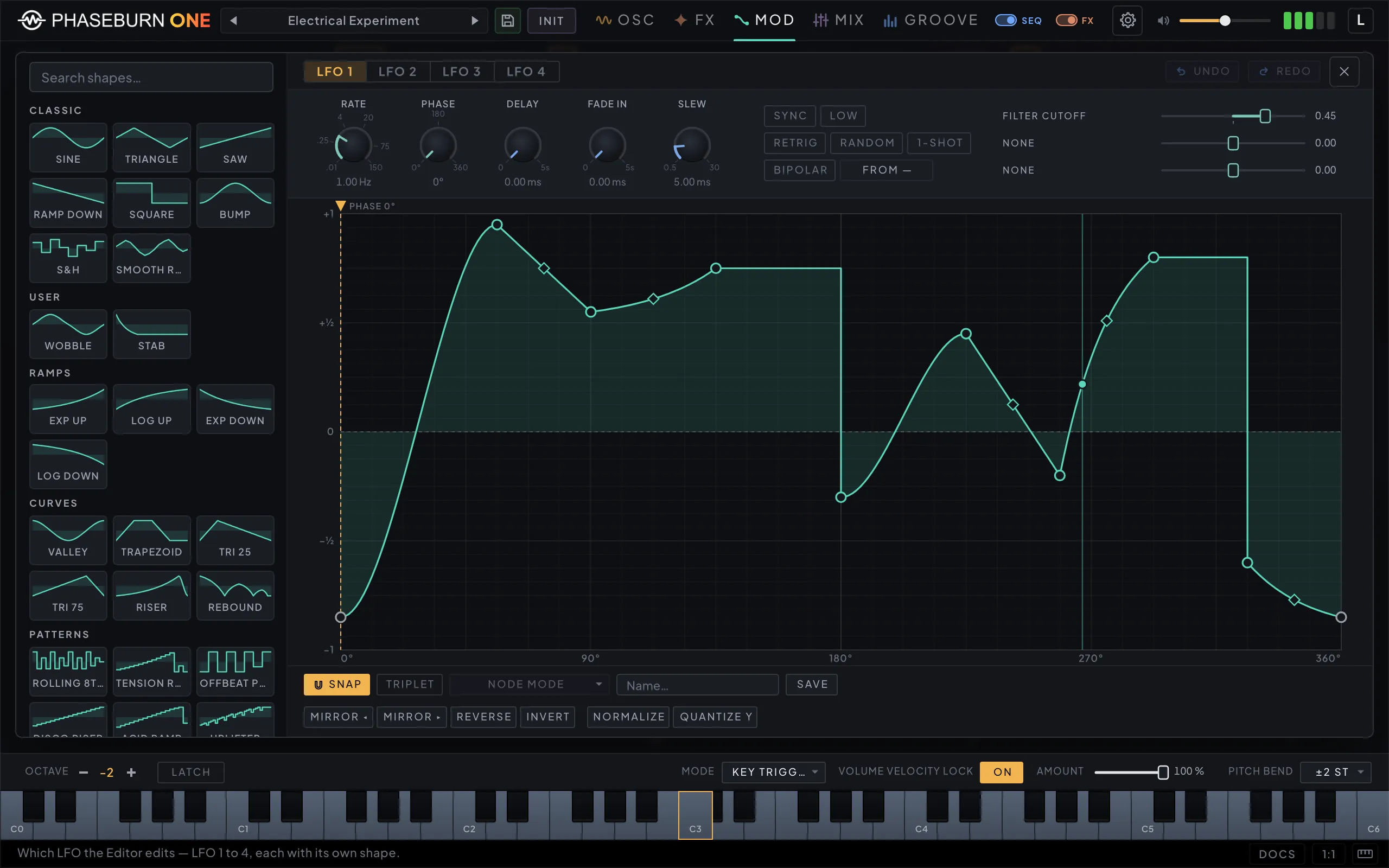
Phaseburn One modulation page: three routable LFOs, note strength, velocity and aftertouch modules, and a bipolar step sequencer
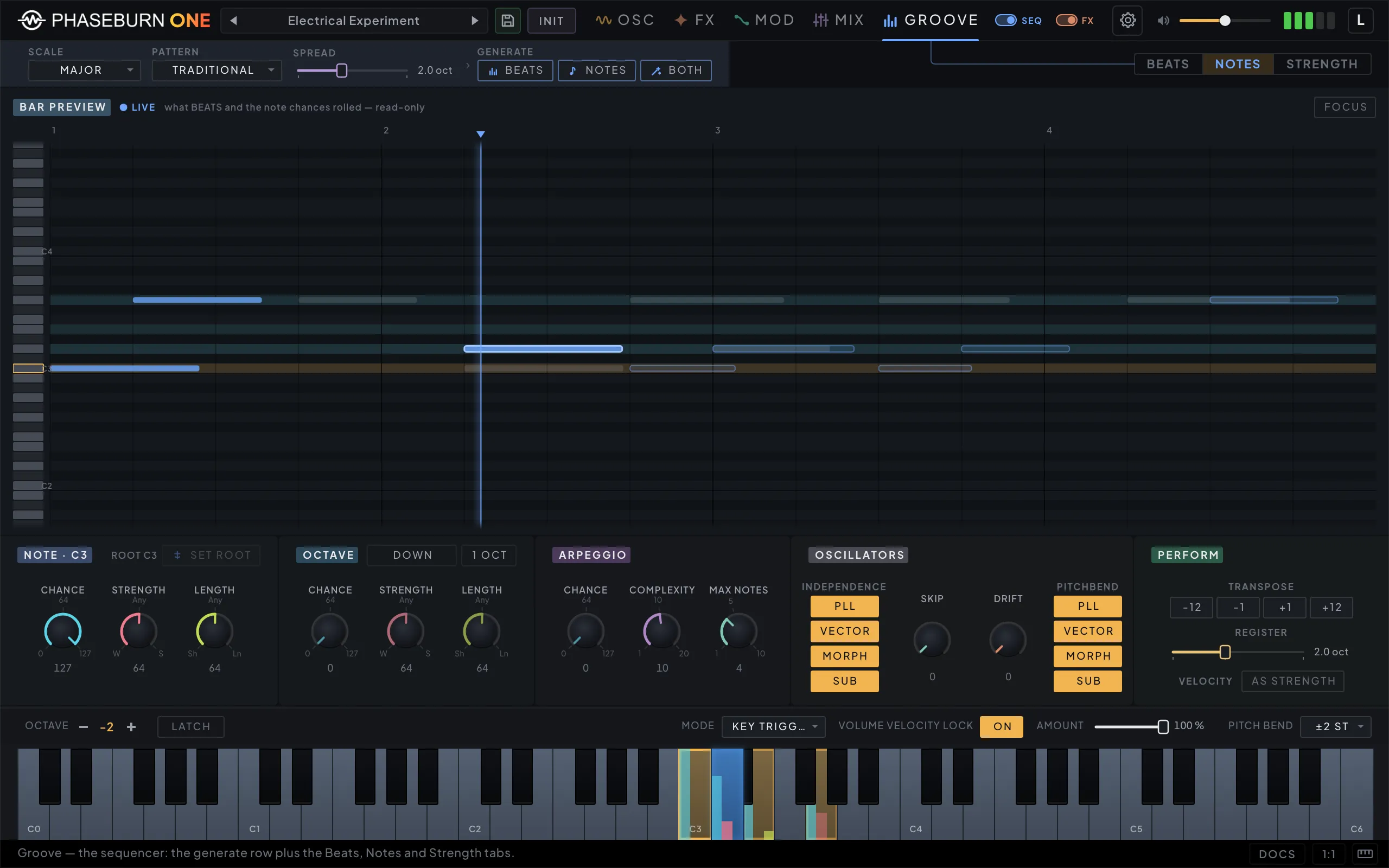
Phaseburn One Groove page, Notes tab: live bar preview above a keyboard note pool with chance, strength and length controls
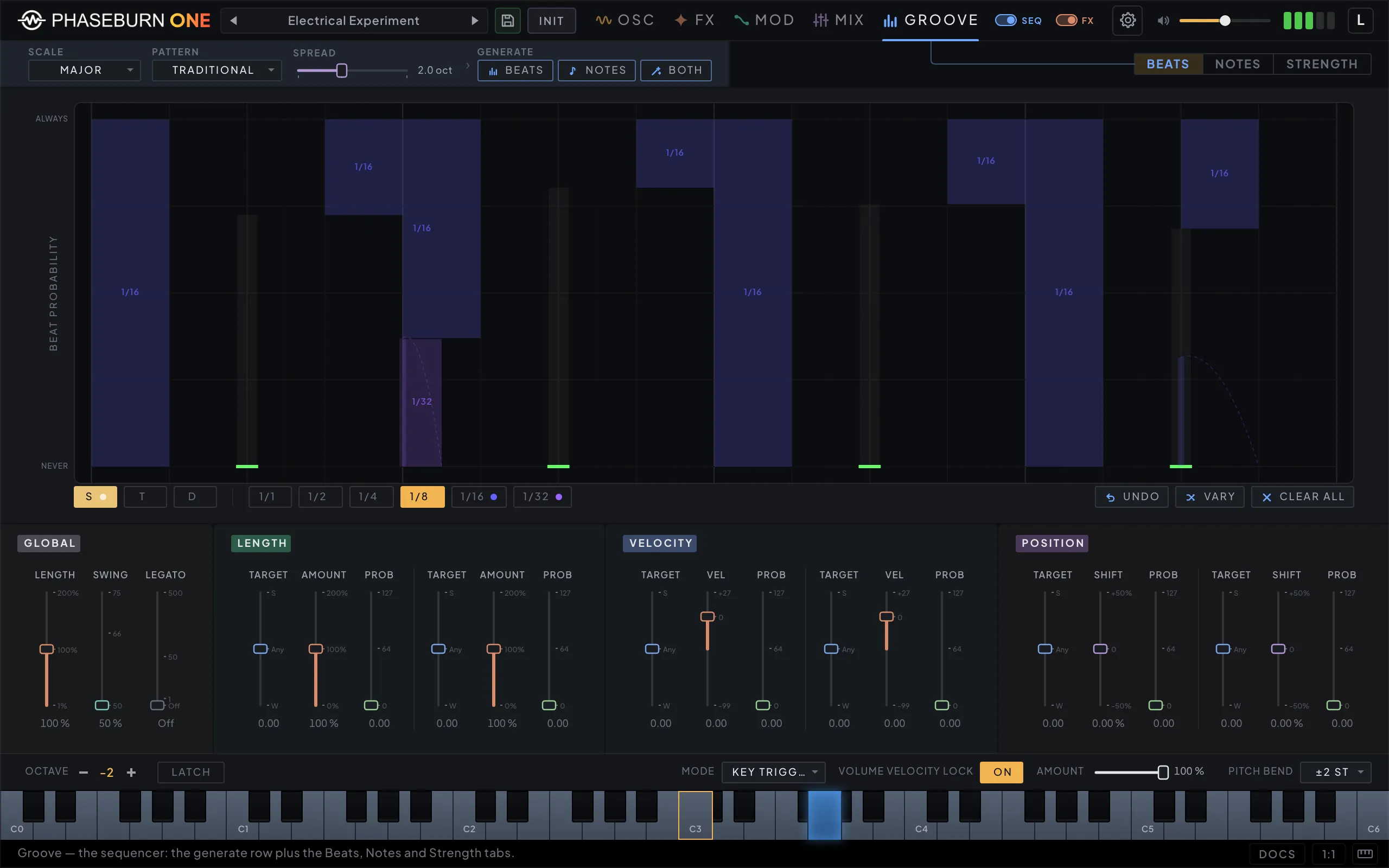
Phaseburn One Groove page, Beats tab: per-slot probability bars with swing, length, velocity and position groove tools
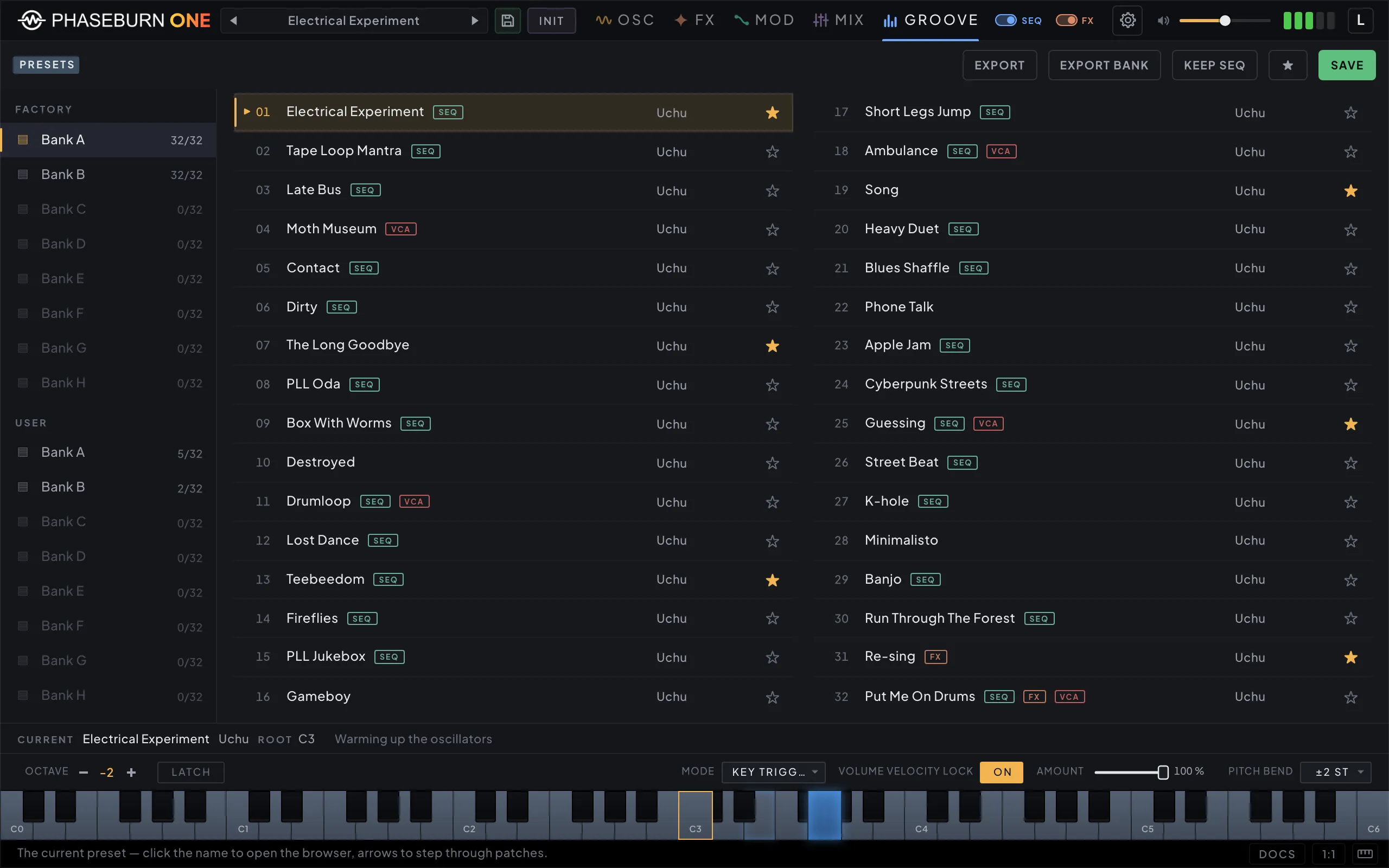
Phaseburn One preset browser: factory and user banks with favorites and sequence tags
Oscillators Phase-Locked Loop, Vector Phase Shaping and MORPH, side by side
Mixer & patchbay Per-module faders with a live stereo scope, modules wired as patch cables below
FX Filter, chorus, delay, reverb, distortion, bitcrusher, freezer — each with its own input
Modulation Three LFOs, note modulators, and a step sequencer with per-step probability
Groove · Notes Scale-aware note pool with per-note probability — and a live preview of every rolled bar
Groove · Beats Beat slots carry chances, not fixed steps — every bar is a fresh draw
Presets Factory and user banks — favorites, sequence tags, import and export down to whole banks
1 / 7
Sound sources

Four oscillators, one voice

All four run into a single monophonic voice — that focus is what buys the loop mathematics, the double-precision path and the oversampling. And the voice is true stereo: left and right are generated independently — divergent loops, per-side phase shaping, per-channel unison — so width comes from the source, not from a widener bolted on at the end. Full parameter names below are the actual panel controls.

Phase-Locked Loop

The signature voice

A phase-locked loop is a control circuit from radio engineering: an oscillator listens to a reference, measures how far its phase has drifted, and constantly corrects itself. Phaseburn One turns that whole feedback dance into its main voice.

TRACK sets how fast the oscillator chases, DAMP how hard the correction brakes, INFLUENCE how much the reference pulls. Keep the loop tight and it locks — solid, weighty pitch with analog character. Loosen it and the chase itself becomes audible: gliding approach, ringing overshoot, sirens and growls. Push further with BURST and INJECT and it tips into controlled chaos that stays playable, because the loop always wants to come home.

Four phase detectors change the character of the chase — a smooth analog comparator, a hard edge-triggered PFD, a harmonic-locking XOR and a stepped sample-and-hold. MULT and DIV set the tracked ratio — fifths and undertones, not just octaves, and either knob will sweep every ratio in between once you switch its snap off — a three-way color stage adds harmonics, saturation or keytracked fold-back, and a four-knob loop lab bends the servo itself. And PLL REF points the loop at a different reference altogether: another oscillator, or audio from your host.

And because a loop this deep deserves a map: the PLL Lab charts the whole territory. A lock map — drawn from loop theory calibrated against the actual engine, at your patch and your note — shows where the loop locks (labeled with its musical ratio), where it slips into slow sideband beating — the sweet-spot band — and what you can actually hear. The map is a control surface: drag the operating point, snap to ratios like 3:2, ride a tongue boundary, roll the dice inside a region you like — while a strobe wheel spins at the loop's real slip rate, a phase-portrait scope traces its orbit, and one press of MEASURE overlays a genuine probe of your exact settings on the drawn guide.

  • TRACK
  • DAMP
  • INFLUENCE
  • CHAOS
  • RANGE
  • MULT ×1–64
  • DIV ÷1–8
  • INPUT REF (INT/EXT)
  • BURST THR · AMT
  • INJECT
  • STEP · GRIT
  • LAG · RELOCK
  • FM · RATIO
  • COLOR HARM/SAT/FOLD
  • SATURATE · TUBE
  • DRIFT · RATE
  • PLL LAB

Vector Phase Shaping

The sculptor

The VECTOR oscillator bends the phase of a waveform around a movable inflection point — two coordinates, X and Y, sweep one cycle from smooth and flute-like to bright and biting without ever swapping waveforms. It builds on vector phase shaping, a published synthesis method (Kleimola, Lazzarini, Timoney & Välimäki, 2011), implemented here in double precision.

A FORMANT mode places the energy on vowel-like peaks, and separate left/right offsets (X∆ / Y∆) run the two channels at the same pitch but diverging shapes — width that comes from the waveform itself, not from a chorus.

  • X · Y
  • X∆ · Y∆ stereo
  • FORMANT mode
  • FOLD
  • SHAPE
  • PI mode

MORPH (12 modes)

The palette

One slider, twelve waveform families: classic shapes, a 7-voice detuned unison saw stack, hard-sync sweeps, additive build-ups to 64 harmonics, staircase shapes, true vowel synthesis (A · E · I · O · U) from a runtime source-filter engine, and a spectral wavetable — swept continuously with click-free, equal-power crossfades between modes.

The band-limited modes (additive, the spectral wavetable) stay clean at any pitch; FOLD and SHAPE push the rest from polite to snarling.

  • WAVE
  • FOLD
  • SHAPE
  • STEREO ∆
  • FINE
  • PI mode

Sub

The foundation

A dedicated sub oscillator below everything else: −3 to 0 octaves, continuously shaped from sine through triangle, saw and square to a narrowing pulse, with its own saturation. Its FX BYPASS switch routes the raw sub around the tone-shaping chain entirely, so the low end stays untouched no matter how hard the rest of the patch is driven.

  • OCTAVE −3…0
  • SHAPE sin→pulse
  • SATURATE
  • FX BYPASS
Movement

Around 100 things to move

Modulation is source-centric: pick a source, aim it at a handful of destinations, layer sources for complexity. Roughly one hundred targets across the whole instrument.

3 LFOs

Sample-accurate, free or synced — and they can modulate each other, so two slow LFOs braid into drift no single shape produces.

2 mod sequencers

Step-sequenced modulation lanes that run beside the note sequencer — stepped filter rides, rhythmic pans, evolving morphs.

Aftertouch & velocity

First-class sources, not afterthoughts: press into a pad to open the loop’s influence, strike harder to push drive.

Envelopes

Volume and filter envelopes with per-stage curve shaping, sync, loop mode and a dedicated percussion mode.

Destination groups
  • Oscillators
  • Envelopes
  • Filter
  • Percussion
  • Every FX
  • Mixer
Probability sequencer

How the dice actually roll

Not a step grid with a random switch — a weighted lottery over one bar, engineered so the result stays musical. Rules you can read, dice you load yourself.

  • 01

    You set chances, not steps

    Every one of 152 slots carries a probability. 100% is a step; 30% is a maybe; the space between is where grooves live.

  • 02

    Three grids share one bar

    Straight, triplet and dotted timing run at the same time in the same bar — polyrhythm without switching patterns.

  • 03

    Beats compete for the bar

    Overlapping slots draw from a shared 127-point budget: when one fires, it occupies its length and quiets the rivals. Randomness with musical manners.

  • 04

    Links build figures

    Beat links chain slots into forced follow-ups — ratchets, fills and legato slides that ride along when their anchor fires.

  • 05

    Every bar is a fresh roll

    The pattern re-rolls each cycle, phase-locked to your DAW — the groove breathes instead of looping, and anchors keep it recognizably the same take.

Routing

A patchbay, four rules

Oscillators, audio from your host, the filter and every effect are nodes. Draw gain-scaled cables between any output and any input — series, parallel, or effects nested inside feedback loops.

PLL SUB MORPH VECTOR MIX FILTER CHORUS COMP BITS DELAY REVERB MASTER FX OUT
  • 01

    Inputs sum

    Send any number of cables into one input — they mix, each with its own gain.

  • 02

    Outputs fan out

    One output can feed the filter, a delay and the master at once.

  • 03

    Feedback runs through taps

    Delay, chorus and reverb expose feedback jacks — patch other effects inside the loop; dedicated taps mean it can never stall the engine.

  • 04

    Rebuilt every block

    The graph re-schedules itself on the audio thread with no locks and no allocations — repatch while it plays.

Filter, FX & master

A rack, not an afterthought

Every effect has its own input selector — feed it from the mix, from one oscillator, or from another effect. The rack is part of the instrument, not a garnish.

Filter

Multimode, morphing continuously from low-pass through band-pass to high-pass, with drive, key tracking and its own envelope amount. Zero-delay-feedback core; self-oscillates cleanly.

  • CUTOFF
  • RESONANCE
  • DRIVE
  • KEY TRACK
  • ENVELOPE
  • MORPH LP→HP
  • CHARACTER
  • STEREO SEP
  • SLEW

Delay

A delay with a frequency shifter in the loop: every repeat slides in pitch by a fixed number of hertz — inharmonic tails, barber-pole echoes, metallic clouds. Sideband and smear reshape the shift; tube stage warms the loop.

  • TIME · SYNC
  • FEEDBACK
  • FREQ SHIFT ±
  • SIDEBAND
  • SMEAR
  • TUBE
  • FB LPF · HPF
  • DUAL · WIDE · PONG

Reverb

A feedback-delay-network reverb with modulated tails, ducking that rides the dry signal, and a wet-gain stage that can push the room right to the front.

  • DECAY
  • SIZE
  • WIDTH
  • DIFFUSION
  • DECAY HF
  • PRE-DELAY
  • MOD SPEED · DEPTH
  • DUCKING
  • WET GAIN

Chorus

A four-mode engine — chorus, flanger, ensemble, vibe — with up to eight voices, independent stereo offsets, cross-feedback and filters inside the feedback path: from subtle width to seasick pitch soup.

  • DELAY
  • RATE
  • DEPTH
  • STEREO OFF
  • SPREAD
  • DETUNE
  • FEEDBACK
  • CROSS FB
  • FB FILTER

Distortion

Four archetypes on one cascade — singing overdrive, hard distortion, broken fuzz and scooped high gain — with an envelope-driven mid BITE that keeps accents legible and a clean-sub crossover. Drive is calibrated to change tone, not level.

  • OPTO / FET / LOOP
  • AUTO
  • PEAK RED
  • TILT
  • DRIVE
  • MIX
  • GAIN

Bitcrusher

Bit depth and rate reduction with drive — from vintage-sampler dust to full collapse.

  • BITS
  • FREQ
  • DRIVE
  • MIX

Freezer

A granular freeze that catches a moment and holds it: press FREEZE and a slice of what just played loops back as a seamless sustained pad. Scrub through the capture, resize the grain, play it backwards, or scatter it into a stereo cloud.

  • FREEZE
  • WINDOW
  • GRAIN
  • POSITION
  • MIX
  • SMOOTH · REVERSE · CLOUD

Master

The final stage: a brilliance exciter for air, stereo width with a mono-bass anchor, corrective cuts, and a true-peak limiter that catches inter-sample overs.

  • BRILLIANCE
  • STEREO WIDTH
  • MONO BASS
  • BOX CUT
  • HIGH-PASS
  • TRUE-PEAK LIMITER
Engineering

Built like a measuring instrument

One monophonic voice is a budget decision: every cycle saved on polyphony is spent on precision.

PLL · IDLE 48 kHz · 64-bit
Signal path
64-bit floating point through the core DSP — oscillators, envelopes, filters
Stereo
True stereo — left and right generated independently at the oscillators; width from the source, chorus as a choice rather than a crutch
Oversampling
Built-in on the stages that need it
Filters
Zero-delay-feedback, after published topologies — self-oscillate cleanly
Anti-aliasing
Band-limited modes plus antiderivative anti-aliasing on the brightest stage — strong alias suppression throughout
Output
True-peak limiter — catches inter-sample overs
Audio thread
Lock-free; the patch graph is rebuilt every block with zero allocations
Written in
Native Rust — no garbage collector between you and the sound
Specifications

Runs where you work

Phaseburn One system specifications for macOS and Windows
Specification macOS Windows
Formats VST3 · CLAP VST3 · CLAP
Architecture Apple Silicon & Intel x86-64
OS macOS 11+ Windows 10 / 11
Engine Native Rust DSP Native Rust DSP
Audio I/O Stereo in + sidechain · stereo out Stereo in + sidechain · stereo out

Any host that loads VST3 or CLAP should work — the installers offer both formats, pre-selected, and put what you keep in the standard system folders.

Releases

Every build, logged

Phaseburn One moves fast in early access. Each build lands on the changelog, and beta testers get an email with the download link the day it ships.

v0.1.0 Open beta

First public beta

The first public build of Phaseburn One — one build for everyone, with a DRM-free, perpetual license you own. This is early access: the synth moves fast from here, and beta feedback steers what ships next.

  • Three engines — Phase-Locked Loop (PLL), VECTOR and MORPH — plus a sub oscillator
  • Modular patchbay: series, parallel and feedback routing between modules
  • Probability sequencer with the Suggest groove generator
  • FX rack and master section
Questions

Answered before you ask

The four we hear most. The full list covers licensing, updates and the beta in detail.

Is it really monophonic?

Yes — monophonic by design, not as a cutback. One voice means the entire DSP budget serves the note you’re playing: the Phase-Locked Loop tracking in real time, oversampled engines, zero-delay filters. That’s what keeps the low end solid and the character consistent. Basses, leads, acid lines, drones, percussion — the places a mono synth earns its keep.

What formats and platforms does it run on?

VST3 · CLAP · macOS · Windows. The specs table above lists architectures and OS versions.

What does the beta include — and how long is it free?

The beta is free and open — no card required. The build is free to use until October 15, 2026, then keeps working as a demo until you register a perpetual, DRM-free license (which you can do any time). Ten beta users we pick get the full license free, and shipping at least one of your presets in the factory bank earns you at least a solid discount — all at our discretion.

Perks and preset picks are at our discretion — the beta comes with no guarantees.

How much will it cost at launch?

€149, one time — a perpetual license, VAT included for EU customers. Sales open October 15, 2026; the beta is free until then.

Open beta

Play it before it costs anything

Free and open — no card required. It’s free to use until October 15, 2026, then keeps working as a demo until you register a perpetual, DRM-free license (any time); ten beta users we pick get the full license free, and submitted presets can ship in the factory bank, credited to their authors.

Free €149 one-time at launch

Join the beta → Read the FAQ

Perks and preset picks are at our discretion — the beta comes with no guarantees