
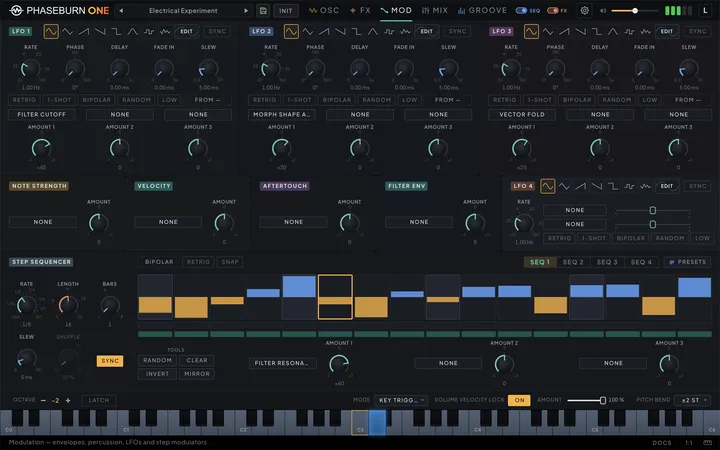
Phaseburn One runs one voice by design, and modulation is what keeps that voice alive. This chapter collects every mover in the engine: the volume envelope that shapes every note and the transient engine that sharpens its first milliseconds — both in the envelope panel on the Oscillators tab, whose VOLUME ENV / FILTER ENV / TRANSIENT ENV tab strip also holds the filter envelope — the four LFOs and four step modulators on the Modulation tab, which can reach most of the instrument, and the velocity, aftertouch and note-strength routes that make playing dynamics count. Filter cutoff has its own dedicated envelope — that one is covered with the filter in the filter chapter (Chapter 3 — The Filter).
Think in sources, not targets
Decide what should move, then give the movement a shape. Phaseburn One’s modulation is source-centric: you do not open a giant routing matrix under a knob — you go to a source (an LFO, a step modulator or aftertouch), and give it destinations. Each LFO and each step modulator carries three routing slots, and aftertouch brings three more, so a patch can run past two dozen routes at once. Every slot is a pair: a destination picked from one list shared by all sources, and a bipolar amount — positive pushes the target up as the source rises, negative inverts the movement, and small values matter more than you expect on sensitive targets. Every route is visible from the other side too: the target control draws a modulation ring showing the live range, whichever source — an LFO, a step modulator, aftertouch, velocity, the note-strength route or the filter envelope — is pushing it.
That shared list covers more than a hundred destinations, and the browser presents it the way the panels do: groups in page order, and each group’s entries in the order its knobs sit on the panel — finding a destination is the same gesture as finding its knob. Above the groups it offers the last four controls you touched, newest first, so routing to a knob you just moved needs no search at all. The Phase-Locked Loop (PLL) oscillator exposes its output shape, the multiplier and the divider — each in a stepped and a continuous form — the input-reference blend, its loop controls — track speed, damping and influence — the burst threshold and amount, injection, the chaos drive, the four loop-lab controls (step, grit, lag and relock), FM depth and ratio, and the color stage and its fold ratio. The VECTOR oscillator exposes its X and Y shaping pair, fold and stereo offsets. The MORPH oscillator exposes its morph amount, fold, shape and stereo detune. Each of the three pitched sources also exposes its mixer pan, so a route can place a source off-centre or swing it across the stereo field. Beyond the oscillators (all introduced in the oscillators chapter (Chapter 2 — Oscillators)) the list reaches both filters — cutoff and resonance through STEREO SEP to each one’s dry/wet mix — the coloration stages, the delay, the reverb (mix, early-reflection level and wet gain), the chorus, the distortion, the BitCrusher, the freezer (loop, reset, window, grain, position, density, spray, shape and mix), the Master EQ’s three bands — frequency, resonance and gain for each of LOW, MID and HIGH, so a tone move can ride a phrase at the very end of the chain — and a MIXER group holding the master’s stereo width. And, unusually, the modulators themselves: every volume envelope stage time, shape, sustain and even three of the velocity routes are destinations, so one source can reshape how another behaves.
That last idea runs all the way through. Every route’s own AMOUNT is a destination, and so is each LFO’s RATE — grouped as LFO DEPTH & RATE, STEP SEQ DEPTH and PLAYING DEPTH at the end of the list. Aim a slow LFO at another LFO’s amount and its wobble breathes in and out instead of running flat; aim one at a step lane’s amount and the lane fades up over a phrase; aim a step lane at an LFO’s rate and the speed jumps in time with the pattern. Aftertouch’s three amounts, the filter-envelope route’s amount and the note-strength route’s amount are there too, so how hard you play can decide how much anything else moves. A depth offset adds to the knob and clamps at its own ends, exactly as a hand would, and a source may sensibly aim at its own amount — the value it reads is the bus as the previous block left it, one block behind, which is far under any of the smoothing downstream. The freezer’s LOOP and RESET are button-style destinations that fire on any positive value, so a bipolar LFO or step lane gates them on its positive half rather than having to cross a midpoint.
When several sources land on the same destination their contributions sum. Amount changes are smoothed, so riding a depth mid-performance never steps audibly; the destination selector itself switches instantly, so pull the amount toward zero first when you re-route a running patch. Coming the other way, right-clicking the target control and choosing Unlink modulation clears every route aimed at it in one gesture — the amounts stay put, so picking a destination again restores the depth that route had. The practical method: build the static patch first, then add one source at a time and give it one clear job — an LFO breathing the filter, a step lane accenting the PLL multiplier, the envelope holding the whole thing together. Because the instrument is a single voice, every route you add changes the one sound you are hearing, which makes cause and effect easy to keep track of — and easy to push much further than a polyphonic patch would tolerate.
The volume envelope

Shape how every note starts, carries and lets go. The volume envelope runs five stages — attack, hold, decay, sustain, release — and attack, decay and release each have their own curve control: at zero the segment is a straight line, negative values bend it into a fast-start logarithmic curve, positive values into a slow-start exponential one. Each of the three also has an S-curve switch that turns the bend into a symmetric ease-in, ease-out shape — the positive half of the shape slider then sets how pronounced the S is, while negative values fall back to a straight line in this mode. Hold sits between attack and decay and keeps the envelope pinned at full level for a moment, which fattens sustained transients without touching the decay itself.
Every timed stage can sync to the host tempo. Flip a stage’s sync switch and its time is derived from a musical division instead of milliseconds, each stage with its own division selector — a release that is always exactly one beat long survives any tempo change. The PLL tail carries the same switch, so a ring-out can be locked to the grid rather than set in milliseconds. The ONE/LOOP button turns the one-shot envelope into a cycling one: while a note is held, attack, hold and decay repeat, which reads as tremolo at short settings and slow rhythmic swells at long ones. The VCA switch beneath the slider decides who owns the voice’s loudness. Unlit — where every instrument patch sits — the volume envelope owns it outright, and the Depth slider is greyed out because nothing is reading it. Lit, the slider hands you the floor: Depth blends between the enveloped signal and a constant level, so pulling it down loosens the envelope’s grip until, at 0, the VCA is simply open and the sound ignores note shape entirely. Switching VCA on from a full-depth slider drops Depth to 0 for you, because full depth is the sound you just switched away from; a slider parked anywhere else is left where you put it, so you can flick the switch to A/B a floor you are dialling in.
A drone needs a pitch before it can sound, and it waits for one. With VCA lit and Depth below 100 %, the voice stays silent after a preset loads until a note names a frequency, whether that comes from your keyboard, the host, or the instrument’s own sequencer. Without that it would start droning the moment the patch landed, on whatever pitch the previous preset happened to leave behind, which is nobody’s choice. Once a note has arrived the drone behaves as it reads: releasing the key leaves it sounding, because that is what a constant level means. The envelopes themselves keep running underneath — the filter envelope still articulates every note, so a drone can move even while its level does not.
Key track shortens the envelope as you play higher and lengthens it lower down, the way acoustic instruments behave.
Because there is one voice, fast lines retrigger the same envelope constantly, and the retrigger behavior is tuned for that: a new note starts its attack from the current level rather than snapping to silence, so runs stay smooth. When you want audible re-articulation instead, raise the retrigger dip — whenever the sequencer retriggers a note while the previous one is still sounding, held or still releasing, it ducks the level before the new attack for a plucked, percussive restatement. Depth buys time as well as depth: at low settings the notch is a brief softening of the retrigger, and as you push it the fall lengthens and then holds at the bottom, so the top of the control is a real gap in the sound — a re-articulation of the note rather than a smoothing of it. A retrigger arriving while a dip is still running keeps the dip in progress instead of ducking again, so fast rolls cannot ratchet the voice down toward silence. The dip acts on sequenced lines only; notes played live over MIDI always take the smooth path. Oscillator phases reset only when a note starts from silence; while the previous note is still sounding, a retrigger leaves the oscillators running, which is part of what keeps fast runs smooth. With legato phrasing, overlapping notes glide without retriggering at all.
The range control — the first slider in the row — is a pure editing zoom: it sets how far the time sliders reach, nothing more. It never changes the sound, and the envelope preview always draws the actual stage times.
| Parameter | Range | Default | What it does |
|---|---|---|---|
| Vol Attack | 0.5 – 5000.0 | 4.0 | Time to rise from silence to full level after note-on — short snaps, long swells. |
| Vol Attack Shape | -100 % – +100 % | 0 % | Bends the attack curve: negative is logarithmic (fast start), 0 linear, positive exponential (slow start). |
| Vol Decay | 0.5 – 10000.0 | 0.5 | Time to fall from peak to the sustain level once attack (and hold) complete. |
| Vol Decay Shape | -100 % – +100 % | 0 % | Bends the decay curve: negative logarithmic, 0 linear, positive exponential. |
| Vol Sustain | 0 % – 100 % | 100 % | Level the envelope holds for as long as the note is held. |
| Vol Release | 3.0 – 10000.0 | 15.0 | Time to fade to silence after note-off; 3 ms is the floor, held even when modulation pushes the time lower. |
| Vol Release Shape | -100 % – +100 % | 0 % | Bends the release curve: negative logarithmic, 0 linear, positive exponential. |
| Vol Atk S | Off / On | Off | S-curve mode for attack — ease-in/ease-out halves; the shape slider then sets S intensity. |
| Vol Dec S | Off / On | Off | S-curve mode for decay — symmetric ease-in-out instead of a one-way curve. |
| Vol Rel S | Off / On | Off | S-curve mode for release — symmetric ease-in-out instead of a one-way curve. |
| Vol Hold | 0.0 – 5000.0 | 0.0 | Holds the envelope at peak between attack and decay — fatter sustained transients; skipped when near zero. |
| Vol Depth | 0 % – 100 % | 100 % | How much the envelope shapes loudness — 0 a constant drone, 1 full envelope control. Read only while VCA is on; below full it leaves a floor that waits for the first note. |
| Vol Loop Mode | One Shot · Loop | One Shot | OneShot plays the envelope once; LoopAHD repeats attack-hold-decay while the note is held. |
| Env Key Track | 0 % – 100 % | 0 % | Scales envelope times with pitch — higher notes get shorter envelopes, lower notes longer. |
| Vel→Attack | -100 % – +100 % | 0 % | Shifts attack time with velocity, up to a second either way; positive stretches it as you hit harder, negative makes hard hits snap. |
| Vel→Decay | -100 % – +100 % | 0 % | Shifts decay time with velocity, up to a second either way; positive stretches it as you hit harder, negative makes hard hits decay faster. |
| Vel→Sustain | -100 % – +100 % | 0 % | Velocity offset on sustain level: positive raises sustain for hard hits, lowers it for soft ones. |
| Vel→Release | -100 % – +100 % | 0 % | Shifts release time with velocity, up to a second either way; positive stretches it as you hit harder, negative makes hard hits release faster. |
| Vol Atk Sync | Off / On | Off | Locks attack time to the host tempo using the attack division. |
| Vol Attack Div | 1/1 … 1/128 (18 steps) | 1/8 | Musical division for the attack stage when tempo sync is on. |
| Vol Hold Sync | Off / On | Off | Locks hold time to the host tempo using the hold division. |
| Vol Hold Div | 1/1 … 1/128 (18 steps) | 1/8 | Musical division for the hold stage when tempo sync is on. |
| Vol Dec Sync | Off / On | Off | Locks decay time to the host tempo using the decay division. |
| Vol Decay Div | 1/1 … 1/128 (18 steps) | 1/8 | Musical division for the decay stage when tempo sync is on. |
| Vol Rel Sync | Off / On | Off | Locks release time to the host tempo using the release division. |
| Vol Release Div | 1/1 … 1/128 (18 steps) | 1/8 | Musical division for the release stage when tempo sync is on. |
| Retrigger Dip | 0 % – 100 % | 0 % | Dips the level before each sequencer re-attack for a plucked re-articulation; deeper also means longer, so the top of the range reads as a gap rather than a softening. |
| Env Range | 20 – 10000 | 2000 | Reserved legacy control — has no audible effect in current v0.3.0 builds. |
| VCA Mode | Off / On | Off | Hands the loudness floor to Vol DEPTH. Off, the volume envelope owns it; on, DEPTH is live and 0 holds the voice open for a re-pitched drone. Turning it on drops full DEPTH to 0. |
Transient engine

Turn the first few milliseconds of every note into a drum designer. The transient engine is a dedicated transient system that rides on top of the volume envelope, with three independent tools that fire together at the start of every hit and decay on their own clocks. Every non-legato hit fires: a note starting from silence additionally resets the VECTOR oscillator phase so repeated hits sound identical, while a retrigger over a still-ringing note keeps the oscillators running click-free and simply restarts the transient clocks. Only legato slurs skip the transient entirely.
Sweep is a pitch envelope in semitones. Positive values start the pitch above the note and drop onto it — the classic falling drum attack; negative values rise into the note from below. Time sets how long the settle takes, from a barely-there flick to long drawn-out drops, and curve reshapes the trajectory: negative straightens it into a linear glide that lands exactly on the note, zero is a natural exponential, positive holds the offset and then dives — the zap and laser end of the range. The slider gives half its throw to the musical ±24 st zone, with the extremes still reachable at the ends.
Click adds an onset strike in one of three characters: NOISE is a burst of bandpass-filtered noise, PING a single damped sine at the TONE frequency, and METAL an inharmonic three-partial strike for rim, cowbell and cymbal-adjacent colors. The click deliberately bypasses the volume envelope, running its own short decay, so it punches through even when the envelope attack is slow — the snap arrives first, the body follows. Tone places the strike from sub-thump up into bright cymbal territory, and TRACK tunes it to the played note — at zero the tone stays absolute, at full it rides the pitch line, so clicks stay proportioned across the keyboard. Width shapes character at constant loudness: narrow is a resonant ring, wide a dry thud (in PING and METAL it sets how long the strike rings), and the click has its own decay — short ticks up to snare-scale noise bodies — and curve controls. DIRECT is the click’s own exit: at zero the click rides the targeted oscillators through the filter and the FX chain, so it takes on the patch’s color; turned up it leaves those buses and joins after the master tone chain instead, at a level that no longer depends on which oscillators are targeted or how loud they are. The snap stays sharp under a dark low-pass or a wall of reverb — and still sounds when every targeted oscillator’s fader is down.
T.Fold is extra wavefolding that is strongest at the attack and decays into the clean tone, adding a harmonically dense bite to the first instant of a note. It applies to the VECTOR and MORPH oscillators only.
Trigger turns the voice into a drum voice proper. Lit, every note runs its volume and filter envelopes through their complete journey without needing the key held: attack, decay to the sustain level, then straight through the release to silence — and the note-off itself is ignored, so a long drum body finishes its fall no matter how short the gate that fired it. Unlit, a sequenced tom with a 300 ms decay and a half-step gate gets chopped at the gate’s end by the release stage; lit, the envelope’s own shape is the note’s whole life. Every stage keeps its meaning: SUSTAIN is the level where the decay hands over, RELEASE is the tail that carries the note out — set sustain to zero and the decay alone is the drum, classic AD style. Only LOOP sits out (a one-shot never loops). The contract latches per note, so flipping the switch never bends a note already sounding, and stopping the transport still cuts notes dead.
All three respond to the VEL control, which decides how much MIDI velocity scales their depth — at zero every hit lands full strength, at maximum soft notes barely trigger the transients. The four target switches choose which oscillators get processed, so the sub can stay round while VECTOR takes the fold; on notes that start from silence the VECTOR oscillator uses a fixed phase reset so every hit sounds identical. Reach for the transient engine when you are building kicks, snares, hats and zaps from the synth voice — but also when a bass or pluck patch needs attack definition that the envelope alone cannot give. Most of the transient controls are modulation destinations too — sweep amount, time and curve; click level, tone, decay and width; fold amount and decay — so an LFO or step lane can vary the drum from hit to hit.
| Parameter | Range | Default | What it does |
|---|---|---|---|
| Transient Enable | Off / On | Off | Turns the transient engine on, so the attack of every note is shaped here rather than left plain. |
| Transient PLL | 0 – 1 | 1 | Includes the PLL oscillator in transient processing. |
| Transient VECTOR | 0 – 1 | 1 | Includes the VECTOR oscillator in transient processing. |
| Transient MORPH | 0 – 1 | 1 | Includes the MORPH oscillator in transient processing. |
| Transient SUB | 0 – 1 | 1 | Includes the sub oscillator in transient processing. |
| Transient Sweep | -96.0 st – 96.0 st | 0.0 st | Pitch sweep depth in semitones: positive drops onto the note from above, negative rises from below. |
| Transient Sweep Time | 0.5 ms – 500.0 ms | 5.0 ms | How fast the pitch sweep settles onto the note — short flicks to long drawn-out drops. |
| Transient Sweep Curve | -100 % – +100 % | 0 % | Sweep shape: -1 a straight linear glide that lands exactly, 0 natural exponential, +1 holds then dives (zap). |
| Transient Click | 0 % – 100 % | 0 % | Level of the filtered noise burst at note start — it bypasses the envelope and lands even under slow attacks. |
| Transient Click Tone | 20.0 Hz – 16000.0 Hz | 1000.0 Hz | Center frequency of the click bandpass filter — sub-thump lows up to cymbal-bright ticks. |
| Transient Click Decay | 0.5 ms – 500.0 ms | 2.0 ms | How fast the click fades — very short ticks up to snare-scale noise bodies. |
| Transient Click Width | 0 % – 100 % | 50 % | Click character at constant loudness: 0 is a narrow resonant ring, 1 a wide dry thud; in PING/METAL it sets the ring length. |
| Transient Click Curve | -100 % – +100 % | 0 % | Click decay shape: -1 straight linear fade, 0 exponential, +1 holds then cuts sharply. |
| Transient Click Track | 0 % – 100 % | 0 % | Tunes the click to the played note: 0% keeps TONE absolute, 100% follows the pitch line fully. |
| Transient Click Mode | Noise · Ping · Metal | Noise | Click character: NOISE is the filtered burst, PING a damped sine at TONE, METAL an inharmonic three-partial strike. |
| Transient TFold | 0 % – 100 % | 0 % | Extra wavefolding at the attack that decays into the clean tone (VECTOR and MORPH only). |
| Transient TFold Decay | 0.5 ms – 50.0 ms | 5.0 ms | How fast the transient fold settles back to the base tone. |
| Transient TFold Curve | -100 % – +100 % | 0 % | Fold decay shape: -1 straight linear settle, 0 exponential, +1 sustained bite that then drops sharply. |
| Transient Velocity | 0 % – 100 % | 0 % | How much MIDI velocity scales sweep, click and fold depth — 0 ignores velocity, 1 follows it fully. |
| Transient Trigger | Off / On | Off | TRIGGER one-shot: notes ignore their gate and last attack + hold + decay + release, so those stages set the length; raise decay or release if a patch collapses to a click. |
| Transient Click Direct | 0 % – 100 % | 0 % | Where the click goes: 0 rides the targeted oscillators through filter and FX, 1 joins after the master tone chain at a target-independent level. |
The four LFOs
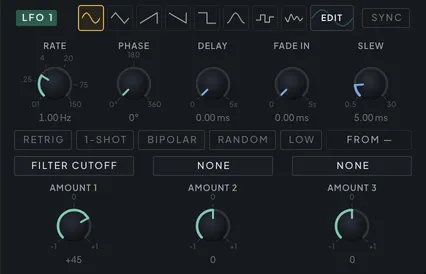
Give any control a pulse. LFO 1–3 are identical full panels, run from very slow drift up to a rate that borders on audio, and each drives three destinations, every one with its own bipolar amount; a fourth, compact LFO joins them below (covered at the end of this section). Eight shape buttons cover the useful space: sine and triangle for smooth breathing, saw and ramp down for rises and falls, square for hard toggles, bump for a single swell and return, sample-and-hold for stepped random motion, and smooth random for wandering curves that never repeat — the organic setting for filter and pitch drift. When none of them is the movement you want, the EDIT button beside them opens the LFO Editor — a catalog of drawn shapes and a place to draw your own — which has its own section below.
Slew smooths the output on its way out, which is what keeps the jumping shapes usable. At the bottom of its range it is effectively transparent — enough to turn every step edge into a short ramp instead of a discontinuity, so square and sample-and-hold stop clicking, and no more. Open it up and the smoothing becomes musical: steps lean into each other, square softens toward a rounded pulse, and a fast sample-and-hold turns into a bubbling wander rather than a staircase.
Each LFO free-runs at a rate in hertz or locks to the host tempo through a division selector that spans cycles several bars long down to very fast subdivisions, with dotted and triplet variants. LOW narrows the free-running RATE to 0.01–5 Hz across the whole knob, for fine control of slow movement; unlit, RATE covers its full range again. Each range remembers its own setting, the way RATE and its synced division do, so flipping LOW can change the speed you hear. LOW greys out while SYNC is lit, since the division sets the rate then. Two toggles decide what a new note does to the cycle, and they compose. RETRIG restarts the LFO on every note for identical motion each time. RANDOM lands every note somewhere new in the cycle for per-note variation — it acts on notes whether or not RETRIG is lit, wins when both are, and holds its ground under tempo sync: SYNC still sets the rate, but a RANDOM LFO keeps each note’s phase instead of being pulled back onto the grid. With neither lit the LFO free-runs and ignores notes entirely — including its onset controls, which then run once from the top of playback rather than per note.
The PHASE offset shifts where in its cycle the LFO reads, in every mode that has a cycle to rotate: on a retriggered LFO it sets where each note starts, on a synced one it slides the whole cycle against the beat — set two synced LFOs a quarter turn apart for quadrature motion — and on a free-running one it rotates the waveform. Sample-and-hold and smooth random have no fixed cycle to rotate, so they ignore PHASE. DELAY holds the LFO at the start of its shape for up to five seconds after the trigger — nothing is heard and nothing has moved on, so the shape begins when the delay ends rather than arriving already underway — and then FADE IN ramps its depth up: the classic pair for vibrato that develops on a held note (both restart on RETRIG/RANDOM notes, and run once from the start of playback in free mode). A one-shot therefore survives its own delay: the shape plays out after the wait instead of finishing unheard. With SYNC on, DELAY becomes a musical division like RATE, with OFF at the bottom of its travel, and it counts in beats — change tempo mid-delay and the wait follows. 1-SHOT makes the LFO play to the end of its waveform and hold the final value, which quietly turns any waveform into an extra modulation envelope — start it mid-shape with PHASE (or RANDOM) and it plays just the remainder, and the held value keeps obeying the slew and fade, so completing never steps the destination, and the LFO Editor shows exactly the part that will play. The held value is wherever the shape ends: sine and triangle are symmetric, so unipolar they hold at their centre rather than at zero — a swoop that should settle back at rest wants BIPOLAR on, or a shape that ends at zero, instead. The BIPOLAR toggle sets the output range: lit, the LFO swings both ways around the target’s set value; unlit — the default — it only pushes one way from where you parked it. The LFO Editor draws the result — the shape as PHASE has rotated it, so what you see is what the LFO plays.
The LFOs can also modulate each other. Pick a source LFO in the cross-mod selector, then blend two effects: phase mod softly pulls the LFO’s phase toward zero on the source’s rising edge — a gentle sync that locks two rates into a rhythmic relationship without hard resets — and rate mod bends the LFO’s speed with the source’s output, up to two octaves in either direction at full amount. A slow sine rate-modulating a fast triangle produces accelerating, decelerating wobbles no single LFO can draw; sample-and-hold rate-modulating anything produces controlled ratchets.
LFO 4 is the compact one, at the right end of the sources row: a rate knob (hertz, or a synced division when its SYNC is lit), the same eight shape buttons with an EDIT button that opens the same LFO Editor, two destination+amount routes — their amounts small horizontal sliders with the polarity marked at each end — and the same RETRIG / 1-SHOT / BIPOLAR / RANDOM / LOW toggles. It is the same LFO engine underneath, with the same full set of controls: its phase, delay and fade, slew, cross-mod and third route sit in the LFO Editor’s control strip, opened from that EDIT button.
| Parameter | Range | Default | What it does |
|---|---|---|---|
| LFO 1 Rate | 0.01 – 150.00 | 1.00 | Free-run speed of LFO 1, from slow drift up to 150 Hz audio-rate flutter; ignored when tempo sync or LOW is on. |
| LFO 1 Waveform | Sine … EUCLID 7 (64 steps) | Sine | Shape of LFO 1's cycle: classic waves or a library pattern. EDIT opens the LFO Editor to draw your own. |
| LFO 1 Tempo Sync | Off / On | Off | Locks LFO 1's rate to the host tempo using its division. |
| LFO 1 Division | 1/1 … 1/128 (18 steps) | 1/4 | Musical division for LFO 1 when tempo sync is on. |
| LFO 1 Sync Source | None · LFO 1 · LFO 2 · LFO 3 | None | Picks another LFO as LFO 1's cross-mod source; -1 means none. |
| LFO 1 Phase Mod | 0 – 100 | 0 | How strongly the source LFO nudges LFO 1's phase toward zero on its rising edge — a soft sync. |
| LFO 1 Dest 1 | None – Master EQ High Gain | None | First modulation target for LFO 1. |
| LFO 1 Amount 1 | -100 – +100 | 0 | Depth and polarity of LFO 1's first routing; negative inverts the movement. |
| LFO 1 Dest 2 | None – Master EQ High Gain | None | Second modulation target for LFO 1. |
| LFO 1 Amount 2 | -100 – +100 | 0 | Depth and polarity of LFO 1's second routing; negative inverts the movement. |
| LFO 1 Dest 3 | None – Master EQ High Gain | None | Third modulation target for LFO 1. |
| LFO 1 Amount 3 | -100 – +100 | 0 | Depth and polarity of LFO 1's third routing; negative inverts the movement. |
| LFO 1 Trigger | Free · Retrigger · Random Phase | Free | RETRIG for LFO 1: on, every note restarts the cycle. (The legacy value 2 means random phase — the RANDOM toggle owns that now.) |
| LFO 1 Phase Offset | 0° – 360° | 0° | Rotates where LFO 1 reads its cycle — the seam marker in the LFO Editor; works free-running, per-note with RETRIG, and slides a synced LFO against the beat. |
| LFO 1 Fade In | 0.0 ms – 5000.0 ms | 0.0 ms | Ramps LFO 1's depth from zero after note-on — vibrato that develops on held notes. |
| LFO 1 One-Shot | Off / On | Off | LFO 1 runs a single cycle then holds its end value — an extra modulation envelope. |
| LFO 1 Bipolar | Off / On | Off | Output range of LFO 1: lit swings both ways around the set value; unlit (the default) pushes one way only. |
| LFO 1 Rate Mod | 0 – 100 | 0 | How strongly the source LFO bends LFO 1's speed — up to two octaves either way at full. |
| LFO 1 Slew | 0.5 ms – 30.0 ms | 5.0 ms | Smooths LFO 1's output, so square and stepped-random shapes ramp between values instead of jumping; at the 0.5 ms floor it is transparent, at 30 ms it smears the shape. |
| LFO 2 Rate | 0.01 – 150.00 | 1.00 | Free-run speed of LFO 2, from slow drift up to 150 Hz audio-rate flutter; ignored when tempo sync or LOW is on. |
| LFO 2 Waveform | Sine … EUCLID 7 (64 steps) | Sine | Shape of LFO 2's cycle: classic waves or a library pattern. EDIT opens the LFO Editor to draw your own. |
| LFO 2 Tempo Sync | Off / On | Off | Locks LFO 2's rate to the host tempo using its division. |
| LFO 2 Division | 1/1 … 1/128 (18 steps) | 1/4 | Musical division for LFO 2 when tempo sync is on. |
| LFO 2 Sync Source | None · LFO 1 · LFO 2 · LFO 3 | None | Picks another LFO as LFO 2's cross-mod source; -1 means none. |
| LFO 2 Phase Mod | 0 – 100 | 0 | How strongly the source LFO nudges LFO 2's phase toward zero on its rising edge — a soft sync. |
| LFO 2 Dest 1 | None – Master EQ High Gain | None | First modulation target for LFO 2. |
| LFO 2 Amount 1 | -100 – +100 | 0 | Depth and polarity of LFO 2's first routing; negative inverts the movement. |
| LFO 2 Dest 2 | None – Master EQ High Gain | None | Second modulation target for LFO 2. |
| LFO 2 Amount 2 | -100 – +100 | 0 | Depth and polarity of LFO 2's second routing; negative inverts the movement. |
| LFO 2 Dest 3 | None – Master EQ High Gain | None | Third modulation target for LFO 2. |
| LFO 2 Amount 3 | -100 – +100 | 0 | Depth and polarity of LFO 2's third routing; negative inverts the movement. |
| LFO 2 Trigger | Free · Retrigger · Random Phase | Free | RETRIG for LFO 2: on, every note restarts the cycle. (The legacy value 2 means random phase — the RANDOM toggle owns that now.) |
| LFO 2 Phase Offset | 0° – 360° | 0° | Rotates where LFO 2 reads its cycle — the seam marker in the LFO Editor; works free-running, per-note with RETRIG, and slides a synced LFO against the beat. |
| LFO 2 Fade In | 0.0 ms – 5000.0 ms | 0.0 ms | Ramps LFO 2's depth from zero after note-on — vibrato that develops on held notes. |
| LFO 2 One-Shot | Off / On | Off | LFO 2 runs a single cycle then holds its end value — an extra modulation envelope. |
| LFO 2 Bipolar | Off / On | Off | Output range of LFO 2: lit swings both ways around the set value; unlit (the default) pushes one way only. |
| LFO 2 Rate Mod | 0 – 100 | 0 | How strongly the source LFO bends LFO 2's speed — up to two octaves either way at full. |
| LFO 2 Slew | 0.5 ms – 30.0 ms | 5.0 ms | Smooths LFO 2's output, so square and stepped-random shapes ramp between values instead of jumping; at the 0.5 ms floor it is transparent, at 30 ms it smears the shape. |
| LFO 3 Rate | 0.01 – 150.00 | 1.00 | Free-run speed of LFO 3, from slow drift up to 150 Hz audio-rate flutter; ignored when tempo sync or LOW is on. |
| LFO 3 Waveform | Sine … EUCLID 7 (64 steps) | Sine | Shape of LFO 3's cycle: classic waves or a library pattern. EDIT opens the LFO Editor to draw your own. |
| LFO 3 Tempo Sync | Off / On | Off | Locks LFO 3's rate to the host tempo using its division. |
| LFO 3 Division | 1/1 … 1/128 (18 steps) | 1/4 | Musical division for LFO 3 when tempo sync is on. |
| LFO 3 Sync Source | None · LFO 1 · LFO 2 · LFO 3 | None | Picks another LFO as LFO 3's cross-mod source; -1 means none. |
| LFO 3 Phase Mod | 0 – 100 | 0 | How strongly the source LFO nudges LFO 3's phase toward zero on its rising edge — a soft sync. |
| LFO 3 Dest 1 | None – Master EQ High Gain | None | First modulation target for LFO 3. |
| LFO 3 Amount 1 | -100 – +100 | 0 | Depth and polarity of LFO 3's first routing; negative inverts the movement. |
| LFO 3 Dest 2 | None – Master EQ High Gain | None | Second modulation target for LFO 3. |
| LFO 3 Amount 2 | -100 – +100 | 0 | Depth and polarity of LFO 3's second routing; negative inverts the movement. |
| LFO 3 Dest 3 | None – Master EQ High Gain | None | Third modulation target for LFO 3. |
| LFO 3 Amount 3 | -100 – +100 | 0 | Depth and polarity of LFO 3's third routing; negative inverts the movement. |
| LFO 3 Trigger | Free · Retrigger · Random Phase | Free | RETRIG for LFO 3: on, every note restarts the cycle. (The legacy value 2 means random phase — the RANDOM toggle owns that now.) |
| LFO 3 Phase Offset | 0° – 360° | 0° | Rotates where LFO 3 reads its cycle — the seam marker in the LFO Editor; works free-running, per-note with RETRIG, and slides a synced LFO against the beat. |
| LFO 3 Fade In | 0.0 ms – 5000.0 ms | 0.0 ms | Ramps LFO 3's depth from zero after note-on — vibrato that develops on held notes. |
| LFO 3 One-Shot | Off / On | Off | LFO 3 runs a single cycle then holds its end value — an extra modulation envelope. |
| LFO 3 Bipolar | Off / On | Off | Output range of LFO 3: lit swings both ways around the set value; unlit (the default) pushes one way only. |
| LFO 3 Rate Mod | 0 – 100 | 0 | How strongly the source LFO bends LFO 3's speed — up to two octaves either way at full. |
| LFO 3 Slew | 0.5 ms – 30.0 ms | 5.0 ms | Smooths LFO 3's output, so square and stepped-random shapes ramp between values instead of jumping; at the 0.5 ms floor it is transparent, at 30 ms it smears the shape. |
| LFO 1 Random | Off / On | Off | Every note lands LFO 1 on a random phase — wins over RETRIG, and a synced LFO keeps the note's phase instead of the grid's. |
| LFO 2 Random | Off / On | Off | Every note lands LFO 2 on a random phase — wins over RETRIG, and a synced LFO keeps the note's phase instead of the grid's. |
| LFO 3 Random | Off / On | Off | Every note lands LFO 3 on a random phase — wins over RETRIG, and a synced LFO keeps the note's phase instead of the grid's. |
| LFO 1 Delay | 0.0 ms – 5000.0 ms | 0.0 ms | Holds LFO 1 at the start of its shape for up to 5 s after the trigger; the shape begins when the delay ends, and Fade In ramps it up from there. |
| LFO 1 Delay Division | Off … 1/128 (19 steps) | Off | Delay length as a musical division while LFO 1 is synced — the same swap Rate makes. Off means no delay, and the countdown follows the tempo through a change. |
| LFO 2 Delay | 0.0 ms – 5000.0 ms | 0.0 ms | Holds LFO 2 at the start of its shape for up to 5 s after the trigger; the shape begins when the delay ends, and Fade In ramps it up from there. |
| LFO 2 Delay Division | Off … 1/128 (19 steps) | Off | Delay length as a musical division while LFO 2 is synced — the same swap Rate makes. Off means no delay, and the countdown follows the tempo through a change. |
| LFO 3 Delay | 0.0 ms – 5000.0 ms | 0.0 ms | Holds LFO 3 at the start of its shape for up to 5 s after the trigger; the shape begins when the delay ends, and Fade In ramps it up from there. |
| LFO 3 Delay Division | Off … 1/128 (19 steps) | Off | Delay length as a musical division while LFO 3 is synced — the same swap Rate makes. Off means no delay, and the countdown follows the tempo through a change. |
| LFO 4 Rate | 0.01 – 150.00 | 1.00 | Free-run speed of LFO 4, from slow drift up to 150 Hz; ignored when tempo sync or LOW is on. |
| LFO 4 Waveform | Sine … EUCLID 7 (64 steps) | Sine | Shape of LFO 4's cycle: classic waves or a library pattern. EDIT opens the same LFO Editor. |
| LFO 4 Tempo Sync | Off / On | Off | Locks LFO 4's rate to the host tempo using its division. |
| LFO 4 Division | 1/1 … 1/128 (18 steps) | 1/4 | Musical division for LFO 4 when tempo sync is on. |
| LFO 4 Sync Source | None · LFO 1 · LFO 2 · LFO 3 | None | Picks another LFO as LFO 4's cross-mod source; -1 means none. |
| LFO 4 Phase Mod | 0 – 100 | 0 | How strongly the source LFO nudges LFO 4's phase toward zero on its rising edge — a soft sync. |
| LFO 4 Dest 1 | None – Master EQ High Gain | None | First modulation target LFO 4 drives. |
| LFO 4 Amount 1 | -100 – +100 | 0 | Depth and polarity of LFO 4's first routing; negative inverts the movement. |
| LFO 4 Dest 2 | None – Master EQ High Gain | None | Second modulation target LFO 4 drives. |
| LFO 4 Amount 2 | -100 – +100 | 0 | Depth and polarity of LFO 4's second routing; negative inverts the movement. |
| LFO 4 Dest 3 | None – Master EQ High Gain | None | Third modulation target LFO 4 drives. |
| LFO 4 Amount 3 | -100 – +100 | 0 | Depth and polarity of LFO 4's third routing; negative inverts the movement. |
| LFO 4 Trigger | Free · Retrigger · Random Phase | Free | RETRIG for LFO 4: on, every note restarts the cycle. |
| LFO 4 Random | Off / On | Off | Every note lands LFO 4 on a random phase — wins over RETRIG, and a synced LFO keeps the note's phase instead of the grid's. |
| LFO 4 Phase Offset | 0° – 360° | 0° | Rotates where LFO 4 reads its cycle — the seam marker in the LFO Editor; works free-running, per-note with RETRIG, and slides a synced LFO against the beat. |
| LFO 4 Delay | 0.0 ms – 5000.0 ms | 0.0 ms | Holds LFO 4 at the start of its shape for up to 5 s after the trigger; the shape begins when the delay ends, and Fade In ramps it up from there. |
| LFO 4 Delay Division | Off … 1/128 (19 steps) | Off | Delay length as a musical division while LFO 4 is synced — the same swap Rate makes. Off means no delay, and the countdown follows the tempo through a change. |
| LFO 4 Fade In | 0.0 ms – 5000.0 ms | 0.0 ms | Ramps LFO 4's depth from zero after note-on — vibrato that develops on held notes. |
| LFO 4 One-Shot | Off / On | Off | LFO 4 runs a single cycle then holds its end value — an extra modulation envelope. |
| LFO 4 Bipolar | Off / On | Off | Output range of LFO 4: lit swings both ways around the set value; unlit (the default) pushes one way only. |
| LFO 4 Rate Mod | 0 – 100 | 0 | How strongly the source LFO bends LFO 4's speed — up to two octaves either way at full. |
| LFO 4 Slew | 0.5 ms – 30.0 ms | 5.0 ms | Smooths LFO 4's output, so square and stepped-random shapes ramp between values instead of jumping; at the 0.5 ms floor it is transparent, at 30 ms it smears the shape. |
| LFO 1 Low Range | Off / On | Off | LOW range for LFO 1: RATE runs from 0.01 to 5 Hz across the whole knob for fine slow movement; no effect while SYNC is on (greyed out on the panel). |
| LFO 1 Rate Low | 0.01 – 5.00 | 1.00 | Free-run speed of LFO 1 while LOW is lit, 0.01 to 5 Hz; kept separately from the full-range rate and ignored when tempo sync is on. |
| LFO 2 Low Range | Off / On | Off | LOW range for LFO 2: RATE runs from 0.01 to 5 Hz across the whole knob for fine slow movement; no effect while SYNC is on (greyed out on the panel). |
| LFO 2 Rate Low | 0.01 – 5.00 | 1.00 | Free-run speed of LFO 2 while LOW is lit, 0.01 to 5 Hz; kept separately from the full-range rate and ignored when tempo sync is on. |
| LFO 3 Low Range | Off / On | Off | LOW range for LFO 3: RATE runs from 0.01 to 5 Hz across the whole knob for fine slow movement; no effect while SYNC is on (greyed out on the panel). |
| LFO 3 Rate Low | 0.01 – 5.00 | 1.00 | Free-run speed of LFO 3 while LOW is lit, 0.01 to 5 Hz; kept separately from the full-range rate and ignored when tempo sync is on. |
| LFO 4 Low Range | Off / On | Off | LOW range for LFO 4: RATE runs from 0.01 to 5 Hz across the whole knob for fine slow movement; no effect while SYNC is on (greyed out on the panel). |
| LFO 4 Rate Low | 0.01 – 5.00 | 1.00 | Free-run speed of LFO 4 while LOW is lit, 0.01 to 5 Hz; kept separately from the full-range rate and ignored when tempo sync is on. |
The LFO Editor
Draw the movement you hear in your head instead of settling for the nearest classic wave. Beside the eight shape buttons of every LFO sits an EDIT button; press it and the LFO Editor opens over the page, the rest of the window blurred behind it, and the instrument keeps sounding, so audition as you draw. EDIT lights amber whenever none of the eight buttons owns the playing shape: a drawn shape, an edited catalog shape, or a catalog shape with no button of its own. The ✕ in the top-right corner closes the Editor.
The header row across the top is short: the LFO 1–4 tabs — each LFO keeps its own shape — and, at the right, UNDO, REDO and the ✕. Under it, a strip in the LFO’s own colour carries the LFO’s full control set — RATE, PHASE, DELAY, FADE IN and SLEW (with PHASE MOD and RATE MOD while a cross-mod source is picked), SYNC and LOW, RETRIG, RANDOM and 1-SHOT, BIPOLAR and the cross-mod source, and all three destinations with their amounts — so the whole LFO can be played without leaving the editor. A destination reads here as a plain label, because picking one is a job for the Modulation page where the picker lives; its amount is a readout you can click and type into, and its slider carries a single centre tick. Down the left runs the shape catalog: the eight classics under CLASSIC, in the same order as the panel’s buttons, then your own saved shapes under USER, then RAMPS and CURVES, PATTERNS — twelve stepped figures that take a whole LFO cycle to say what they have to say, each one different from cycle to cycle rather than a short figure repeated, which is what RATE is for — and then the library groups: gates, Euclidean patterns, staircases that glide between their levels instead of jumping, and the hard-edged pulse, gap and centre families. Search by name or scroll the groups, press a shape to load it into the LFO, then keep editing to make it yours.
The chart in the middle is the curve itself, one cycle wide, drawn the way it plays: the left edge is the moment the LFO starts — on a note, or when the transport starts — so the curve is rotated by PHASE. Drag a node — a point the curve passes through — to move it; double-click empty space to add one and double-click a node to remove it. Between any two nodes lies a segment, in one of three modes. LINEAR, the default, carries a handle whenever its ends sit at different levels: drag it up or down to bend the straight line into a curve. STEP holds its level flat until the next node, and SMOOTH curves through its nodes without a corner — neither shows a handle, since there is no straight line left to bend. NODE MODE sets the mode of the segment leaving the selected node, and stays greyed out until a node is selected.
The grid is 32 × 32. Its columns come in four brightnesses — halves brightest, then quarters, eighths and the single columns faintest — and its rows in three. SNAP keeps nodes on it, so timing lands on divisions of the cycle and levels on even steps; switch it off to draw freehand. TRIPLET switches the columns to 24, so snapped timing lands on triplets instead.
Two tool rows run along the bottom, and no more. The first holds SNAP, TRIPLET and NODE MODE, then the shape’s name — it reads Name… until you give it one — and SAVE, with a few words of status after it. The second row is the transforms you reach for most, each one press on the whole curve: MIRROR ◂ / ▸ copies one half onto the other, REVERSE plays it backwards, INVERT flips it upside down, NORMALIZE stretches it to the full range and QUANTIZE Y snaps every level to the grid.
The other eight live on the chart’s right-click menu, where all thirteen are listed together: ROTATE ◂ / ▸ shifts the curve one grid column, TENSION − / + bends every linear segment a step further one way or the other, SKEW ◂ / ▸ leans its timing to one side, and FOLD boosts the curve and folds whatever crosses the top or bottom back inside. Each press is one undo step, and UNDO and REDO in the header step back through every edit you make in the Editor, so experiment freely.
The seam — the marker where the cycle wraps — is the PHASE control, drawn on the chart. Drag it to move PHASE, double-click it to reset it, or right-click a node and choose Set start here: the chart rotates so that node sits at the left edge, and PHASE follows. With 1-SHOT lit, the stretch after the seam greys out and reads hold, because that part will never play before the LFO holds its end value. PHASE at its maximum draws the same as PHASE at zero, just as it sounds the same. A node sitting exactly on the seam is drawn at both edges of the chart, since the cycle’s end and start are the same moment. Sample-and-hold and smooth random ignore PHASE, so while one of them is picked the chart is empty and shows no seam.
A drawn shape plays as long as the LFO’s shape setting stays where it was when the shape was chosen or last edited. If an automation lane, a learned MIDI controller or the host’s own editor moves that setting, the LFO plays the shape it was moved to and the page lights its button (or EDIT, for a shape with no button) — the drawn shape is kept, and it plays again the moment the setting returns. The Editor says which shape is playing and where the drawn one comes back; any edit makes the drawn shape play at the current setting. Sessions and presets remember this, so a drawn shape that was waiting for its setting when you saved is still waiting when you reopen it.
When a shape is worth keeping, type a name into the field beside SAVE in the first tool row and press it: the shape lands under USER on this machine, ready for any preset and any instance of the instrument. Names are unique, so saving under one already taken arms a REPLACE confirmation with a NO beside it rather than overwriting silently. You do not have to save to keep a shape, though. Whatever you draw travels inside the preset, so the patch moves the same way wherever it goes. Open that preset in an older build of the instrument and it plays the base shape the curve was drawn from instead, so the patch still moves. It works the other way round too: a preset or session saved by a newer Phaseburn keeps its drawn shapes untouched even when this build cannot draw them. Here that LFO plays its fallback shape, the Editor says so above the chart, and your first edit replaces the newer shape.
The USER library is one file shared by every instance on this machine. If that file belongs to a newer build, or the app cannot read it at all, Save, Rename and Delete refuse and name the reason rather than risk the file — nothing already in the library is touched, and it recovers on its own once the file is readable again. A shape a newer build saved, or one this build cannot play, survives every save you make here.
A preset switch that lands on a bar line brings its saved shapes in with the rest of the sound, at the bar line — not a beat ahead of it, the way the sequencer grid used to move first.
Step modulators SEQ 1 to SEQ 4

When modulation should follow the grid, draw it. Step modulators SEQ 1 to SEQ 4 are four identical lanes on the Modulation tab, each a row of bipolar step values played back at a tempo-synced rate, one step per division, looping at whatever length you set. Each drives three destinations with bipolar amounts, the same routing capacity as an LFO.
What a step lane gives you that an LFO cannot is rhythm as a first-class shape. An LFO repeats one curve; a step lane holds an exact value per grid position, so you can write accents, rests, sudden jumps and asymmetric patterns that correspond to no waveform at all — a filter that opens only on beats two and four, a PLL multiplier that leaps between intervals in a fixed riff. Set the lane length to an odd count against a square sequencer pattern and the lane phases against the bar, a polymeter that keeps a short loop evolving for minutes. Leave retrigger off and the lane free-runs with the tempo regardless of what notes play; switch it on and every note restarts the pattern from step one, tying the modulation to phrasing instead of the bar. A retrig lane also plays without the transport: with the DAW stopped, every note you play launches the pattern and it runs for as long as the note sounds, release tail included — sound design and performance get the full moving patch, not a frozen snapshot of it. A transport start — pressing Play, or the DAW beginning playback — still resets every step modulator to step one of bar one and every LFO to the top of its cycle, so a take always begins the same way; the one exception is a retrig lane still sounding a note, which keeps its phase — its clock belongs to the note, not the timeline.
Two controls decide how steps connect. Ties glide between adjacent steps with a smooth S-curve interpolation — the acid-style slide, drawn per step. Untied steps use the slew control instead: at zero they snap, higher values round every transition, up to 50 ms. That ceiling is deliberate — past it the glide outruns the step at every rate you would actually use, and the lane stops reading as a sequence and starts reading as an LFO. Snap quantizes step values to a twelve-tone grid, which matters the moment a lane drives anything pitch-shaped — the PLL multiplier, the tracked-filter offset, oscillator tuning territory — because steps then land on musical intervals instead of arbitrary values, and ties glide between the snapped levels.
Rate runs from four bars per step down to 1/64, with dotted and triplet divisions on the way, so a lane can be a slow drift across a whole section or a rattle inside a single beat.
SHUFFLE bends the lane’s timing the same way Swing bends the sequencer’s. At 50 the steps are evenly spaced; raise it and the offbeat eighth arrives late, 66 giving the triplet lean and 75 a hard shuffle. It is the same warp the note sequencer applies, so a lane at a given amount grooves identically to the notes at that amount — which is the point of SYNC, the switch beside it. With SYNC on, and it is on by default, the lane simply follows the sequencer’s Swing and the SHUFFLE dial greys out, showing you the value in force rather than a stale one of its own. Switch SYNC off when you want a lane to lean against the groove instead of with it: a straight 16th lane under shuffled notes, or a lane shuffled harder than the sequencer, both of which pull in a way an unshuffled lane never can. Shuffle changes when steps play, not what they hold, and it never changes how long the pattern takes to come round.
BARS is the pattern’s length in bars. Leave it at one and the lane behaves exactly as above. Raise it and the lane plays bar 1, then bar 2, and so on before looping — each bar carrying its own steps, its own probabilities and its own tie row, and a tie on a bar’s last step gliding into the first step of the next. A strip of numbered segments appears in the panel header as soon as BARS is above one; click a segment to edit that bar, and a dot marks whichever bar the playhead is currently in. Pulling BARS back down hides the later bars without erasing them, so you can try a shorter loop and go back.
TOOLS act on the bar you are looking at. RANDOM, INVERT, MIRROR and CLEAR each apply to the visible bar only — CLEAR included, so emptying a long pattern means clearing each bar in turn. There is no undo on the step lanes, which is exactly why CLEAR is scoped this way. Loading one of the built-in step patterns always sets BARS back to one, because those patterns are single-bar and would otherwise be followed by empty bars.
BIPOLAR, RETRIG and SNAP sit in the panel header, to the left of the SEQ tabs — they describe the whole lane rather than any one dial, which is why they live with its name. Every fourth step in the grid carries a slightly brighter background, marking steps 1, 5, 9 and 13, so you can put an accent on the beat without counting cells.
The four lanes are fully independent, switched with the SEQ 1 to SEQ 4 tabs, and a productive habit is giving each one a clear job: SEQ 1 as a fast rhythmic accent lane, SEQ 2 as a slow, long-loop drift that keeps the patch from standing still, the other two held in reserve for accents you add as the patch grows. SEQ 3 and SEQ 4 are newer than the first pair and default to silence — no destination, zero amount, an empty pattern — so a preset or session saved before they existed loads and sounds exactly as it always did.
The step values themselves are pattern data, not host parameters: they travel with the preset and with your saved project, but they do not appear in the DAW’s parameter list and cannot be automated from a lane there. Everything that shapes the lane — rate, length, bars, slew, shuffle, polarity, retrigger, snap and the three routes — is a normal automatable parameter.
| Parameter | Range | Default | What it does |
|---|---|---|---|
| MSeq Division | 1/1 … 1/64 (17 steps) | 1/16 | Playback rate of modulator A — one step per musical division, synced to the host tempo. |
| MSeq Slew | 0 ms – 50 ms | 5 ms | Smoothing between untied steps in modulator A — 0 snaps, higher values round every transition. |
| MSeq Dest 1 | None – Master EQ High Gain | None | First modulation target for modulator A. |
| MSeq Amount 1 | -100 – +100 | 0 | Depth and polarity of modulator A's first routing; negative inverts the pattern. |
| MSeq Dest 2 | None – Master EQ High Gain | None | Second modulation target for modulator A. |
| MSeq Amount 2 | -100 – +100 | 0 | Depth and polarity of modulator A's second routing; negative inverts the pattern. |
| MSeq Length | 1 … 32 (32 steps) | 16 | Number of steps modulator A loops over; odd lengths phase against the bar for polymeter. |
| MSeq Retrigger | Off / On | Off | When on, modulator A restarts from step 1 on every note-on and plays per-note even with the transport stopped; off free-runs with the tempo. |
| MSeq Bipolar | Off / On | On | Step range of modulator A: bipolar swings both ways, unipolar keeps steps pushing one way only. |
| MSeq Dest 3 | None – Master EQ High Gain | None | Third modulation target for modulator A. |
| MSeq Amount 3 | -100 – +100 | 0 | Depth and polarity of modulator A's third routing; negative inverts the pattern. |
| MSeq Snap | Off / On | Off | Snaps modulator A's step values to a twelve-tone grid — musical intervals on pitch-like targets. |
| MSeq2 Division | 1/1 … 1/64 (17 steps) | 1/16 | Playback rate of modulator B — one step per musical division, synced to the host tempo. |
| MSeq2 Slew | 0 ms – 50 ms | 5 ms | Smoothing between untied steps in modulator B — 0 snaps, higher values round every transition. |
| MSeq2 Dest 1 | None – Master EQ High Gain | None | First modulation target for modulator B. |
| MSeq2 Amount 1 | -100 – +100 | 0 | Depth and polarity of modulator B's first routing; negative inverts the pattern. |
| MSeq2 Dest 2 | None – Master EQ High Gain | None | Second modulation target for modulator B. |
| MSeq2 Amount 2 | -100 – +100 | 0 | Depth and polarity of modulator B's second routing; negative inverts the pattern. |
| MSeq2 Dest 3 | None – Master EQ High Gain | None | Third modulation target for modulator B. |
| MSeq2 Amount 3 | -100 – +100 | 0 | Depth and polarity of modulator B's third routing; negative inverts the pattern. |
| MSeq2 Length | 1 … 32 (32 steps) | 16 | Number of steps modulator B loops over; odd lengths phase against the bar for polymeter. |
| MSeq2 Retrigger | Off / On | Off | When on, modulator B restarts from step 1 on every note-on and plays per-note even with the transport stopped; off free-runs with the tempo. |
| MSeq2 Bipolar | Off / On | On | Step range of modulator B: bipolar swings both ways, unipolar keeps steps pushing one way only. |
| MSeq2 Snap | Off / On | Off | Snaps modulator B's step values to a twelve-tone grid — musical intervals on pitch-like targets. |
| MSeq Bars | 1 · 2 · 3 · 4 · 5 · 6 · 7 · 8 | 1 | Pattern length of modulator A in bars — it plays bar 1 through bar N and loops. Each bar has its own steps, probabilities and ties. |
| MSeq2 Bars | 1 · 2 · 3 · 4 · 5 · 6 · 7 · 8 | 1 | Pattern length of modulator B in bars — it plays bar 1 through bar N and loops. Each bar has its own steps, probabilities and ties. |
| MSeq3 Division | 1/1 … 1/64 (17 steps) | 1/16 | Playback rate of modulator C — one step per musical division, synced to the host tempo. |
| MSeq3 Slew | 0 ms – 50 ms | 5 ms | Smoothing between untied steps in modulator C — 0 snaps, higher values round every transition. |
| MSeq3 Dest 1 | None – Master EQ High Gain | None | First modulation target for modulator C. |
| MSeq3 Amount 1 | -100 – +100 | 0 | Depth and polarity of modulator C's first routing; negative inverts the pattern. |
| MSeq3 Dest 2 | None – Master EQ High Gain | None | Second modulation target for modulator C. |
| MSeq3 Amount 2 | -100 – +100 | 0 | Depth and polarity of modulator C's second routing; negative inverts the pattern. |
| MSeq3 Dest 3 | None – Master EQ High Gain | None | Third modulation target for modulator C. |
| MSeq3 Amount 3 | -100 – +100 | 0 | Depth and polarity of modulator C's third routing; negative inverts the pattern. |
| MSeq3 Length | 1 … 32 (32 steps) | 16 | Number of steps modulator C loops over; odd lengths phase against the bar for polymeter. |
| MSeq3 Retrigger | Off / On | Off | When on, modulator C restarts from step 1 on every note-on and plays per-note even with the transport stopped; off free-runs with the tempo. |
| MSeq3 Bipolar | Off / On | On | Step range of modulator C: bipolar swings both ways, unipolar keeps steps pushing one way only. |
| MSeq3 Snap | Off / On | Off | Snaps modulator C's step values to a twelve-tone grid — musical intervals on pitch-like targets. |
| MSeq3 Bars | 1 · 2 · 3 · 4 · 5 · 6 · 7 · 8 | 1 | Pattern length of modulator C in bars — it plays bar 1 through bar N and loops. Each bar has its own steps, probabilities and ties. |
| MSeq4 Division | 1/1 … 1/64 (17 steps) | 1/16 | Playback rate of modulator D — one step per musical division, synced to the host tempo. |
| MSeq4 Slew | 0 ms – 50 ms | 5 ms | Smoothing between untied steps in modulator D — 0 snaps, higher values round every transition. |
| MSeq4 Dest 1 | None – Master EQ High Gain | None | First modulation target for modulator D. |
| MSeq4 Amount 1 | -100 – +100 | 0 | Depth and polarity of modulator D's first routing; negative inverts the pattern. |
| MSeq4 Dest 2 | None – Master EQ High Gain | None | Second modulation target for modulator D. |
| MSeq4 Amount 2 | -100 – +100 | 0 | Depth and polarity of modulator D's second routing; negative inverts the pattern. |
| MSeq4 Dest 3 | None – Master EQ High Gain | None | Third modulation target for modulator D. |
| MSeq4 Amount 3 | -100 – +100 | 0 | Depth and polarity of modulator D's third routing; negative inverts the pattern. |
| MSeq4 Length | 1 … 32 (32 steps) | 16 | Number of steps modulator D loops over; odd lengths phase against the bar for polymeter. |
| MSeq4 Retrigger | Off / On | Off | When on, modulator D restarts from step 1 on every note-on and plays per-note even with the transport stopped; off free-runs with the tempo. |
| MSeq4 Bipolar | Off / On | On | Step range of modulator D: bipolar swings both ways, unipolar keeps steps pushing one way only. |
| MSeq4 Snap | Off / On | Off | Snaps modulator D's step values to a twelve-tone grid — musical intervals on pitch-like targets. |
| MSeq4 Bars | 1 · 2 · 3 · 4 · 5 · 6 · 7 · 8 | 1 | Pattern length of modulator D in bars — it plays bar 1 through bar N and loops. Each bar has its own steps, probabilities and ties. |
| MSeq Shuffle | 50 – 75 | 50 | Shuffle for modulator A — 50 is straight, 66 a triplet feel, 75 a hard shuffle. Delays the offbeat eighth, exactly as the note sequencer's Swing does. Ignored while Sync is on. |
| MSeq Shuffle Sync | Off / On | On | Ties modulator A's shuffle to the note sequencer's Swing, so both groove together. On by default; switch it off to shuffle this modulator on its own. |
| MSeq2 Shuffle | 50 – 75 | 50 | Shuffle for modulator B — 50 is straight, 66 a triplet feel, 75 a hard shuffle. Delays the offbeat eighth, exactly as the note sequencer's Swing does. Ignored while Sync is on. |
| MSeq2 Shuffle Sync | Off / On | On | Ties modulator B's shuffle to the note sequencer's Swing, so both groove together. On by default; switch it off to shuffle this modulator on its own. |
| MSeq3 Shuffle | 50 – 75 | 50 | Shuffle for modulator C — 50 is straight, 66 a triplet feel, 75 a hard shuffle. Delays the offbeat eighth, exactly as the note sequencer's Swing does. Ignored while Sync is on. |
| MSeq3 Shuffle Sync | Off / On | On | Ties modulator C's shuffle to the note sequencer's Swing, so both groove together. On by default; switch it off to shuffle this modulator on its own. |
| MSeq4 Shuffle | 50 – 75 | 50 | Shuffle for modulator D — 50 is straight, 66 a triplet feel, 75 a hard shuffle. Delays the offbeat eighth, exactly as the note sequencer's Swing does. Ignored while Sync is on. |
| MSeq4 Shuffle Sync | Off / On | On | Ties modulator D's shuffle to the note sequencer's Swing, so both groove together. On by default; switch it off to shuffle this modulator on its own. |
Velocity and aftertouch
Make how hard you hit part of the patch. Velocity in Phaseburn One arrives from two places: your MIDI playing, and the sequencer itself, which generates velocity per note on its Strength tab. Either way, the same routes apply.
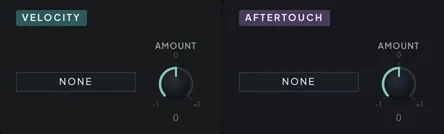
Four bipolar routes feed the volume envelope: velocity to attack, decay, sustain and release. The time routes shift their stage by an amount of time rather than by a percentage — at full depth the velocity extremes move the stage up to a second either side of where the slider sits, and velocity in the middle of the range leaves it exactly there. Positive amounts read the way every bipolar route in the instrument does — more velocity pushes the value up, so harder hits stretch the stage and softer hits tighten it, for pads that open out when you dig in. Pull the slider negative for the classic plucked and struck response, where digging in snaps the stage shut and soft playing blooms slowly. Because the shift is measured in time and not in proportion, it has the same authority on a snappy patch as on a slow one: a 4 ms attack with the route pulled fully down is still instant when you dig in and becomes a second-long swell when you play softly. Stages cannot be driven below their floors, so at extreme settings the fast end simply arrives at the shortest stage the envelope will run. The sustain route offsets level directly, so hard notes carry more body, not only a faster front — it reaches the full level range at full depth, which also means a patch already sustaining at 100% can only be pushed downward, by playing softer. The filter envelope carries the same four routes of its own, plus its own key track, applied with the same formulas — so a note’s brightness can answer touch independently of its loudness; they live on the envelope panel’s FILTER tab and are covered in the filter chapter (Chapter 3 — The Filter). A fifth dynamic control lives in the transient engine: its VEL parameter scales the sweep, click and fold transients, which turns velocity into hit intensity when you play the synth as a drum. Three of the four envelope velocity routes — attack, decay and sustain — are themselves modulation destinations, so an LFO or step lane can vary how dynamic the instrument feels across a phrase. These routes read how hard you played whether or not Volume Velocity Lock is on: that switch levels the loudness of a played note and nothing else, so a locked keyboard still shapes its envelopes with your hand. What decides how much of that hand reaches them is Velocity Amount beside it — at 0% every note arrives at the resting level everywhere, which is the flat response the old lock used to force, and the routes then follow the sequencer’s velocity modifiers alone. Both are instance settings in the header’s cog menu and in the keyboard row; see Input modes (Chapter 10 — MIDI & Your DAW).
Aftertouch is the third continuous source. The engine listens to both channel pressure and polyphonic pressure and follows whichever presses harder, then feeds that pressure through three routing slots of its own — each a destination picked from the same shared list, with a bipolar amount, exactly like an LFO slot. Route pressure into filter cutoff for swells that live under your fingers, into VECTOR fold for a growl that answers how hard you lean, or into envelope sustain so held notes bloom under pressure. The first slot lives in the AFTERTOUCH module on the Modulation page; the other two are reachable through the host’s parameter list or automation. These routes travel with the preset. If your keyboard sends no aftertouch at all, an LFO with a long fade-in or a one-shot LFO acting as a slow secondary envelope covers similar ground.
Two more one-route modules sit in the same row. VELOCITY feeds the sounding note’s velocity — played or sequenced — into one destination for the note’s duration, so a hard hit can open the filter or push a send without touching the envelope routes. NOTE STRENGTH does the same with the sequencer’s strength map: each internally sequenced note reads its own painted cell from the Groove page’s Strength tab and holds that value on the destination for as long as it sounds, one amount knob deep. A bar with accents painted high therefore pushes its destination hardest exactly on the accents — the map you drew becomes per-note modulation directly, with none of the weak/strong targeting the Beats-page modifiers use. The Notes page PERFORM module’s As Strength switch feeds the same route from your hands instead: with it on, the raw struck velocity — read before Velocity Amount touches it — becomes the note’s strength, for played notes and for the whole phrase in the gated modes, even while Volume Velocity Lock holds the loudness flat; see Input modes (Chapter 10 — MIDI & Your DAW).
The filter envelope as a source
The FILTER ENV module sends the filter envelope back out as a modulation source: the same shape that is sweeping the cutoff drives one destination from the shared list, with a bipolar amount. It is the cheapest way to make the rest of the patch move with the filter rather than beside it — into sub volume so the low end steps back while the sweep is open, into delay feedback so echoes stretch out as the envelope decays, into an oscillator’s own colour so the timbre and the cutoff arrive together. Its route draws a modulation ring on the target like any other source, so you can watch the envelope working from the knob it is moving.
The source runs whether or not the filter itself is powered on, so switching the filter out of the patch never silently kills the modulation you built on top of it. The value is read one audio block behind the envelope that produced it — inaudible at modulation rates.
Its two parameters are named GR Dest 1 and GR Amount 1 in a host’s automation list. That is a scar, not a clue: the slot used to carry the distortion’s input envelope, and renaming the ids would strand every preset and automation lane already pointing at them.