

A rack, not an afterthought
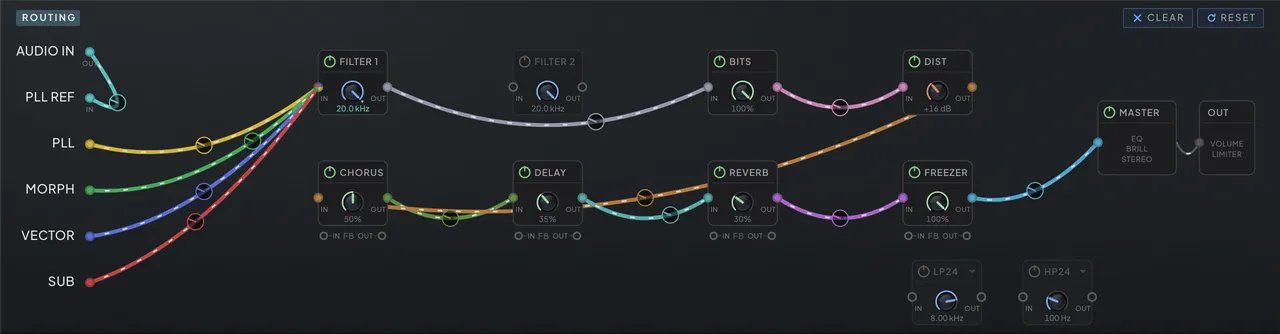
Two filters and six effects, then a master section — the filters inside the voice, then a delay with a frequency shifter in its loop, a feedback-delay-network reverb, a four-mode chorus, a four-archetype distortion, a bitcrusher and a granular engine. Each is a node you patch, not a slot in a fixed chain, and each runs on the same 64-bit path as the voice. Patch AUDIO IN into any of them and the rack works on your tracks with no note held.
Every effect listens where you point it
Effects take cables, and every cable carries its own gain. Three rules cover everything: inputs sum, outputs fan out, loops are refused.
The default patch is the classic chain — the four sources into FILTER 1, on into FILTER 2, then bitcrusher, distortion, chorus, delay, reverb, freezer and the master — with every module off until you power it. A cable is silent at the bottom of its travel, unity a quarter of the way up and +12 dB at the top, so the patchbay is also the mixer.
The header’s FX switch is the honest A/B: it lifts the whole rack out and drops it back exactly as it was. Power a module that nothing feeds and its power button reads PATCH; Connect splices it in.
Two plain filter slots live in the bay and nowhere else: FILTER 3 and FILTER 4, low-pass, high-pass, band-pass or notch on a single frequency knob you can modulate. They are for the jobs the voice filters are too characterful for — clearing the mud under a reverb return, taking the fizz off a feedback loop, narrowing a source before it meets a distortion.
Two filters, six effects, their real controls
Each one runs real per-sample processing on the same 64-bit signal path as the voice — not a garnish on the way out.
Filter
Two filter machines on one set of controls, picked with TOPOLOGY: a four-pole saturating ladder and a state-variable filter. One MORPH knob sweeps the response through real in-between shapes — the ladder runs steep low-pass, gentle low-pass, band-pass, notch, steep high-pass; the SVF runs longer, low-pass, band-pass, high-pass, notch, peak, all-pass. Drive, key tracking and its own envelope amount. Zero-delay-feedback in both; the ladder self-oscillates at any cutoff, the SVF sings in the last stretch of its resonance range. And there are two of them: FILTER 2 is a complete second filter on the same panel, picked by the FILTER 1 | FILTER 2 tabs — run them in series for a steeper sweep with two characters in it, or give each its own sources for a parallel pair. It arrives powered off, so nothing you have already made sounds different.
- FILTER 1 | FILTER 2
- CUTOFF
- RESONANCE
- LADDER · SVF
- DRIVE
- KEY TRACK
- ENVELOPE
- MORPH
- CHARACTER
- STEREO SEP
- BASS LOCK

Delay
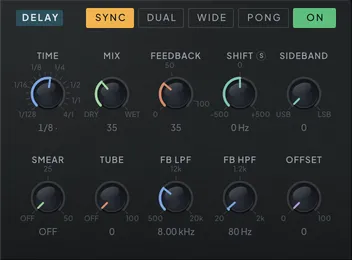
A delay with a frequency shifter in the loop: every repeat slides in pitch by a fixed number of hertz — inharmonic tails, barber-pole echoes, metallic clouds. SIDEBAND picks which way the shift runs — up, down, or both at once for a ring-modulated echo; SMEAR diffuses each repeat toward a reverb-like wash; a tube stage warms the loop; DUAL, OFFSET and PONG spread it. Free TIME reaches 1 ms, where the repeats stop being echoes and become a tuned comb — metallic resonators and flanged textures instead of a delay.
- TIME · SYNC
- FEEDBACK
- FREQ SHIFT ± · WIDE
- SIDEBAND
- SMEAR
- TUBE
- FB LPF · HPF
- DUAL · OFFSET · PONG
Reverb
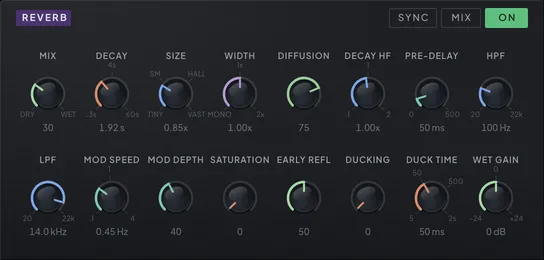
A feedback-delay-network reverb with modulated tails, ducking that rides the dry signal, and a wet-gain stage that can push the room right to the front. Resize the room mid-note and the tail follows without a click.
- DECAY
- SIZE
- WIDTH
- DIFFUSION
- DECAY HF
- PRE-DELAY
- MOD SPEED · DEPTH
- DUCKING
- WET GAIN
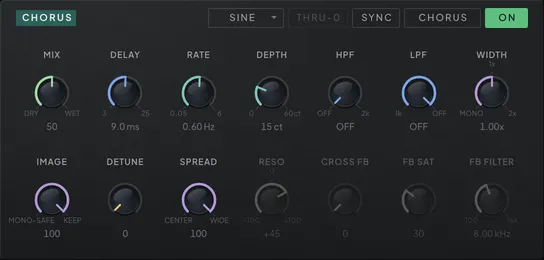
Chorus
A four-mode engine — chorus, flanger, ensemble, vibrato — with up to three detuned, pan-spread voices and, in flanger, cross-feedback and a filter inside the feedback path: from subtle width to seasick pitch soup. Depth is set in cents of pitch bend, so a setting means the same thing at every rate.
- DELAY
- RATE
- DEPTH
- WIDTH
- IMAGE
- SPREAD
- DETUNE
- RESO
- CROSS FB
- FB FILTER
Distortion
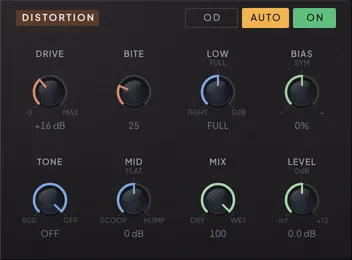
Four archetypes on one cascade — singing overdrive, hard distortion, broken fuzz and scooped high gain — with an envelope-driven mid BITE that keeps the accents legible and a clean-sub crossover. Drive is calibrated to change tone, not level, so you can A/B honestly.
- OD / DIST / FUZZ / METAL
- AUTO
- DRIVE
- BITE
- LOW
- BIAS
- TONE
- MID
- MIX
- LEVEL
Bitcrusher
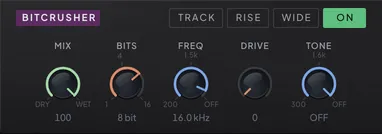
Bit depth and rate reduction with drive — from vintage-sampler dust to full collapse. TRACK ties the rate to the played pitch so the crush stays in tune with the note.
- BITS
- FREQ
- TRACK
- DRIVE
- MIX
Freezer
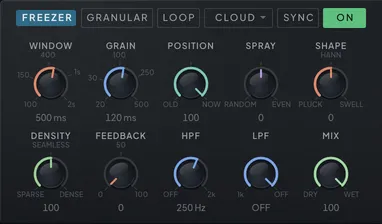
A granular engine that chops whatever reaches it into grains and rebuilds the sound out of them, and you choose what it does when you are not holding LOOP. On GRANULAR it granulates continuously, so it is an effect you play through; on LOOPER the wet path stays shut until you press LOOP and a slice of what just played comes back as a seamless sustained pad. Scrub through the capture, resize the grain, play it backwards, or scatter it into a stereo cloud. LOOP itself is a modulation target, so a step modulator can grab and release on a rhythm.
- GRANULAR | LOOPER
- LOOP
- WINDOW
- GRAIN
- POSITION
- MIX
- SMOOTH · REVERSE · CLOUD
The master section
A fixed chain at the very end of the signal, tuned for finished mixes rather than for effect.
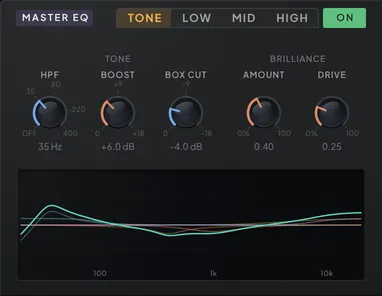
The final stage, in fixed order: a high-pass with BOOST, BOX CUT, a BRILLIANCE shelf with its own drive, then three parametric EQ bands — a resonant low shelf, a bell and a resonant high shelf, each sweepable across the spectrum with its own resonance and ±15 dB — then STEREO WIDTH with a MONO BASS anchor, and a true-peak limiter that catches inter-sample overs. Its 1.5 ms look-ahead is the only latency in the plug-in, reported to your host whether the limiter is on or off, so switching it is just a short gain fade. Every band ships flat, and a flat band is a true bypass.
The tone controls and the three EQ bands live in MASTER EQ on the FX tab, behind a TONE | LOW | MID | HIGH tab strip, while STEREO WIDTH and MONO BASS sit on the Mixer tab beside the stereo meter, and the limiter is the header’s L button. The sub’s NO FX switch routes it around the tone and stereo stages, straight to the output — only the master volume, the DRY/WET blend and the limiter still touch it.
- HIGH-PASS · BOOST
- BOX CUT
- BRILLIANCE
- LOW · MID · HIGH
- STEREO WIDTH
- MONO BASS
- TRUE-PEAK LIMITER
Run your own tracks through it
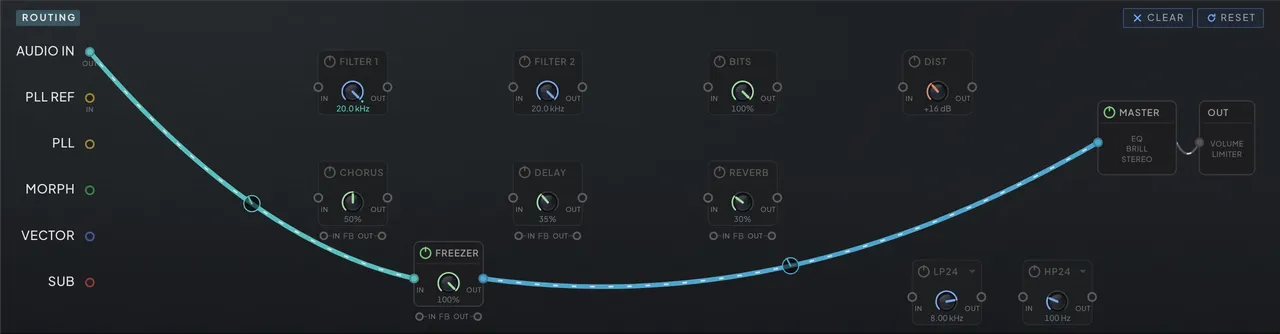
A stereo input and a sidechain, summed into one patchbay source called AUDIO IN — beside the oscillators, with the same cables.
Two ways to feed it, and they add: insert the plug-in on an audio track, or send to it from another track through its sidechain. The effects chain runs whether or not a note is held, so this needs no key press and no sequencer. DRY/WET on the AUDIO IN strip blends your track back in: 100 % is Phaseburn One alone, 0 % your track alone.
Insert the VST3, or the CLAP where your host allows it. In Logic Pro the AU sits in the instrument slot, so audio arrives through the channel strip’s Side Chain menu; in Studio One use the VST3, which declares itself as both instrument and effect.
AUDIO IN can also feed PLL REF, the reference input of the Phase-Locked Loop (PLL) oscillator, so the loop chases your audio — the Sound page has that story.
Three patches worth stealing
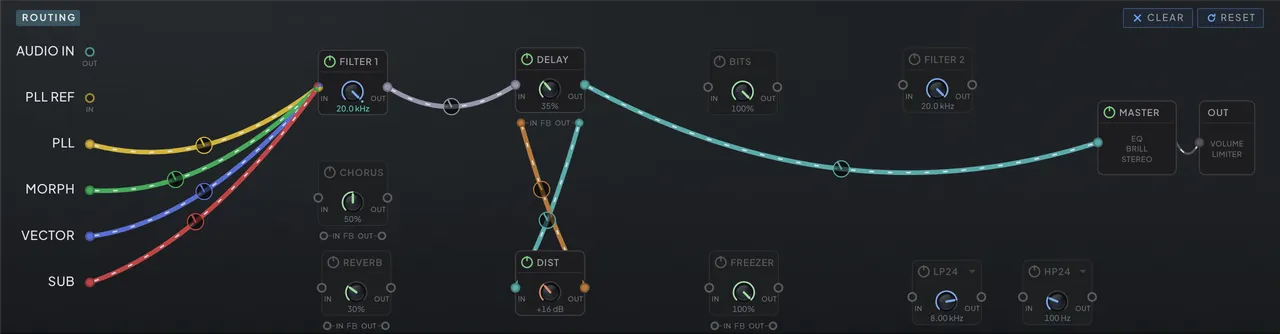
Feedback taps sit between passes, so an insert inside a loop never stalls the graph. Four of them — delay, chorus, reverb, freezer — and each is also a PLL REF source.
A distortion inside the delay’s feedback. Patch the delay’s FB tap into the distortion and the distortion back into FB return: every repeat degrades a little more, tails that rot as they fade.
A bitcrusher parallel to the dry signal. Fan the filter’s output into the crusher on a second lane straight to the master and use that cable’s own gain as the blend — grit beside the clean voice, not on top of it.
The sub straight to the output. NO FX on the SUB section — the same control as the patchbay’s SUB → OUT cable — keeps the low end untouched however hard the rest is driven.
Read the chapters
Every claim on this page traces to the manual — the same manual that ships inside the plugin.

Own it forever
One payment, a perpetual, DRM-free license: activate once, verified offline forever, on up to 3 of your machines. The demo is free to try — registering lifts its limits: the periodic dip, and the watermark that keeps you from bouncing with it.
€149 one-time · VAT included
Card, PayPal, Apple Pay or Google Pay — secure checkout by Paddle, the license key arrives by email instantly