

Monophonic synth · native Rust

PHASEBURN ONE

Built around a Phase-Locked Loop — a control circuit from radio engineering, turned into a voice. Locked, it’s precise, weighty bass. Pushed, it glides, overshoots and slips into controlled chaos no ordinary oscillator can make.

  • Three engines + sub — published research plus our own algorithms, nothing emulated
  • True stereo from the source — most synths fake width afterwards
  • A probability sequencer that writes grooves with you, not for you

Open beta 15 August 2026 v1.0 release 15 October 2026

Free while in beta · €149 at launch

VST3 · CLAP · macOS · Windows

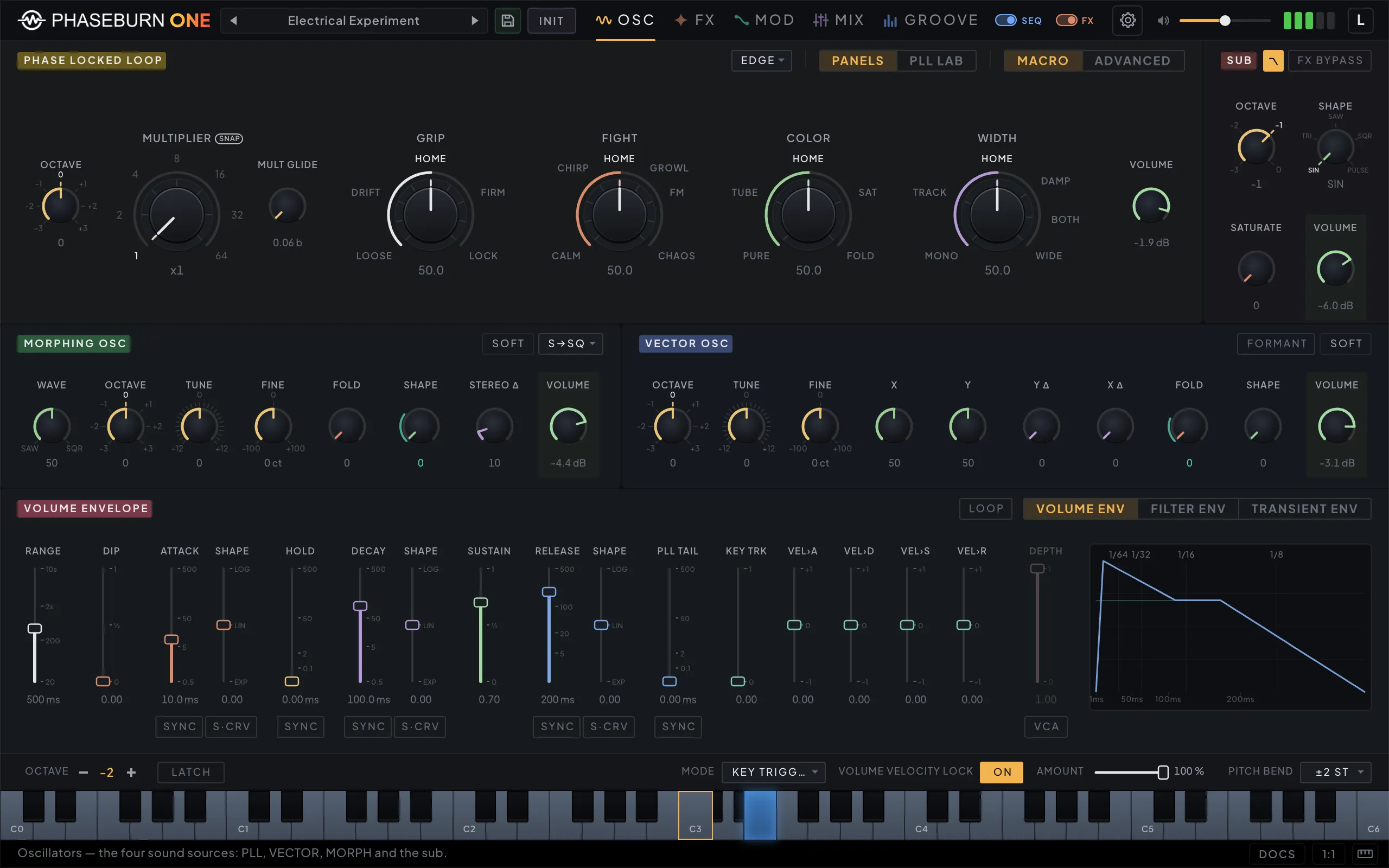
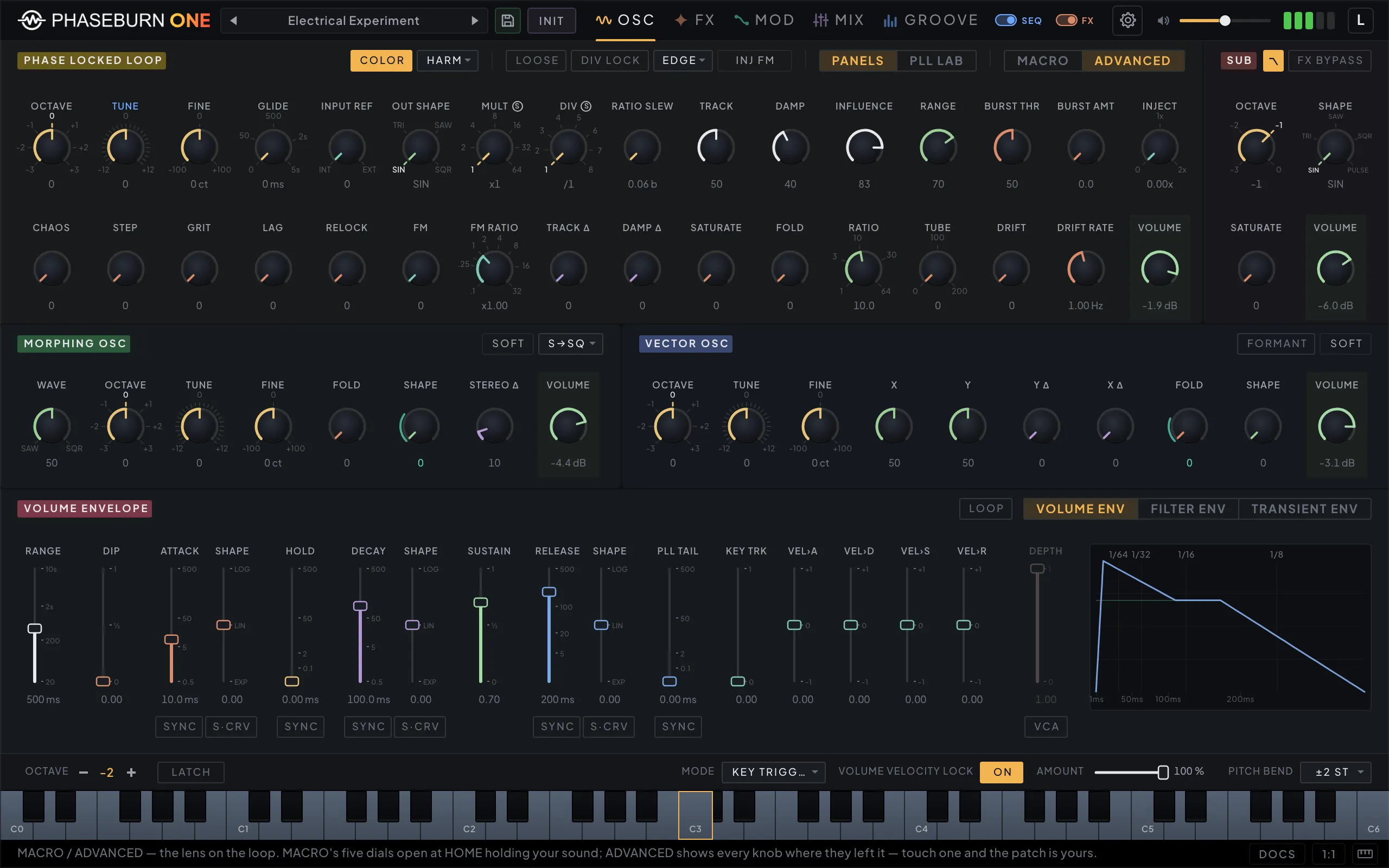
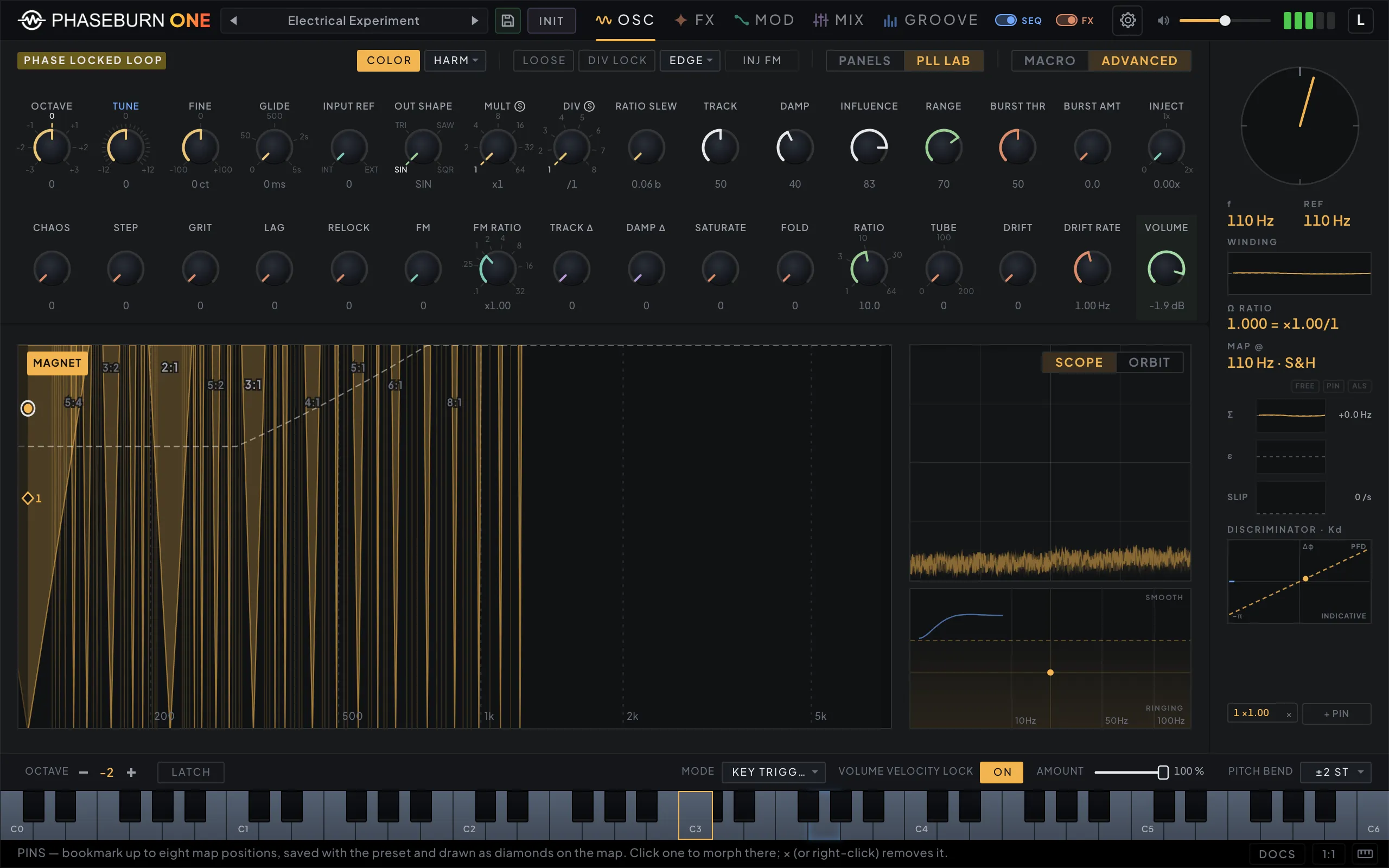
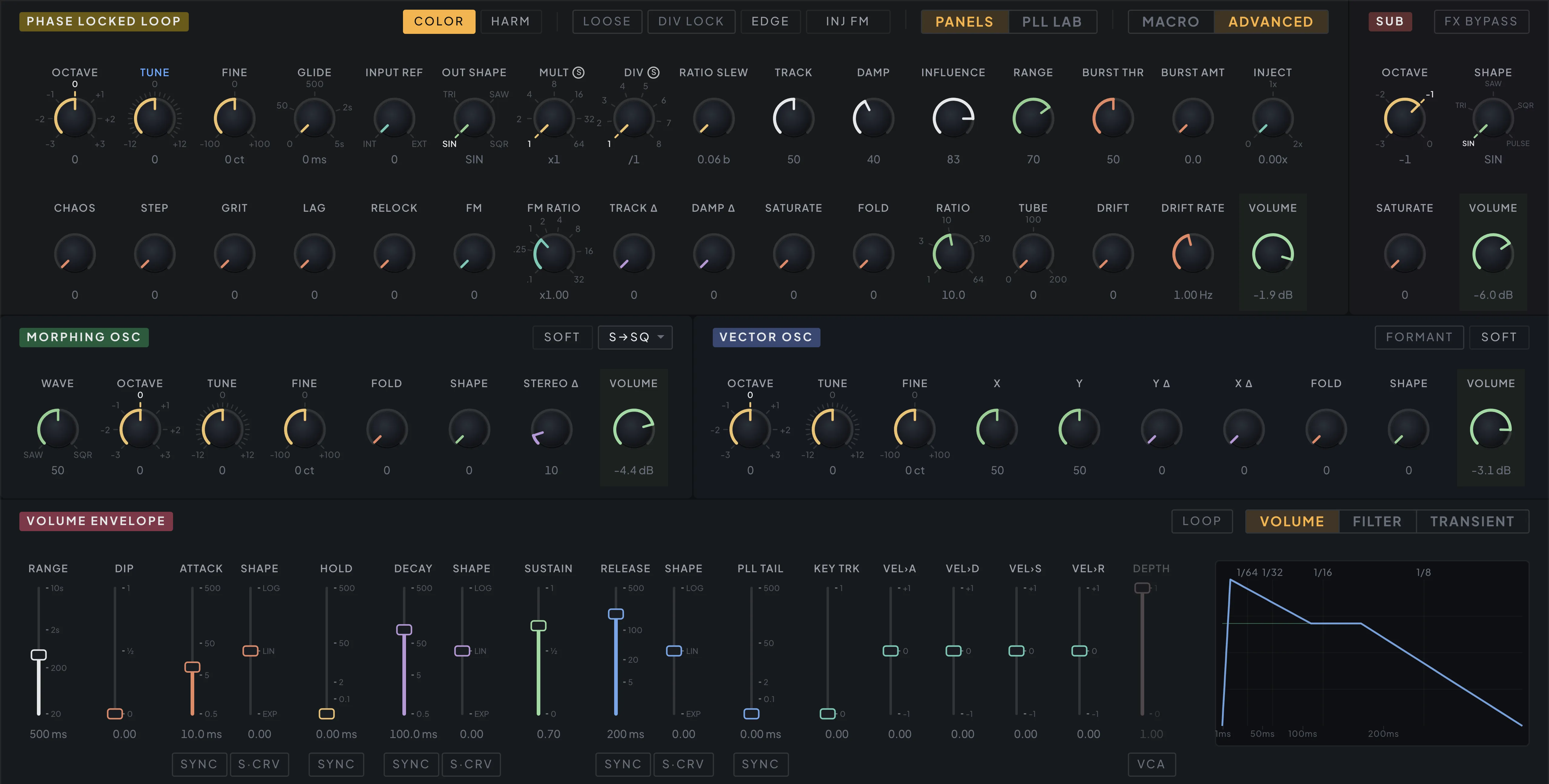
Phaseburn One oscillators page: Phase-Locked Loop, MORPH and Vector Phase Shaping panels with color-coded knobs
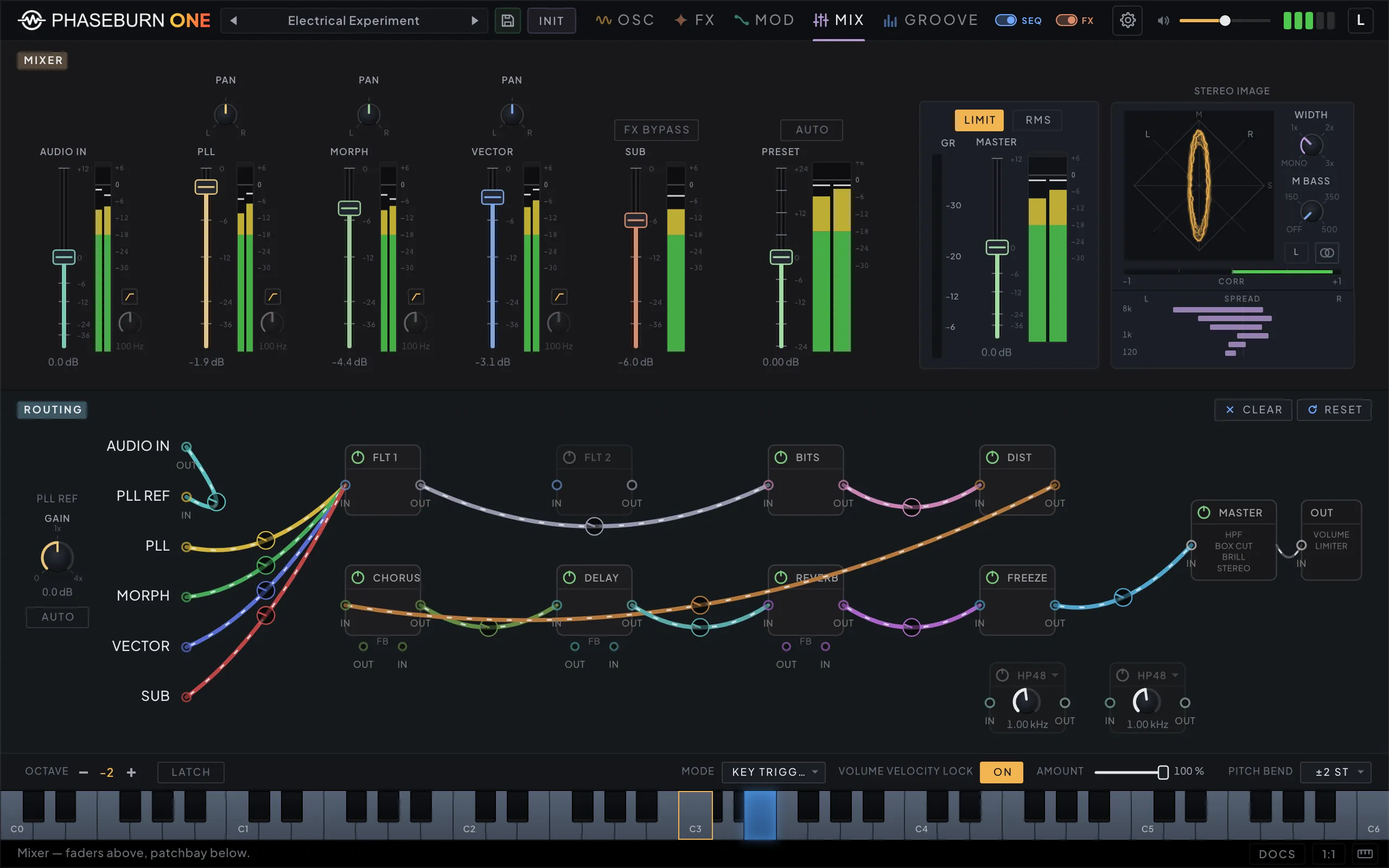
Phaseburn One mixer page: per-module channel faders, a goniometer stereo-image scope, and a routing patchbay where modules are connected by patch cables
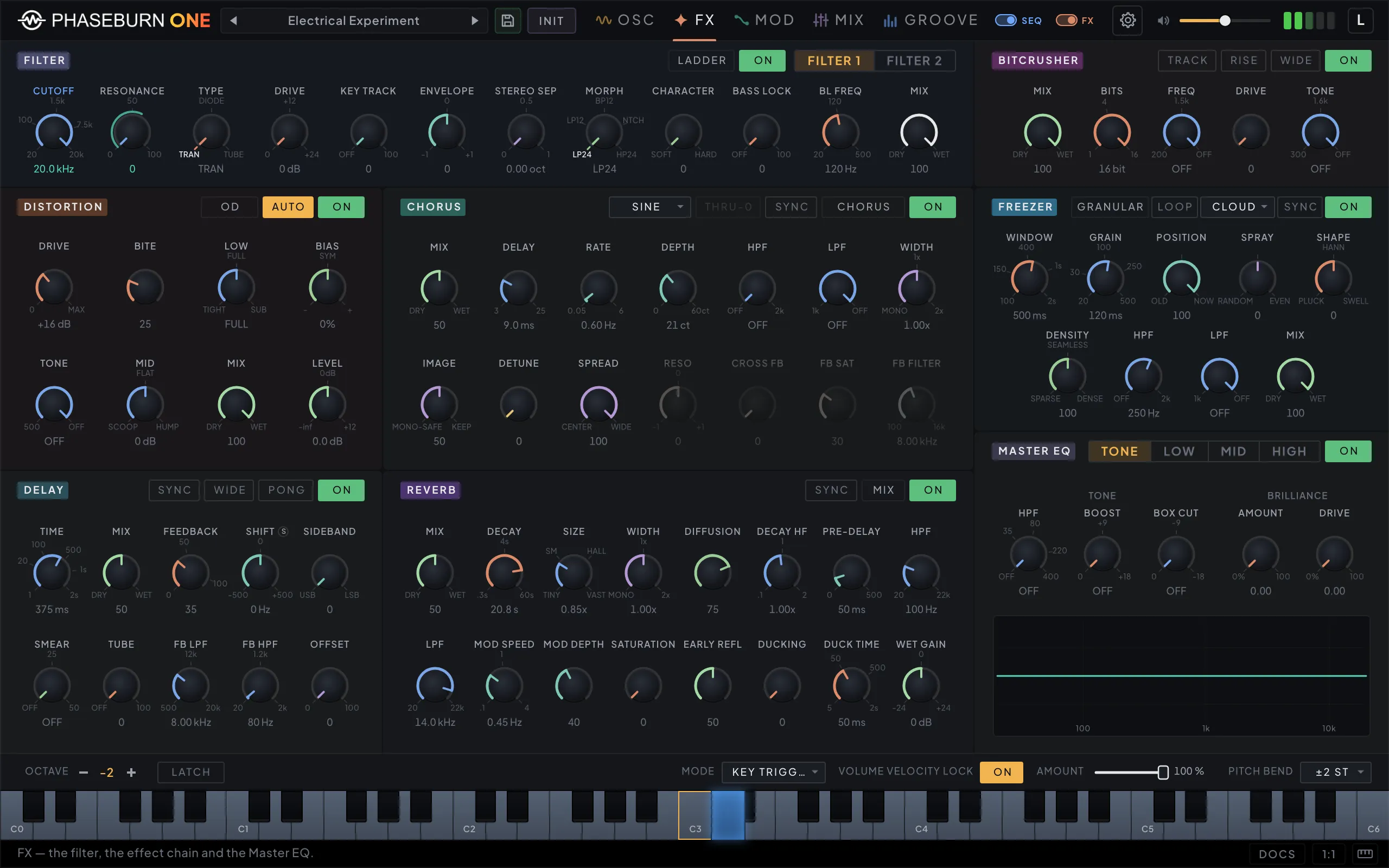
Phaseburn One FX page: filter, chorus, delay, reverb, distortion, bitcrusher and granular freezer sections
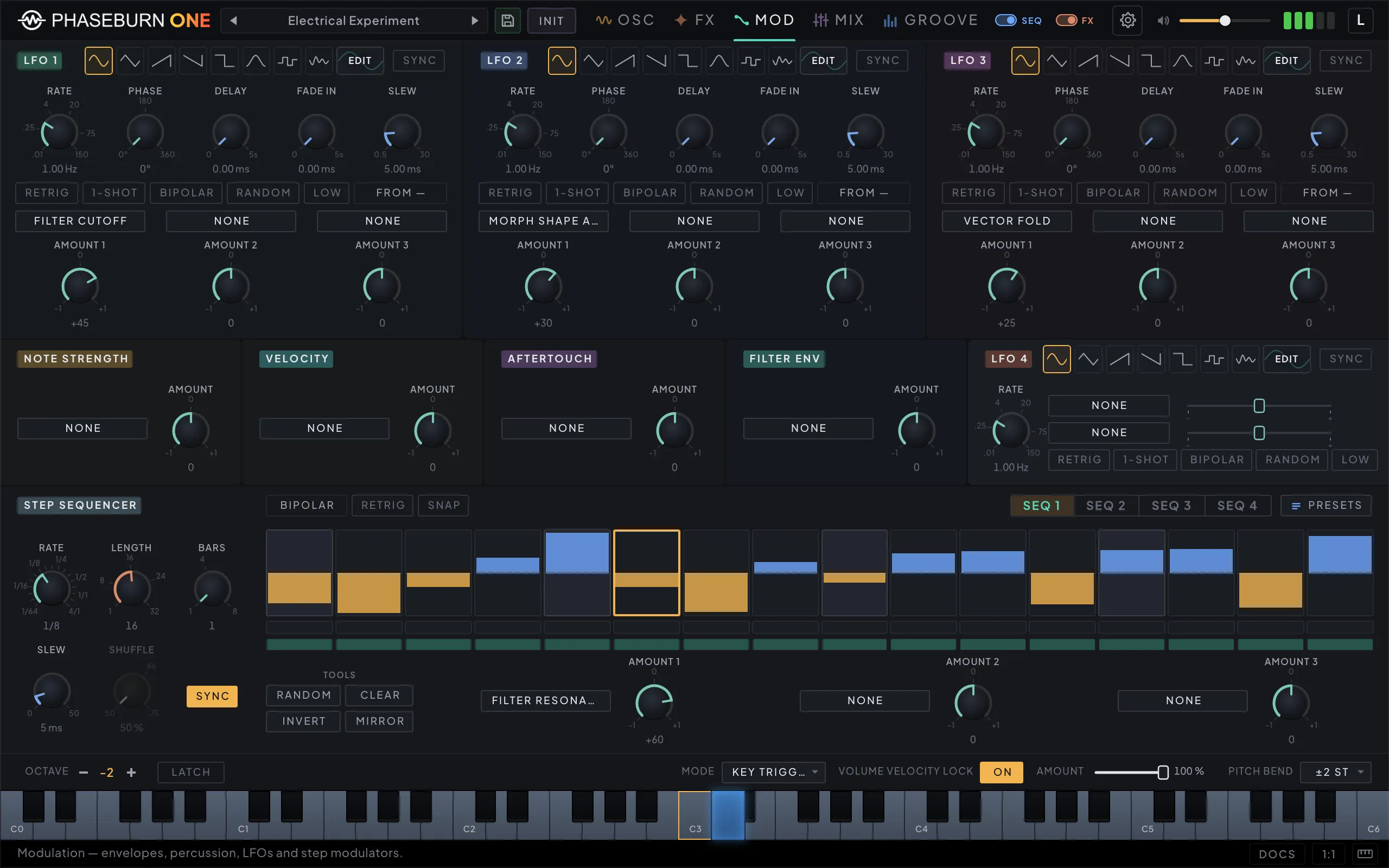
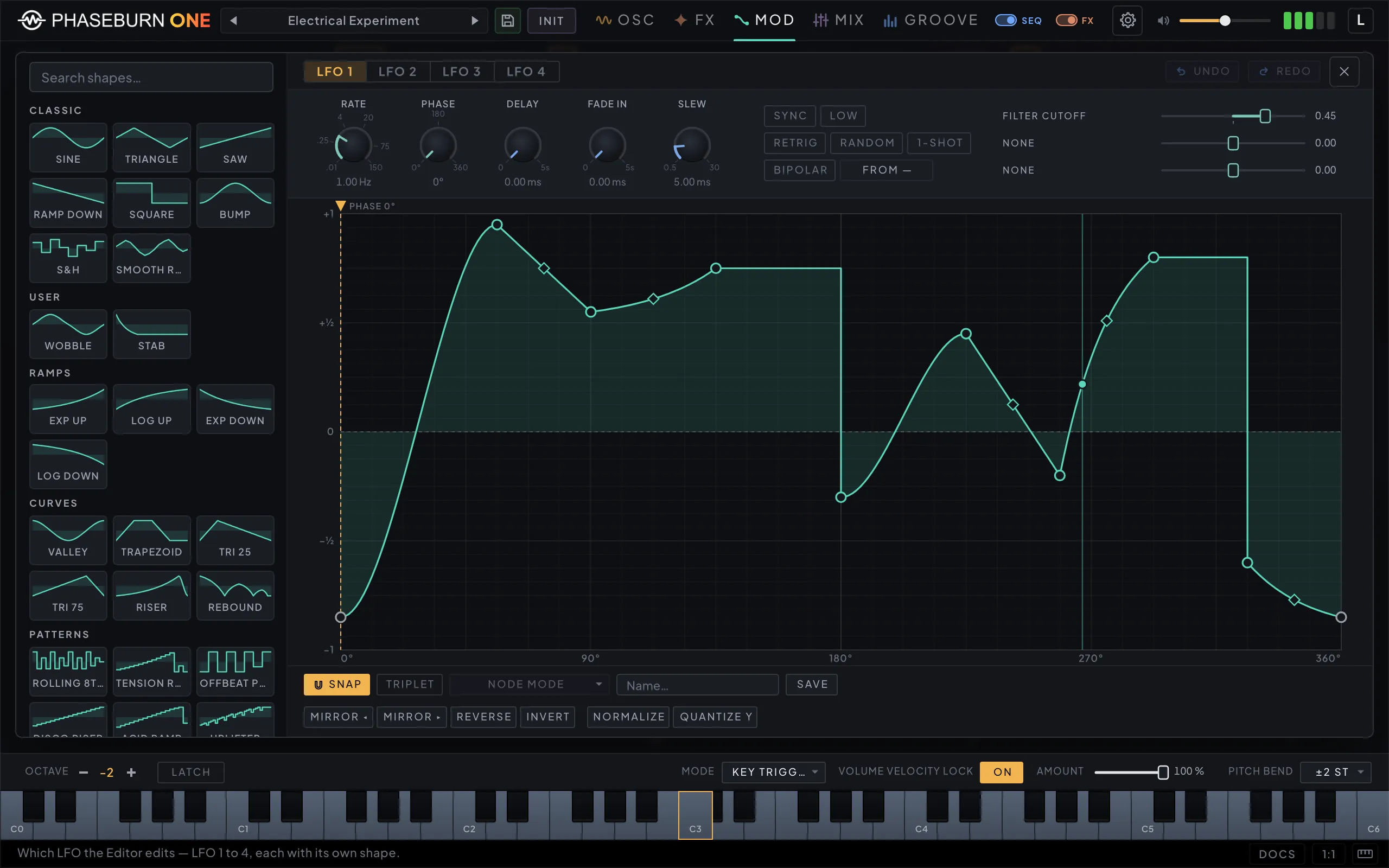
Phaseburn One modulation page: three routable LFOs, note strength, velocity and aftertouch modules, and a bipolar step sequencer
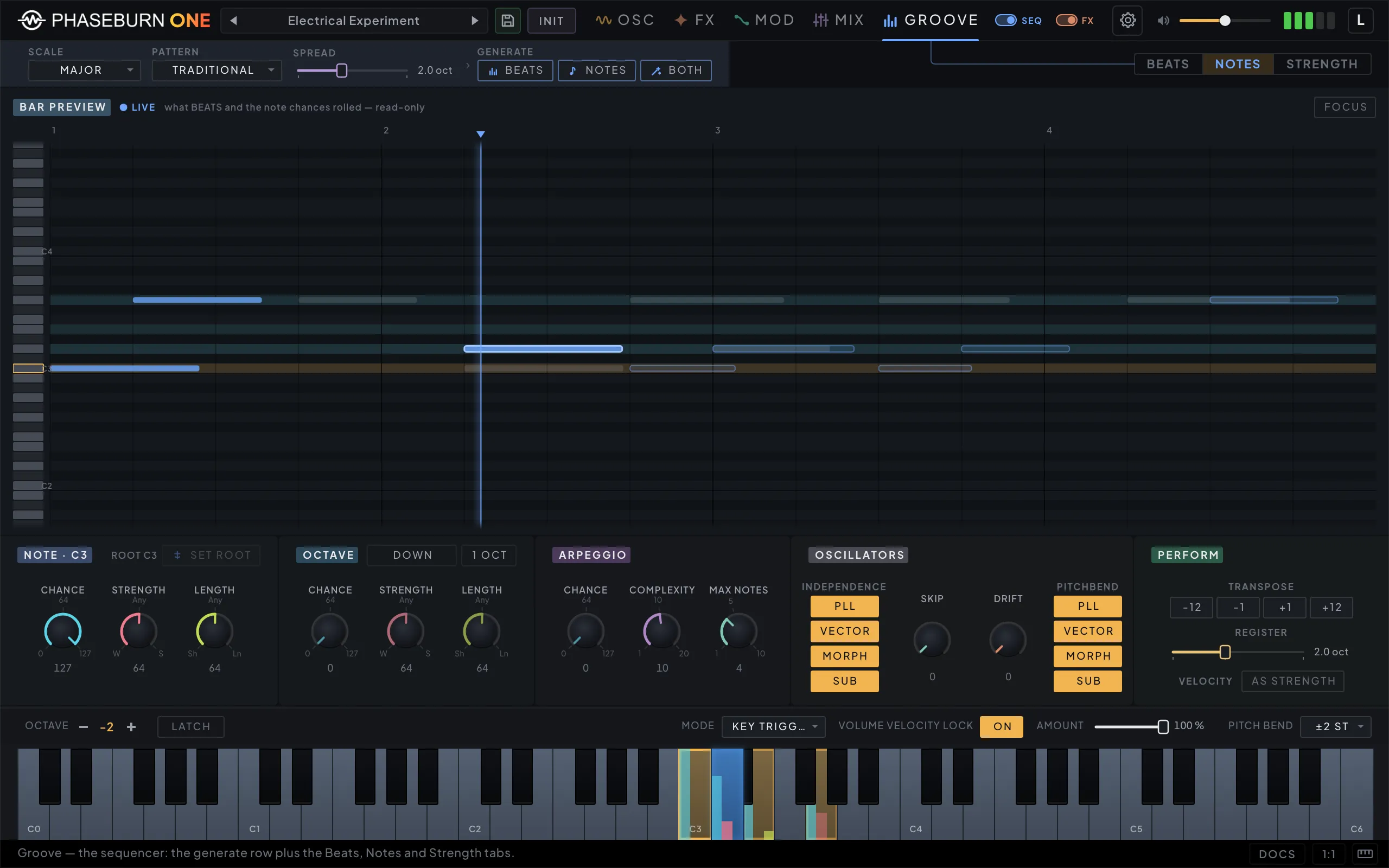
Phaseburn One Groove page, Notes tab: live bar preview above a keyboard note pool with chance, strength and length controls
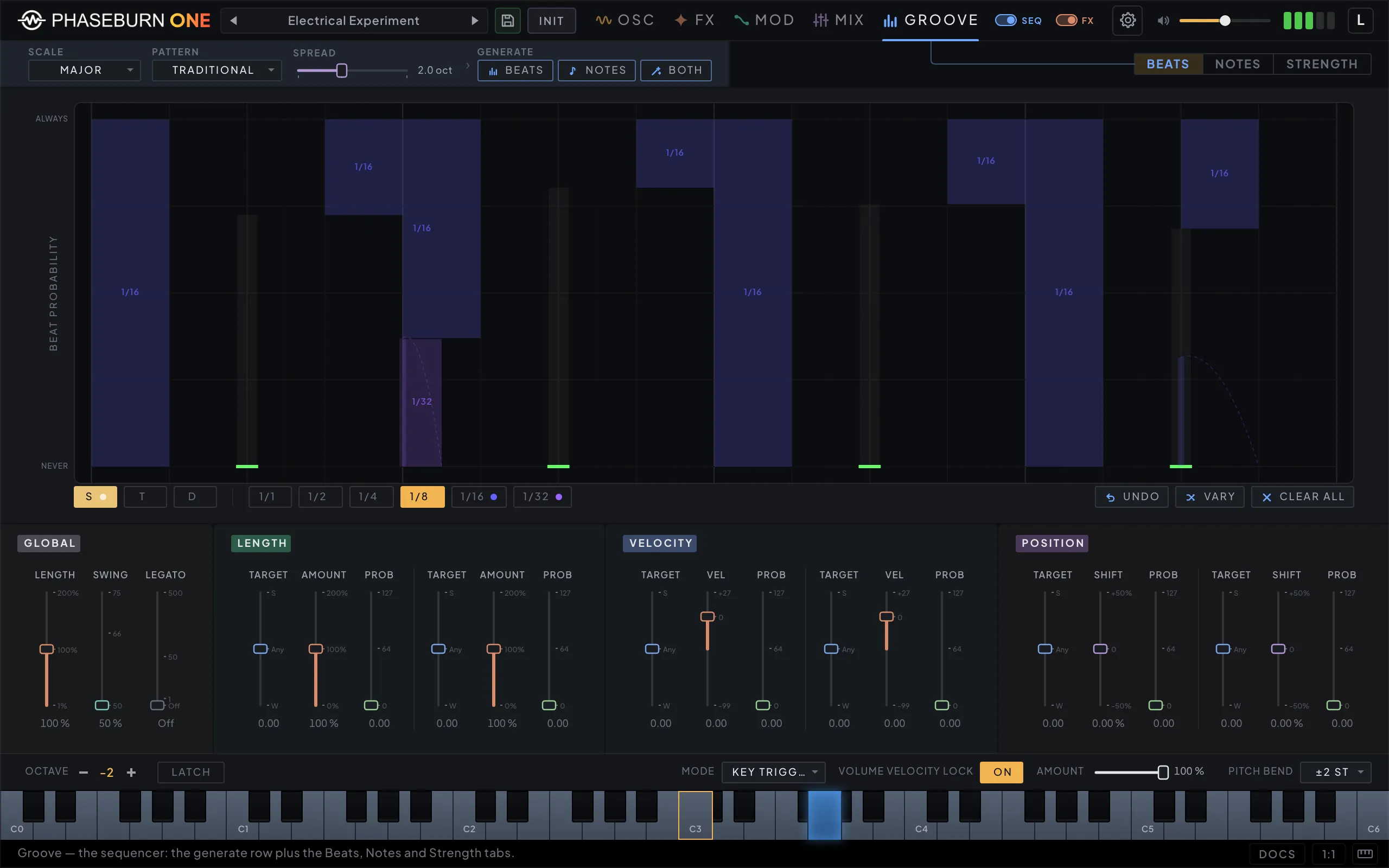
Phaseburn One Groove page, Beats tab: per-slot probability bars with swing, length, velocity and position groove tools
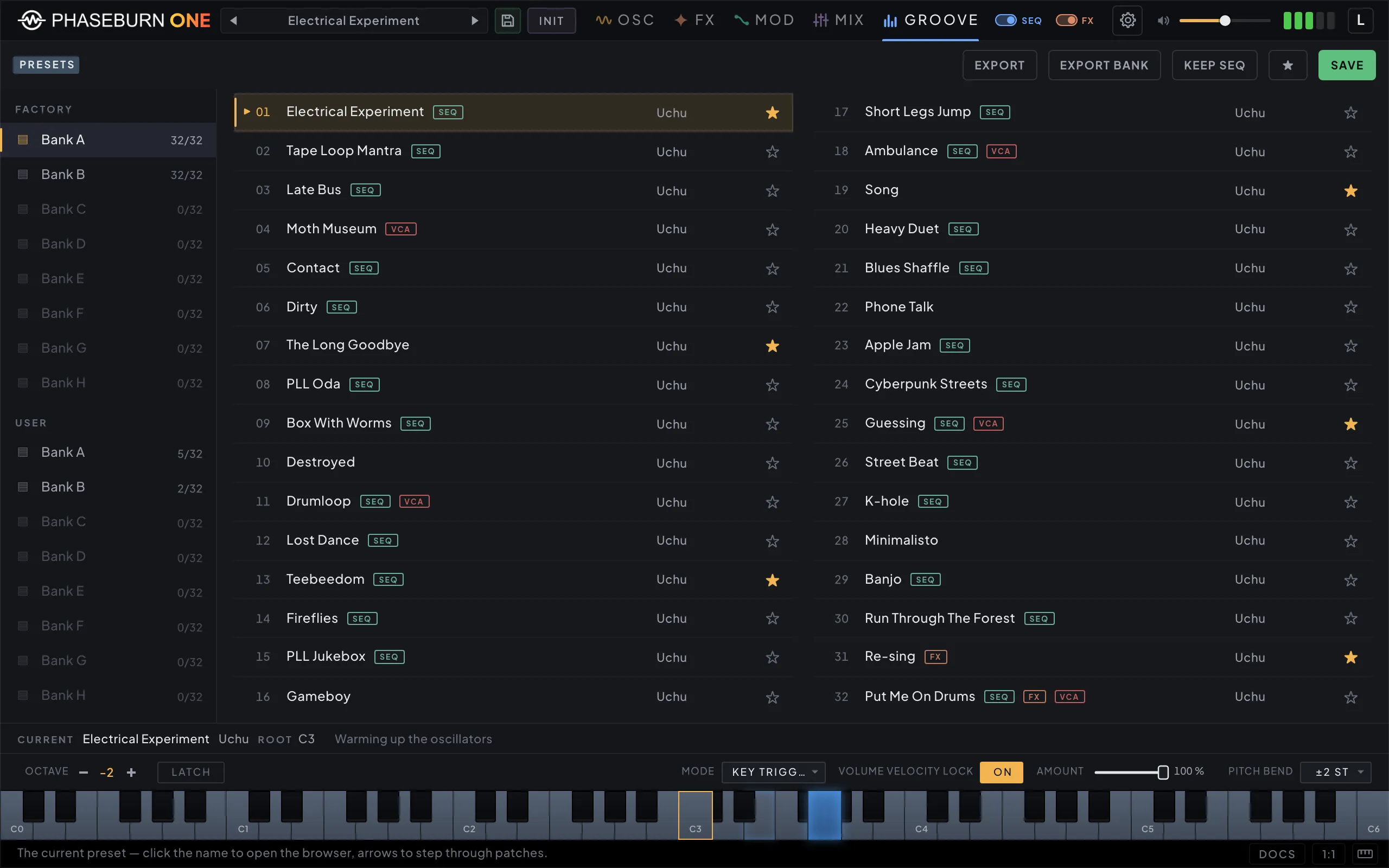
Phaseburn One preset browser: factory and user banks with favorites and sequence tags
Oscillators Phase-Locked Loop, Vector Phase Shaping and MORPH, side by side
Mixer & patchbay Per-module faders with a live stereo scope, modules wired as patch cables below
FX Filter, chorus, delay, reverb, distortion, bitcrusher, freezer — each with its own input
Modulation Three LFOs, note modulators, and a step sequencer with per-step probability
Groove · Notes Scale-aware note pool with per-note probability — and a live preview of every rolled bar
Groove · Beats Beat slots carry chances, not fixed steps — every bar is a fresh draw
Presets Factory and user banks — favorites, sequence tags, import and export down to whole banks
1 / 7
Why it’s different

Four reasons producers pick it up

The voice

Phase-Locked Loop synthesis

An analog control loop turned into an oscillator — from locked, weighty bass to gliding, controlled chaos, with a four-knob loop lab to bend the servo itself. And it is true stereo: both channels generated independently, at the source.

The wiring

A patchbay inside

Every module is a node. Cable series, parallel, even feedback taps — from a classic chain to setups usually only modulars reach.

The groove

Probability sequencer

Steps carry chances, not certainties, across three grids in one bar. Suggest writes grooves from music theory — rules you can read.

The build

Engineered precision

64-bit signal path, oversampling, zero-delay filters, true-peak limiting. Native Rust — published research plus algorithms of our own.

In the box

Everything, at a glance

Engines
  • Phase-Locked Loop
  • PLL Lab lock map
  • Vector Phase Shaping
  • MORPH (12 modes)
  • Sub oscillator
  • True stereo path
  • Percussion mode
FX
  • Multimode filter
  • Frequency-shifting delay
  • FDN reverb
  • Granular freezer
  • 4-mode chorus
  • 4-archetype distortion
  • Bitcrusher
Master
  • Brilliance exciter
  • Stereo width
  • Mono bass
  • Box cut
  • High-pass
  • True-peak limiter
Modulation
  • 3 cross-modulating LFOs
  • 4 mod sequencers
  • 115+ targets
  • Aftertouch & velocity
  • MIDI learn
Sequencer
  • 3 grids in one bar
  • Per-step probability
  • Beat links: ratchets & fills
  • Suggest groove generator
  • 17 scales
  • DAW sync
Routing
  • Modular patchbay
  • Stereo audio input
  • Works as an insert effect
  • PLL locks to external audio
  • Feedback inserts
  • Repatch while it plays
Phaseburn Music

Instrument № 1 of many

Phaseburn One is the first. More instruments and tools are in the lab — build notes, sound-design experiments and beta news land on the blog.

No slop

No AI in the sound. Every voice is built from published research and our own algorithms.

The generative tools run on plain music theory — deterministic rules you can read and predict. The foundations come from open research; the character comes from algorithms of our own — the probability sequencer, Suggest, the patchbay engine. Phaseburn One emulates nothing. It sounds like itself.

We credit the people whose published work and ideas the engine stands on:

  • Vector phase shaping Kleimola, Lazzarini, Timoney & Välimäki, 2011
  • Zero-delay-feedback / TPT filters after Zavalishin, “The Art of VA Filter Design”
  • Nonlinear ladder filter after D’Angelo & Välimäki, IEEE 2014
  • Antiderivative anti-aliasing (ADAA) Parker, Zavalishin & Le Bivic, 2016
  • Hadamard feedback-delay-network reverb Jot / Stautner–Puckette lineage
  • Single-sideband frequency shifting classic Bode frequency-shifter technique
  • Probability-sequencer concept based on ideas by Alexey Kurkin (Parasense)
Open beta

Get in before launch

Free to use until October 15, 2026 — after that it keeps working as a demo until you register a perpetual, DRM-free license, which you can do any time. The full license goes free to ten beta users we pick, and shipping at least one of your presets in the factory bank earns you at least a solid discount — all at our discretion.

Free €149 to own — any time

Join the beta → Explore Phaseburn One

No card required · perks and preset picks are at our discretion — the beta comes with no guarantees