
Four sources, one voice
The voice is a Phase-Locked Loop (PLL) — a control circuit from radio engineering, turned into an oscillator that has to chase every note. Beside it sit VECTOR, MORPH and a sub, summed into one voice by design, with width built at the point of generation by the three pitched sources. One voice — and still chords, rolled by chance through Paraphony.
The loop is the voice
An oscillator that listens to a reference, measures how far its phase has drifted, and constantly corrects itself. Phaseburn One turns that chase into sound.
TRACK sets how fast the oscillator chases, DAMP how hard the correction brakes, INFLUENCE how much the reference pulls. Keep the loop tight and it locks: solid, weighty pitch with analog character. Loosen it and the chase itself becomes audible — a gliding approach, ringing overshoot, sirens and growls.
The circuit was built to hide its error. The error is the interesting part.
Four dials to play it
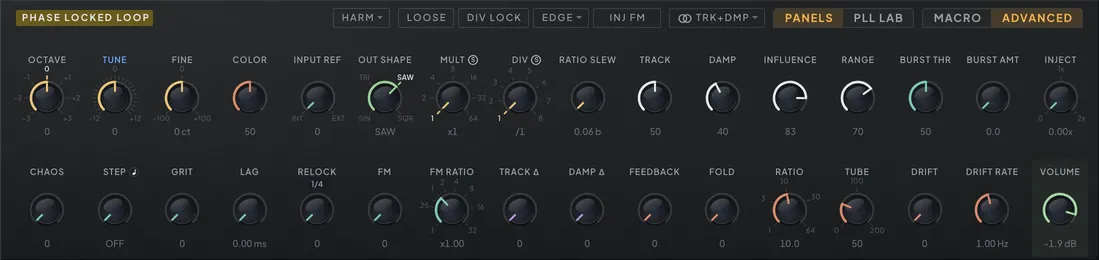
The PLL opens on the MACRO lens. Your sound lives at twelve o’clock; nothing changes until you turn a dial.
GRIP is how hard the loop holds the note. FIGHT is how much is thrown at it. COLOR is the coloration stage — tube, color, the loop’s own feedback and the fold — as one travel. WIDTH is how far apart the two loops are tempered. MULTIPLIER sits beside them, because the ratio is a musical choice rather than a character.
Each dial is a single path through the loop, tuned by ear, with named landmarks along the way, and every one opens on HOME — your own patch, exactly as saved. Nothing is hidden: ADVANCED shows the full panel, unchanged, and touching any knob a macro owns hands the patch straight back to you.
Push it
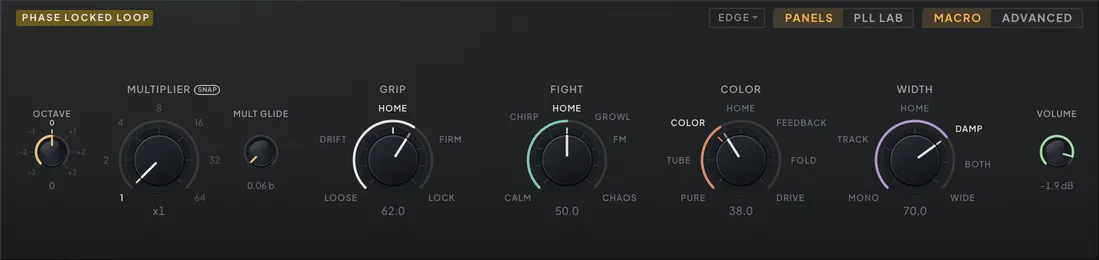
Under ADVANCED the loop is the stock circuit with its four defects on knobs — all at zero until you ask.
MULT and DIV set the ratio the loop chases — note × MULT ÷ DIV — so it reaches fifths, twelfths and undertones, and either knob sweeps every ratio in between once its snap is off. Four phase detectors change the character of the chase: a smooth analog comparator, a hard edge-triggered detector, a harmonic-locking XOR and a stepped sample-and-hold.
BURST and INJECT tip it into controlled chaos that stays playable, because the loop always wants to come home; CHAOS walks it to the edge of lock. And the loop lab — STEP, GRIT, LAG, RELOCK — is four defects of real hardware loops, each a modulation destination.
- MULT · DIV
- DIV LOCK
- PD · EDGE · XOR · S&H
- BURST
- INJECT
- CHAOS
- STEP
- GRIT
- LAG
- RELOCK
- HARM · SAT · FOLD
- FEEDBACK
- TUBE
- DRIFT · RATE
See the loop
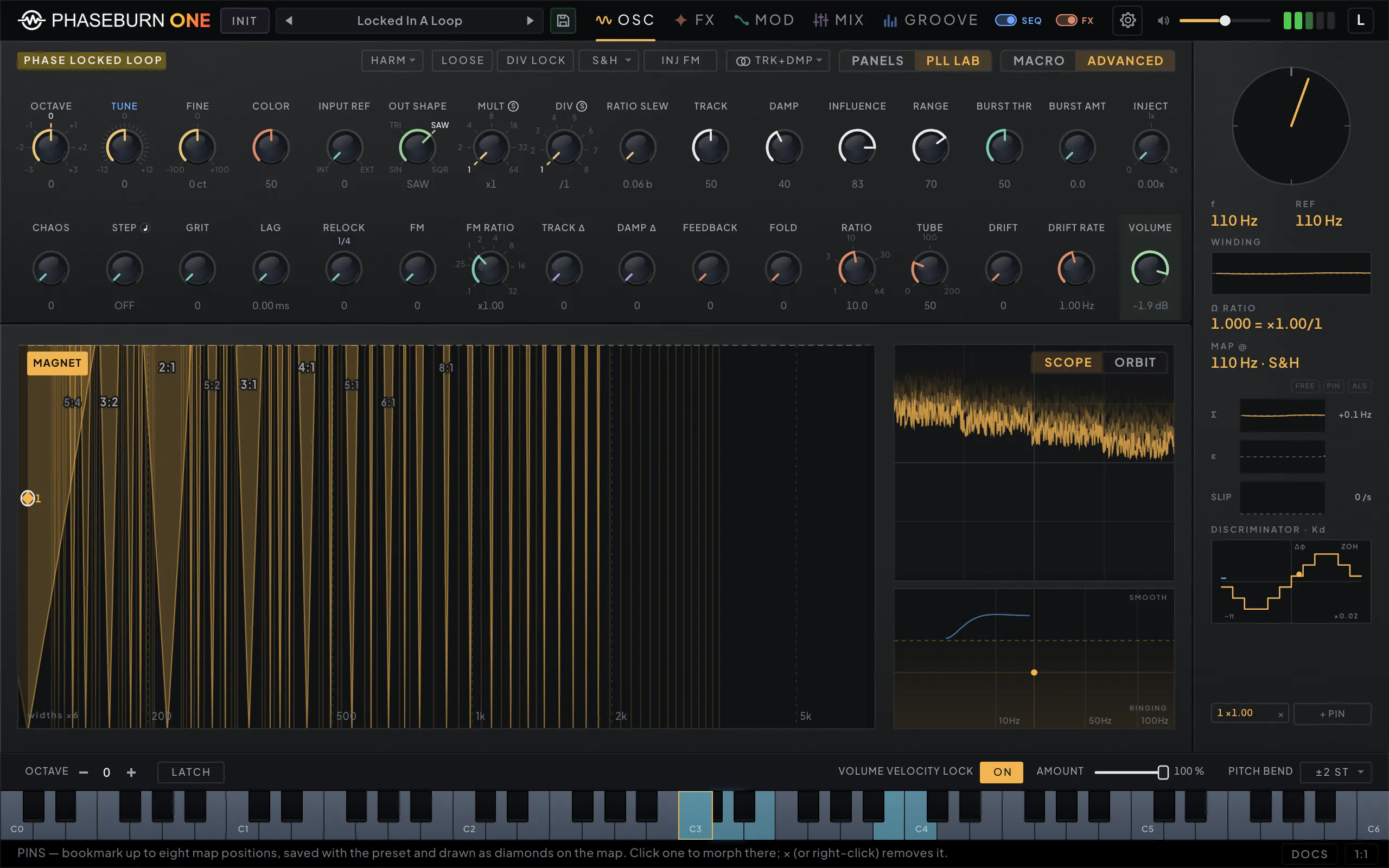
The PLL LAB flips the OSC page into a live chart of the loop itself — and the chart is a control surface.
A computed lock map shows where the loop locks, slips or runs chaotic at the current settings. A strobe wheel freezes when it locks and turns when it slips; a phase-error scope and a servo pad read the loop as it breathes.
Drag the operating point and MULT and INFLUENCE move as real host gestures. MAGNET gently pulls the drag toward the musical ratios, and up to eight PINS bookmark sweet spots that save with the preset.
Lock it to something else
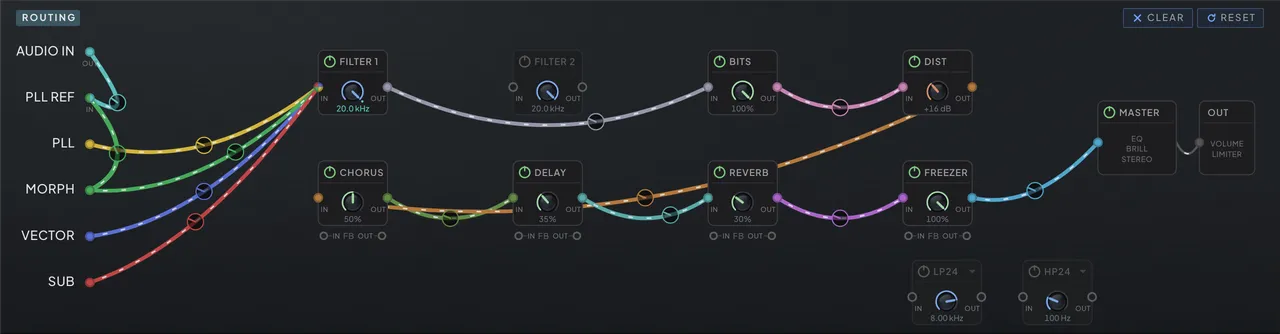
PLL REF takes every output on the panel — any oscillator, the mix, any effect, a feedback tap, or your own audio.
Patch MORPH into PLL REF for cross-modulation with no host routing at all. Patch a drum loop or a vocal in through AUDIO IN and the loop chases that instead. This is not pitch tracking: the note you play still sets where the loop sits, and the incoming signal drags it around — feed it drums and the pitch lurches on every hit.
Every cable into PLL REF carries its own gain, so the cable sets how hard its source drives the comparator; the AUDIO IN fader trims your audio before it gets there. Silence on AUDIO IN closes the oscillator instead of leaving a drone.
The sculptor, the palette, the foundation
Three more sources into the same voice, each with a job the loop does not do.
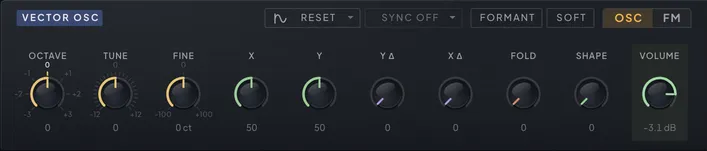
VECTOR bends the phase of a waveform around a movable inflection point: X and Y sweep one cycle from smooth and flute-like to bright and biting without swapping waveforms — vector phase shaping, after Kleimola, Lazzarini, Timoney and Välimäki (2011). FORMANT places the energy on vowel-like peaks, and an FM tab lets MORPH, the sub and the PLL play into it, each through its own TONE, with FEEDBACK, a stereo WIDTH and the filter envelope to sweep the depth.
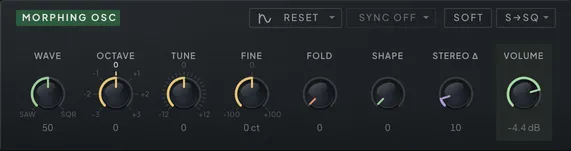
MORPH sweeps twelve waveform families on one knob — classic shapes, Swarm’s seven detuned saws, hard sync, additive build-ups to 64 harmonics, staircase shapes, source-filter vowels with BREATH and SIZE, a spectral wavetable — with click-free crossfades. VECTOR and MORPH each carry a Sync menu: lock to the note or the sub, then turn Tune for the classic sync sweep while the note stays put.
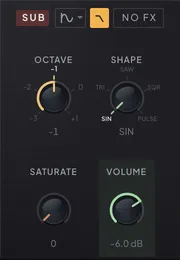
The sub runs from three octaves below the note to one above, shaped from sine through triangle, saw and square to a narrowing pulse, with SATURATE for weight and a NO FX switch that routes it around the whole rack, so the low end stays untouched however hard the rest is driven.
Width, built at the source
The three pitched sources generate left and right independently, so width is built at the point of generation.
The PLL runs two complete, independent loops, and a stereo pair menu chooses what sets them apart: TRACK Δ and DAMP Δ temper one side against the other, or PHASE and DETUNE hold a still, wide offset or an in-tune chorus beat. The MACRO view’s WIDTH dial drives whichever pair you chose. VECTOR runs X∆ and Y∆. MORPH’s Swarm spreads its seven voices across the field, and with STEREO ∆ at zero it folds back to mono. The filter adds STEREO SEP. Width comes from the waveform itself and moves with the sound, instead of being pasted on at the end.
The sub is the exception: mono, feeding both channels equally, which keeps the low end centered — and MONO BASS in the master section anchors it. There is still a chorus, as a color, not a repair.
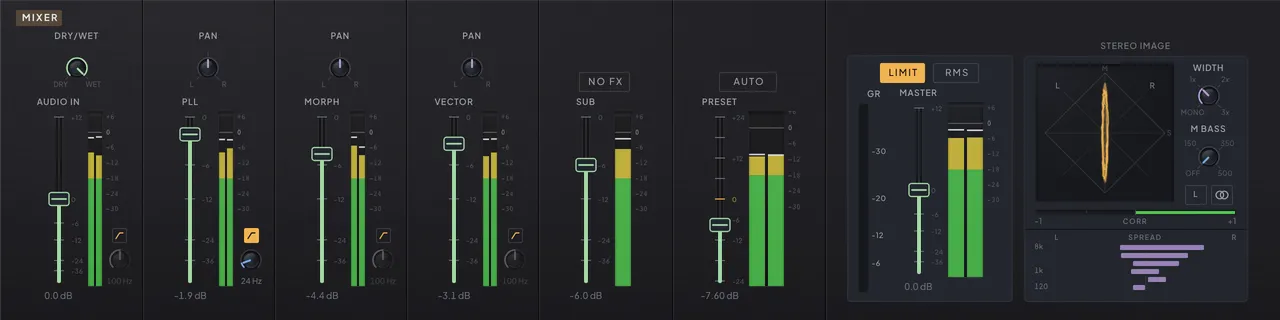
One voice — and chords, by chance
Every cycle of the engine goes into one voice. Independence lets the four sources disagree about the note.
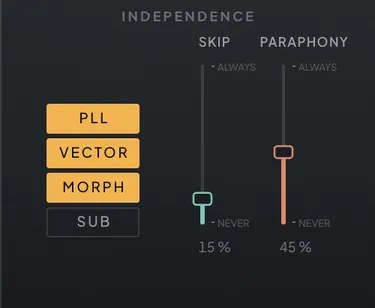
On the OSC page’s Voicing tab, Independence has four target switches and two sliders. SKIP is a per-note chance that a source sits a note out. PARAPHONY is a per-note chance that it plays a different note from the sequencer’s pool, with the same chance-and-strength weighting the pool always uses.
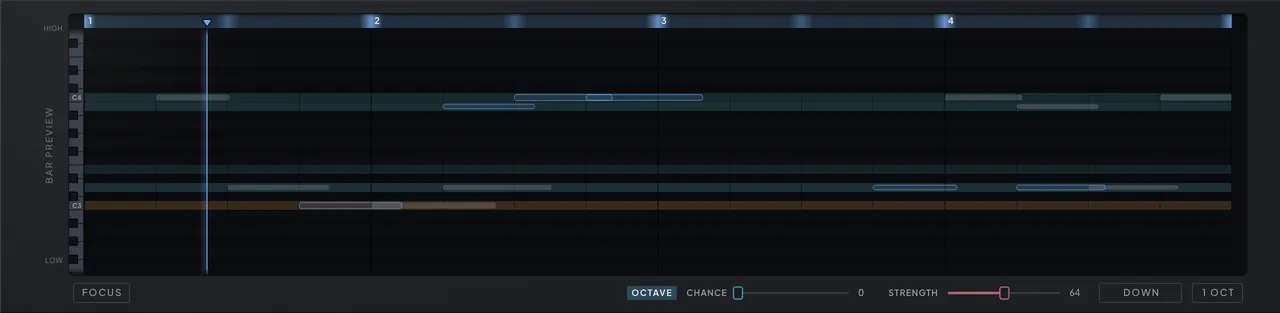
Arm PLL, VECTOR and MORPH, protect the sub, and one line stacks intervals, open fifths, whole chords — harmony that moves, because the sequencer is choosing. The bar preview draws the rolled bar before you hear it, and marks each drifted note the moment it fires. Notes you play roll the same dice, SEQ on or off, so a line you play from the keyboard still splits across the sources with the Groove put away. Only an audition, a click on a note in the pool, plays exactly that note on every oscillator.
Read the chapters
Every claim on this page traces to the manual — the same manual that ships inside the plugin.
Own it forever
One payment, a perpetual, DRM-free license: activate once, verified offline forever, on up to 3 of your machines. The demo is free to try — registering lifts its limits: the periodic dip, and the watermark that keeps you from bouncing with it.
€149 one-time · VAT included
Card, PayPal, Apple Pay or Google Pay — secure checkout by Paddle, the license key arrives by email instantly