
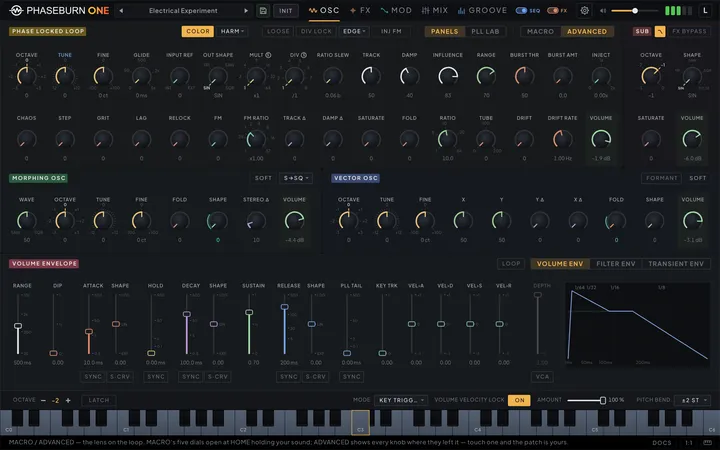
Everything you hear from Phaseburn One starts with four sources: the Phase-Locked Loop (PLL) that gives the instrument its voice, a VECTOR phase-shaping oscillator, the MORPH oscillator with its twelve waveform families, and a sub. This chapter walks through each one — what it is for, how to play it, and every control it exposes.
Four sources, one voice
Pick the sources you need, balance them with four volume knobs, and the instrument plays them as a single line. All four live on the OSC tab — a section each for the PLL, VECTOR, MORPH and the sub — and every section ends in its own volume knob. Their outputs sum into one voice path, and the entire processing budget goes into making that voice deep rather than eight shallow ones — though the voice is optionally paraphonic: each source can leave the written note behind (see Oscillator independence below).
Each source has a distinct job. The PLL is the lead character — a feedback circuit whose struggle to stay in tune is the tone itself, covered in the sections that follow. VECTOR is the sculptor: two knobs bend a wave from soft to snarling, with a formant mode for vowel-like resonances. MORPH is the conventionalist, holding every classic waveform and a few less classic ones on a single morphing knob. The sub is the anchor: low-end weight with shape and saturation controls, and routing that keeps it clean when the rest of the patch gets violent.
Blending is direct: raise the volume of what you want, pull down what you don’t. The volume knobs top out at unity, so the balance you set is the level every cable from that source starts from, and the same four volumes reappear as channel faders on the Mixer tab. There, each pitched source also gets a PAN knob — a constant-power stereo balance that is bit-transparent at centre and a modulation destination in its own right, so a source can sit off to one side or swing across the field under an LFO. Stereo character itself comes from the pitched sources — the PLL, VECTOR and MORPH each run independent left and right engines, so width is built at the point of generation instead of being pasted on afterwards. The sub is the exception: it is mono, feeding both channels equally with no pan, which keeps the low end centered where it belongs.
The tables at the end of each section in this chapter list every parameter with its range and default; the same data, compact and complete, lives in the full parameter index (Chapter 12 — Reference). Prose in this chapter deliberately avoids repeating numbers the tables already carry.
The Phase-Locked Loop
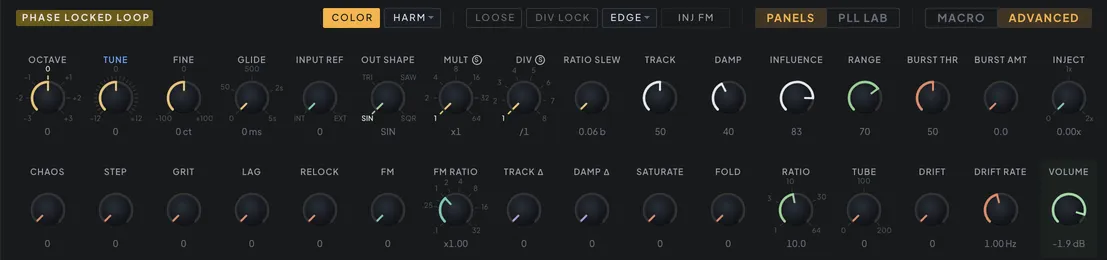
Make a note lock solid and weighty, then loosen the loop until the pitch has to fight its way to every note. The Phase-Locked Loop (PLL) is Phaseburn One’s main voice, and the fight is the sound.
A phase-locked loop comes from radio engineering. One oscillator listens to a reference signal, measures how far its phase has drifted, and corrects itself continuously. In every textbook application the loop exists to erase that error as fast and as invisibly as possible. Phaseburn One is built on the opposite idea: the error is the interesting part. An ordinary oscillator jumps to a new pitch instantly and perfectly. A loop has to get there — it notices it is wrong, accelerates, brakes, overshoots, corrects again — and that whole struggle happens at audio rate, in the waveform itself. Engineers spend careers suppressing this behavior. Here it has knobs.
Keep the loop tight and it locks: solid pitch with analog character, because the correction never fully rests — a live feedback process breathes under the tone. Loosen it and the chase becomes audible: the oscillator glides toward each note, overshoots, rings around the target before settling. Fast lines turn into sirens; held notes with the loop barely holding on turn into growls.
Three knobs are the core, and they map directly onto the physics:
TRACK sets how fast the oscillator chases the reference. High values snap to the note; low values drag, so every interval becomes a glide the loop has to earn. Push TRACK high enough and it overtracks — the loop overshoots in bursts.
DAMP sets how hard the correction brakes. Heavy damping eases into the target pitch. Light damping arrives too fast, overshoots, and rings — a pitch that wobbles around the note before it lands.
INFLUENCE sets how much the reference pulls at all. Back it off and the oscillator only half-believes the note you played; the loop drifts, leans, and finds its own way there.
On the full panel none of these are macros over hidden parameters — they are the loop’s actual coefficients, scaled to musical ranges. (The MACRO view, the next section, is the one place the module does offer macros, and even there they drive these same knobs.) The reference the loop chases is an oscillator of its own, and you can move the target: transpose it with the octave and tune controls, or detune it slightly with the fine control so the lock leans and slowly beats. OCTAVE reaches four octaves down from whatever you play, which on a low note takes the reference under hearing — territory with its own rules, described at the end of Pushing the loop below.
MACRO view
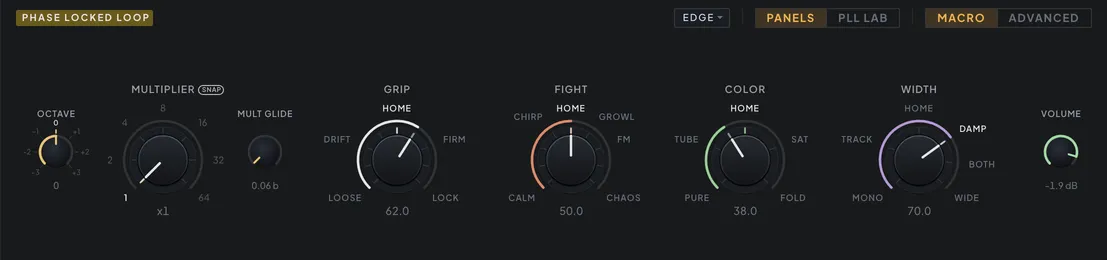
Play the loop with four dials instead of twenty. At the far end of the PLL header sits a MACRO / ADVANCED switch — the lens the module is looked at through, and the loop opens on MACRO. There the two knob rows are gone and five large dials stand in their place: MULTIPLIER, and the four macros GRIP, FIGHT, COLOR and WIDTH. OCTAVE, GLIDE and VOLUME keep their ordinary size beside them, and the detector selector stays in the header — the detector is the loop’s circuit, not one of its settings.
MULTIPLIER is the full panel’s MULT knob, enlarged: the same ×1 to ×64 travel and the same S badge, so the stops you learn in one view are the stops in the other. No macro takes it over, because the ratio is a musical choice rather than a character. GLIDE beside it is the full panel’s RATIO SLEW — the same length of time for any move, an octave or five.
The four macros are the character. Each one sweeps a curated path through the parameters it owns: a run of settings tuned by ear, with the dial travelling between them, so every position on a macro is a place somebody stopped at rather than an average of the two ends. Switches flip where they sit on the path, which means a macro can change the loop’s wiring as it turns and not only its numbers. Every parameter a macro owns is a control on the ADVANCED lens, so whatever a dial does you can watch it happen — and undo it by hand.
GRIP — how hard the loop holds the note. TRACK, DAMP, INFLUENCE and RANGE move together along it, and DIV LOCK and LOOSE flip where the path puts them. One end is a loop that barely believes you, the other is one that clamps down.
FIGHT — how much is thrown at the loop. BURST’s threshold and amount, INJECT’s amount with its INJ FM / INJ LOCK choice, the FM operator’s depth and ratio, CHAOS and RELOCK. The burst threshold rides as bite — how far below TRACK the threshold sits — so overtrack keeps biting the same way wherever GRIP has left TRACK, instead of going quiet every time GRIP moves.
COLOR — the coloration stage as one travel. It runs from clean, through the TUBE stage on its own, and on into the harmonic, saturate and fold cores, carrying the COLOR switch, the mode menu, SATURATE, FOLD, RATIO and TUBE with it. Coloration has its own section further down this chapter; COLOR is that whole block on one dial.
WIDTH — how far apart the two loops are tempered. TRACK Δ and DAMP Δ, one flavour on each side of HOME: TRACK below it tempers the two loops’ tracking alone, DAMP above it their damping, then BOTH together and WIDE with both offsets at 70 %; MONO at the bottom collapses the pair. Every landmark is the same amount of temper on every patch: WIDE is 70 % wherever GRIP has left TRACK and DAMP. The stereo image here is two loops behaving differently rather than a widener, so each loop stops at the ends of TRACK’s and DAMP’s own ranges — with GRIP parked near either extreme the pair spreads to the side that still has room.
What the macros leave alone. DIV, TUNE, FINE, the loop’s own GLIDE, INPUT REF, OUT SHAPE, STEP, GRIT, LAG, DRIFT and DRIFT RATE keep whatever the preset set for them. They have no dial in the MACRO view; switch to ADVANCED to change them, and switch back.
Your sound lives at twelve o’clock. Every macro opens straight up, on the landmark marked HOME, and handing the loop to the macros never changes what you hear: the patch as it stands is grafted onto that position. Choosing the lens is not what hands it over — MACRO and ADVANCED only decide which controls you are looking at, and a patch you merely look at is a patch you have not touched. Moving a dial is the hand-over, and from that moment the layer is driving. Turning a dial morphs from your sound into the curated path — down one way, up the other — and turning it back to HOME brings the patch back, exactly. Load any preset and the same thing happens: the dials re-centre and the loaded sound becomes the new HOME. The other scale words are the path’s landmarks; the one nearest the pointer lights up.
The lens is not the layer. Switching between MACRO and ADVANCED changes what you look at and nothing else — it neither starts nor stops the layer: the macros keep driving the loop and an LFO riding COLOR keeps sweeping. The knobs a macro owns follow it while it does. Turn a dial and you can watch which knobs move and how far, so the rows always read as the sound you are hearing rather than as the patch underneath it.
Touching one hands that macro back. The macro gives up the knobs it owns, holding the loop exactly as it stood, and your edit lands on top of that. Its dial returns to HOME, where your new sound becomes the sound it grafts. The other three carry on driving, on the readings you left them at — one edit in ADVANCED never stops a performance on the other three dials.
Every hand counts as touching it. A MIDI knob you have learned to one of those controls, an automation lane, your host’s own parameter list: each hands its macro back the same way the mouse does, and the value you send lands the same way. So a hardware knob mapped to TRACK does something whichever lens is showing, and so does a lane you drew before you ever opened MACRO.
Dials go home only when something edited what they hold. A new sound arriving — a preset load, or a session your host restores — re-centres all four: every dial takes the new sound as its HOME. Nothing you hear moves in either case.
Automation and modulation. The four macros are host parameters like any other and modulation destinations in their own right, so an LFO on COLOR sweeps the whole coloration path — switches included, because the macro owns those switches. And because the layer stays engaged behind the ADVANCED lens, that LFO keeps working whichever view is showing. The other side of that deal: automating a parameter a macro owns hands that macro back rather than fighting it — the lane wins, that dial goes to HOME, and the other three carry on. Modulation routed to one of those parameters in the MOD matrix is the exception, and still applies on top of whatever the macro resolved: the macro sets the base, the modulator moves around it, and no modulator ever counts as an edit.
The layer belongs to the patch. Whether the macros are driving is saved with the preset, not with the window: a patch handed over to the macros comes back driving them in every format, with the editor closed and in an offline bounce — which is what makes an LFO or a mod sequencer routed at GRIP, FIGHT, COLOR or WIDTH a route you can rely on rather than one that only plays while the right panel is open. The preset also stores the values the macros were resolving, so anything that reads the file — another view, an older build — still gets the sound. The dials themselves always open at their rest positions: a preset is a place to explore from, not a dial diagram to restore.
Pushing the loop
Sirens, growls, interval chases and squelching acid lines all come out of the same handful of controls, because they are all the same circuit failing in different directions. No matter how hard you shove the loop, it always wants to come home — every excursion bends back toward the note you played. That gravity is what keeps the chaos playable.
MULT, DIV and DIV LOCK. The loop can track at a ratio of the reference instead of the note itself. MULT climbs in doublings, octave by octave; DIV divides. Together they set the ratio the loop chases — note × MULT ÷ DIV — and RATIO SLEW sets how long any move between ratios takes: an octave or five, the same length of time, so interval sweeps become something you perform rather than program.
Both ratio knobs carry an S badge, and both arrive with it lit. Snapped, they land only on the whole ratios above, one detent per drag step. Switch the badge off and the same knob sweeps everything in between — ×3, ×5.5, ÷2.75 — for ratios that beat against the note instead of consonating with it. Toggling the badge never moves the sound: it changes how the knob travels, not where the loop is, so you can find a ratio free-hand and then relight the badge to keep the dial on the detents.
Alone, MULT only ever reaches octaves, which the OCTAVE knob already does. DIV is what makes the ratio musical: it is the second divider of every hardware frequency synthesiser, and dividing by something that is not a power of two lands the loop on intervals no amount of MULT can reach. Divide by three and the oscillator drops a twelfth below the note; by five and by seven it descends the undertone series, the mirror image of the harmonic series and the reason organ builders bothered with subharmonics at all. Combine the two and the ratios turn into intervals: MULT 4 over DIV 3 is a perfect fourth above, 8 over 5 a minor sixth, 8 over 3 an octave and a fifth. Because the whole ratio is one number to the loop, DIV inherits everything MULT has — the glide, the modulation and the snap grid.
The DIV LOCK switch — a divider lock, and a different control from DIV — decides what “track at a ratio” means. Off, the loop chases the ratio the way it always has: the correction never finds a true resting point at the target interval, and the residue is a gritty shimmer of extra frequencies clustered around the note. On, a divider goes into the loop’s feedback path, and the oscillator genuinely locks to the ratio — MULT and DIV become an interval selector with the solid, glued quality of a true lock, a slow hunting wobble when disturbed, and an audible swoop as it captures each new note. Ratios that are not whole harmonics need that lock to hold their tuning; without it they are a pitched fight rather than a note, which is its own instrument.
Four detectors. The part of the loop that measures being wrong is the phase detector, and the detector selector picks its temperament. PD is a smooth analog-style comparator: it measures continuously and produces a rounded, elastic error — the misbehavior stays melodic. EDGE reacts only at signal edges, so the error arrives in abrupt decisions: locks are snappier, failures are harsher, and the same TRACK and DAMP settings turn noticeably more aggressive. XOR is the classic logic-gate comparator: it settles a quarter-cycle off-center and lets a fast ripple leak into the correction as a constant buzz, and because it hard-limits whatever reference it hears, it will happily lock onto odd harmonics instead of the note — a detector with opinions. S&H samples the loop’s position once per reference cycle and holds it, so the correction moves in steps: quiet and steady when the loop is relaxed, audibly hunting in staircase wobbles when TRACK and INFLUENCE push it — and with GRIT feeding the detector noise, the held value itself turns random, a pitch that stumbles around the note. A companion parameter, edge sensitivity, sets how small an edge still counts for the edge-triggered detectors — it has no panel control and is reachable only as a host automation parameter.
The reference below hearing. Wind OCTAVE far enough down on a low note and the reference falls under the bottom of the audio range — a few cycles per second, then less than one. The loop keeps working; it stops being about pitch. Its edges become rhythm, and the controls you were using to tune a note now shape a pulse. PD compares phase continuously, so it simply follows the reference down: the oscillator sits on it, and with OUT SHAPE toward pulse the voice turns into a click train you play from the keyboard, or a drone you can beat against another voice. EDGE has nothing to measure between one edge and the next, so it ratchets — long still stretches broken by a fast chirp each time the reference crosses. XOR breaks into bursts. S&H holds its last measurement until the next edge arrives, which down here is a very long hold; below a couple of cycles per second it wanders rather than tracks, exactly as hardware sample-and-hold loops do. Nothing in the signal path strips this material out: sub-audio output moves woofers and pumps a limiter at the reference rate, so the master high-pass is worth switching on when a patch lives down there.
Patches saved before the reference could go this low keep the behavior they were written against, where it stopped at the bottom of hearing and the lowest OCTAVE settings on a bass note all sounded the same. The switch that carries that choice, PLL Ref Floor, has no panel control and is reachable from a host’s parameter list; setting it to FULL opens an older patch up. It also clears a tuning error the old limit caused — with the reference pressed against the bottom the loop’s hunt was cut off on one side only, which dragged the pitch of low EDGE patches sharp by as much as a third of an octave.
Injection, bursts, and the loop lab
Past the detectors and the lock, the loop takes passengers: signals fed into its correction path on purpose, a chaos drive that takes its stability away, and a rack of four ways to break the servo itself. This is where growls, whoops and glitches live.
BURST and INJECT. BURST is overtrack intensity: push TRACK above the threshold you set with BURST THR and the loop’s own overshoot feeds back into the correction as extra kick, scaled by BURST AMT — chirps, whoops and squeals that always resolve back to pitch. The threshold works in every color mode, so it is always on the panel. INJECT feeds the reference straight into the correction path, from a subtle undertow of growl at the bottom of its range to controlled chaos at the top. A switch beside it picks what the injection is: INJ FM modulates the pitch with the reference waveform for sideband growl, while INJ LOCK is true injection locking — the reference captures the oscillator and holds it within a range set by the amount, so detune the reference and the tone bends, fights, then breaks free at the edge of the capture range and snaps back when you return. (It is a different lock from DIV LOCK — one couples the injection, the other divides the feedback path.) RANGE narrows the main loop’s own lock bandwidth — the chase, not the injection — so low settings hunt slowly toward the note like a worn analog circuit.
CHAOS. The loop normally settles at a stable equilibrium; CHAOS takes it away. The knob — first in the advanced row — overdrives the detector’s error curve until competing lock points appear, raises the loop gain past where the servo can settle, and slows the error smoothing so every correction arrives a little too late — while a slight keytracked wander keeps the fight seeded. Low settings ring the loop into a vibrato-like growl. The middle mode-hops between rival equilibria in period-doubled warbles. At the top the correction scribbles chaotically around the note without ever abandoning it, because everything still happens inside the loop’s own limits — RANGE, the integrator’s saturation and the detector all keep their say, so each detector breaks down with its own accent.
The COLOR switch adds harmonics drawn from the loop’s core, with a mode menu picking the core flavor. HARM blends in an upper partial that climbs with MULT — bright, glassy, sometimes gloriously rude — and SAT drives the output itself into saturation, from a gentle analog warmth at zero to a soft square rasp at full; in both, SATURATE sets how much. FOLD synthesizes a fold-back partial — the clang of a harmonic reflected off a virtual rate at RATIO times the note — with FOLD setting its level and RATIO choosing the inharmonic interval, which stays constant across the keyboard because the fold rate tracks the note. Every knob works in every mode: the fold-back pair layers onto HARM and SAT at FOLD’s level, and in FOLD mode SATURATE drives the carrier and the clang into saturation together, from clean at zero. Only the COLOR switch itself silences them — with it off the whole coloration block is out of circuit, and the three knobs grey out to say so. The FM operator and HARM’s partial are tapered at the edge of the audio band, so the top of the keyboard rings cleanly instead of folding back into hash. An FM section modulates the output oscillator at a ratio of the pitch — the FM and FM RATIO knobs in the advanced row. An envelope-to-FM depth — for attacks that clang and then settle — exists as a host automation parameter only, with no panel control.
The loop lab. Four knobs break the servo itself — they follow CHAOS in the advanced row — each one a real defect of hardware loops pushed to musical extremes, each a modulation destination, and all of them at zero by default, where the loop is exactly the stock circuit. STEP samples-and-holds the whole correction at a servo rate: continuous at the bottom, and as it slows the pitch hunting starts moving in discrete steps — robot chirps, bubbling glitch arps, gated glissandi. GRIT feeds noise into the phase detector upstream of the loop smoothing, so TRACK sets its color: analog fizz at low drive, a drunk wobble in the middle, a full random stumble at the top — every detector gets the trick the old noise reference reserved for S&H. LAG inserts a transport delay into the correction path, up to thirty milliseconds, so the loop steers by where the note was: metallic servo flutter at short settings, standing-wave hunting and time-smeared chases at long ones. RELOCK opens and closes the loop in a cycle, from a slow breath up to twelve times a second: while open the corrections freeze and the pitch sags away; at close the loop wakes to everything it missed and fights its way home — the capture swoop, the best sound a PLL makes, on demand.
| Parameter | Range | Default | What it does |
|---|---|---|---|
| PLL FM Amount | 0 – 2 | 0 | FM depth on the loop's output oscillator — from gentle shimmer to clangorous sidebands. |
| PLL FM Ratio Float | x0.10 – x32 | x1 | The FM modulator's frequency as a multiple of the pitch — whole numbers stay harmonic, fractions clang. |
| PLL Track Speed | 0 – 1 | 0.5 | How fast the loop chases the reference — low drags and glides, mid locks solid, high overtracks into bursts. |
| PLL Damping | 0 – 1 | 0.5 | How hard the correction brakes — low overshoots and rings around the pitch, high settles smoothly. |
| PLL Multiplier | x1 – x64 | x4 | Locks the loop onto a multiple of the reference, ×1 to ×64 — continuous, so ×3 and ×5.5 are reachable with SNAP off. |
| PLL Mult Snap | Off / On | On | SNAP for MULT — constrains the knob to the whole doublings ×1 … ×64. Toggling it never moves the ratio, only how the knob travels. |
| PLL Divider | /1 – /8 | /1 | Divides the loop ratio, ÷1 to ÷8, so MULT ÷ DIV reaches intervals octaves cannot — undertones below, fourths and sixths above. |
| PLL Divide Snap | Off / On | On | SNAP for DIV — constrains the knob to the whole divisors ÷1 … ÷8. Toggling it never moves the ratio, only how the knob travels. |
| PLL Colored | Off / On | On | Switches the loop's coloring stage on — off takes the whole block out of circuit and greys out Saturate, Fold and Ratio. |
| PLL Color Mode | HARM · SAT · FOLD | HARM | Color flavor: HARM adds a bright upper partial, SAT drives into warm saturation, FOLD synthesizes a keytracked fold-back clang. |
| PLL Fold Amount | 0 – 1 | 0 | Level of the synthesized fold-back clang — layers onto any color mode, not just FOLD. |
| PLL Fold Ratio | 1.0 – 64.0 | 10.0 | Virtual fold rate as a multiple of the note pitch — which inharmonic interval the clang lands on, constant across the keyboard. |
| PLL Divider Lock | Off / On | Off | DIV LOCK — puts a divider in the feedback path so MULT and DIV become an interval selector the loop genuinely locks to. |
| PLL Detector | PD · EDGE · XOR · S&H | EDGE | How the loop measures being wrong: PD is smooth, EDGE snaps at edges, XOR buzzes, S&H holds and hunts in steps. |
| PLL Ratio Slew Time | 0 – 1 | 0 | Glide length for MULT and DIV changes, in beats — from a sixteenth-note snap to a slow eight-beat sweep. |
| PLL Ref Octave | -3 · -2 · -1 · 0 · 1 · 2 · 3 | 0 | Octave shift for the reference oscillator — the loop chases the transposed target. Four down takes it under hearing on low notes, where edges become rhythm rather than pitch. |
| PLL Ref Tune | -12 … 12 (25 steps) | 0 | Semitone offset for the reference — sets fixed intervals for the loop to chase. |
| PLL Ref Fine | -100 ct – +100 ct | +0 ct | Fine detune of the reference; small offsets make the lock lean and slowly beat. |
| PLL Chaos | 0 – 1 | 0 | Drives the loop past stability — wobble, then mode-hopping warbles, then bounded chaotic scribble that still gravitates to the note. |
| PLL Influence | 0.0000 – 1.0000 | 0.1408 | How strongly the reference pulls — low lets the pitch drift and find its own way to the note. |
| PLL Volume | -inf dB – 0.0 dB | -6.0 dB | PLL level in the oscillator mix. |
| PLL Pan | L100 – R100 | C | Stereo balance of the PLL voice — constant-power, transparent at centre, and a modulation destination. |
| PLL Stereo Damp Δ | 0 – 0.5 | 0 | Splits damping between L and R so each channel rings differently — stereo width from the loop itself. |
| PLL Glide | 0.0 – 5000.0 | 0.0 | Always-on portamento — how long pitch takes to reach each new note. |
| PLL Burst Threshold | 0 – 1 | 0 | Error level that trips a burst — lower thresholds make the loop panic sooner. |
| PLL Burst Amount | 0 – 20 | 10 | How hard the loop is kicked when the error trips the threshold — chirps, whoops and squeals. |
| PLL Color Amount | 0 – 1 | 0 | Saturation drive on the colored output — emphasis of the HARM partial, the drive in SAT, and in FOLD it pushes the clang and carrier into saturation together, from clean at zero. |
| PLL Range | 0 – 1 | 0.5 | Lock bandwidth — low hunts slowly toward the note like a worn analog circuit, high locks fast. |
| PLL Stereo Track Δ | 0 – 0.5 | 0 | Splits track speed between L and R — the channels arrive at each note at different times. |
| PLL Precision | Off / On | TIGHT | LOOSE — lit, the loop runs the legacy math: baggier chases, narrower hunting swing. Dark (the default) is the strict, faster-locking loop. Hosts show it as PLL Precision. |
| PLL Injection Amount | 0 – 2 | 0.00246875 | Injects the reference straight into the correction path — a subtle undertow of growl at the bottom of the range, controlled chaos at the top. |
| PLL Injection Mode | Off / On | Off | INJ FM / INJ LOCK — switches INJECT from FM to true injection locking; the reference captures the pitch within a range set by the amount. |
| PLL Out Shape | 0 – 1 | 0 | Morphs the loop's output from sine through triangle and saw to square — brighter as it rises. |
| PLL Step | 0 – 1 | 0 | Sample-and-holds the loop correction at a servo rate — pitch hunting turns into discrete steps: chirps, glitch arps, gated glissandi. |
| PLL Grit | 0 – 1 | 0 | Noise into the phase detector, colored by TRACK — analog fizz at low drive, drunk wobble, full random stumble at the top. |
| PLL Lag | 0 – 1 | 0 | Transport delay in the correction path — the loop steers by where the note was: servo flutter short, time-smeared hunting long. |
| PLL Relock | 0 – 1 | 0 | Cyclically opens the loop and lets it recapture — pitch sags while open, then swoops home on every relock. |
| PLL Macro Grip | 0 – 1 | 0.5 | How hard the loop holds the note — one tuned path through TRACK, DAMP, INFLUENCE, RANGE and the DIV LOCK and LOOSE switches. The GRIP dial of the PLL's MACRO view. |
| PLL Macro Fight | 0 – 1 | 0.5 | How much is thrown at the loop — one tuned path through BURST, INJECT, the FM operator, CHAOS and RELOCK. The FIGHT dial of the PLL's MACRO view. |
| PLL Macro Color | 0 – 1 | 0.5 | The coloration stage on one dial: clean, then the tube, then the harmonic, saturate and fold cores with their amounts. The COLOR dial of the PLL's MACRO view. |
| PLL Macro Width | 0 – 1 | 0.5 | How far apart the two loops are tempered — TRACK Δ and DAMP Δ, the same amount of temper on every patch. The WIDTH dial of the PLL's MACRO view. |
| PLL Tail | 0.0 ms – 5000.0 ms | 0.0 ms | Lets the PLL ring past release — extra fade time after the shared envelope has closed. Flip SYNC to set it as a note division instead. |
| PLL Tail Sync | Off / On | Off | Locks the PLL tail to the host tempo — the fade length follows a note division instead of a time in milliseconds. |
| PLL Tail Div | 1/1 … 1/128 (18 steps) | 1/8 | The note division the PLL tail rings for when SYNC is on. |
| PLL Input Ref | 0 – 1 | 0 | INPUT REF — blends the PLL's own reference against whatever is patched into PLL REF: at INT the loop is untouched, toward EXT it chases the incoming signal. A modulation target. |
| PLL Pitchbend | Off / On | On | Lets the pitch wheel bend the PLL oscillator; off, it holds the played pitch while the others bend. On by default. |
PLL Lab
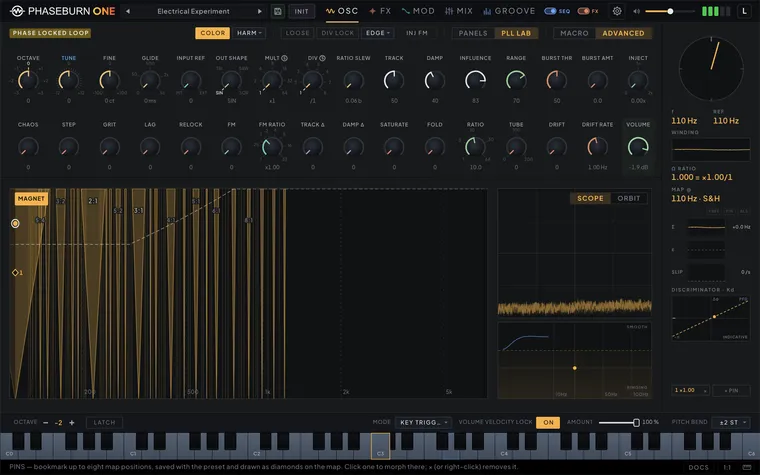
Stop steering the loop by ear alone — look at it. At the far end of the PLL header sits a PANELS | PLL LAB strip; switch views and both PLL knob rows stay put while the rest of the page becomes a live chart of the loop itself: the LOCK MAP, a phase-error scope with the servo pad, and a telemetry column.
The LOCK MAP plots the loop’s ratio across and the coupling — INFLUENCE — upward. The amber wedges are Arnold tongues: the regions where a pushed oscillator gives in and locks to a whole-number ratio, the broadest labeled p:q, the simple ratios labeled even where their tongues run narrow. Between the tongues lie the slip regions, where the loop keeps losing whole cycles and the loss is audible as sidebands; most of the growl in this chapter lives there. The picture is computed, not painted: tongue positions come from number theory, their widths from phase-locked-loop theory calibrated against this exact oscillator, and the map redraws instantly when you touch a knob that reshapes it. The detector redraws the world — S&H is the classic-tongues detector, near-textbook wedges; EDGE runs genuinely chaotic territory that theory can only sketch, so its wedges draw dashed and the map says so. Some detector families lock in bands too narrow to draw at all; the map then magnifies every tongue by one common factor and owns up in the corner — widths ×N — so the proportions stay honest while the picture stays playable. Zones whose pitch leaves the audible band dim out, iso-pitch guides cross the wedges so you always know how high you are, and the band beyond MULT’s reach at the current DIVIDE stays shaded, with the reason on the help line.
And the map is a control surface. Dragging on it turns MULT and INFLUENCE as real host gestures your DAW records. A hollow ring is what you asked for; the amber dot, trailing a comet, is what the loop measurably does — under modulation the dot visibly leaves the ring, and a faint rectangle outlines how far your modulation can push it. With MULT’s S badge lit the drag snaps to the computed rationals — 3:2, 5:4 — not the knob’s octave grid, because the tongues live between the octaves; MAGNET is a gentler pull toward the same stops; Shift is fine motion; hold Alt and the cursor latches onto the nearest tongue wall and rides it — coupling swept along the boundary where lock gives way. The map always frames exactly what a drag can reach — MULTIPLIER’s six octaves, slid along the axis by DIVIDE — so the cursor is never off the picture; the view glides rather than jumps when DIVIDE moves it. PINS bookmark up to eight positions as numbered diamonds on the map; click one and the sound morphs there in a short glide, × removes it. Pins — along with the MAGNET and scope choices — save with your preset, so a patch ships its own map of sweet spots.
The lab under the macros. GRIP owns INFLUENCE and the servo pair, so the lab stops writing to them: dragging the map turns MULTIPLIER alone, and the SERVO pad dims and takes no drag. Everything it draws carries on as usual — the hollow ring, the servo pad’s operating point and its step response all follow what the loop is running, which the macros resolve every block, so the lab reads the same whichever lens the section wears. Only PINS wait for the advanced lens, because a pin bookmarks a coupling the macros are resolving. What the lab measures was never in question: it comes from the running engine, not from the knobs.
Reading the loop
The loop’s life shows as motion, not flickering numbers. The STROBE wheel turns the loop’s phase difference into a pointer the way a strobe tuner does: frozen means locked; rotating means slipping, and the rotation speed is the slip rate; jitter is chaos; watch it settle after a note-on and you are watching capture happen. Under it, the measured frequency and reference hold steady enough to read, and the WINDING ribbon draws the measured ratio’s last few seconds against the dashed knob target — a RATIO SLEW glide or a sequencer riding DIVIDE reads as travel, echoed by a chevron crossing the map’s bottom edge.
The phosphor PHASE ERROR θe scope traces the correction gap over time — flat line is a lock, steady ramps count slips one lost cycle at a time, hash is chaos — and its ORBIT view replots the same signal against its own motion, a phase portrait: a dot when locked, a closed ring while beating, a scribble filling the box in chaos. The SERVO pad charts the loop’s temperament: TRACK across, DAMP upward, with the exact critical-damping line drawn and a live step-response curve showing how your settings approach a new pitch; two dots appear when the stereo Δ knobs split the channels into genuinely different tempers. Drag the pad and you are turning TRACK and DAMP together.
VITALS ribbons the loop filter’s internals: Σ is the integrator — the correction the servo is applying right now — between its ±Loop Limit rails, with a PIN lamp when it saturates (a pinned integrator is why a pitch parks off-center); ε is the working error; SLIP counts slips per second — that number is the spacing of the sidebands you hear. FREE blinks with RELOCK’s freewheel window at its true rate, and ALS warns when the ratio is high enough that the slip counter itself aliases. The DISCRIMINATOR draws the active detector’s transfer curve — the S-curve a bench PLL analyzer would show. Turn CHAOS up and the curve folds before your eyes until extra equilibria appear — filled dots stable, hollow unstable — which is the mechanism of the gurgle, not a metaphor for it; GRIT wraps the curve in its noise band, and a dot rides the curve at the strobe angle. Ω RATIO spells the target as ×MULT over DIVIDE; MAP @ records the reference and detector the chart is drawn for. With no note sounding, the strobe parks and the scope asks you to PLAY A NOTE.
Locking the loop to something else
Everything above assumes the PLL is chasing its own internal reference. It does not have to. The patchbay has a PLL REF jack, and whatever you patch into it becomes what the loop tries to lock to instead — including audio arriving from the host, whether Phaseburn is inserted on an audio track or fed from another track’s send. The INPUT REF knob — on the PLL section’s main row, just before OUT SHAPE — blends between the two: at INT the loop is exactly as described above, and toward EXT it hands the reference over. It is a modulation destination like everything else on that row, and it glides rather than steps, so an LFO or an envelope can open the loop to the outside world and close it again mid-note.
This is not pitch tracking, and it is more interesting than pitch tracking. The note you play still decides where the loop sits; the reference pulls it around within the capture range. Every control you already know becomes a way of shaping how the oscillator reacts to the incoming signal — how hard it grabs, how far it can be dragged, how it recovers:
- Feed a drum loop and open RELOCK and BURST. The pitch lurches on every transient and resolves back, so you get a tuned follower locked to the groove without a clock anywhere in the patch.
- Feed a bass line or a vocal, switch DIV LOCK on and bring MULT up. The loop locks a harmonic of the input rather than the input itself.
- Play deliberately against the incoming pitch. The servo cannot decide, and you get beating, chirping and slow chaotic wandering — the sound of a loop failing, which is the reason to have it.
- Switch the detector to XOR. It multiplies the input and the oscillator square together, which is ring modulation bound to the source’s rhythm.
Level matters. The comparator only registers an edge once the reference crosses ±0.02 — about −34 dBFS — so a quiet reference never triggers a lock at all. The trim for that is GAIN in the ROUTING panel’s PLL REF column, which acts on everything patched into PLL REF at once: press AUTO beside it while the reference plays and it lands the summed reference on −6 dBFS in one shot, with about 28 dB of margin over the comparator. AUDIO IN’s own fader stays the input trim the mix, the filter and the effects receive, with +12 dB above unity; the input is soft-clipped above −3 dBFS, so pushing it hard costs character rather than stability.
And silence stops it. With INPUT REF toward EXT and AUDIO IN patched into PLL REF, the oscillator falls quiet when the input does, and picks back up on the next thing that arrives — so a gated vocal, a sparse drum loop or a track that simply stops leaves silence behind rather than a drone.
This is not something the loop does by itself, which is why it is worth knowing about. The reference is a frequency input: it steers the oscillator, it does not feed it. Take the reference away and the oscillator keeps running — and not at the note you played, either, because each detector idles differently on a dead reference and drags the pitch somewhere of its own. The instrument watches the input level and closes the oscillator down instead.
Two things decide how much say that has, and both can switch it off completely. INPUT REF is the depth — at INT the loop is keytracked, a silent input is none of its business, and nothing is gated; halfway, a dead input can only take half the level away. And it only counts AUDIO IN’s share of the reference: a loop steered by MORPH, by a filter or by an effect return is locking perfectly well with no audio coming in at all, so it is left alone. Patch both and you get the balance between them.
The threshold sits at −60 dBFS with a little hysteresis, well under the ±0.02 the comparator needs, so it only closes on material that could never have locked anyway. It releases over about 150 ms — long enough that the gaps between syllables or the tail of a decaying note do not chop it up.
The detector matters here. XOR, S&H and EDGE all read the incoming waveform directly. PD compares phase against a signal the input does not carry, so it keeps following the played note — useful when you want part of the loop anchored.
PLL REF takes every output on the panel. Not just AUDIO IN: the four oscillators, both filters, every effect, and the three feedback taps can all be cabled into it. Patch MORPH, VECTOR or SUB and you have cross-modulation with no host routing at all — one oscillator steering the loop. Patch PLL into its own reference and the loop chases itself, which is what an analog PLL patched back into its own comparator does. Patch a delay feedback tap and the loop locks to what is circulating inside the delay rather than to what comes out of it.
There is no way to hurt anything doing this. The reference is summed behind its sources, so no patch can form a loop the engine has to reject, and the sum is bounded before it reaches the comparator — the PLL’s output level does not follow its reference level, so the gain never runs away however many cables you open.
What does vary is how far behind. The oscillators and PLL OUT are computed inside the voice, so they arrive one sample late — exactly how patching one analog oscillator into another’s reference input behaves. Everything downstream of the voice — the filters, the effects, the feedback taps — is computed after it, so it arrives one buffer late: a few milliseconds, set by your host’s buffer size. The loop still locks; a constant delay in a reference is a phase offset. What it costs is edge: RELOCK and BURST react a buffer behind the transient that set them off, so an effects return is a looser, laggier reference than a direct one. Smaller buffers tighten it.
Coloration
Perfect stability is a digital habit; the coloration stage is where you break it. It applies its character to the PLL voice — the core of the instrument — rather than politely post-processing the mix, which is why its knobs — DRIFT, DRIFT RATE and TUBE — live in the PLL section of the Oscillators tab rather than next to the filter.
DRIFT lets the pitch wander. It applies a slow wobble to the PLL’s reference — the pitch the loop chases. Low amounts read as an aged oscillator that no longer quite trusts its tuning; higher amounts become an audible, seasick waver. DRIFT RATE sets how fast the wander moves. When the PLL is spread into stereo (raise TRACK Δ or DAMP Δ — see the oscillators chapter (Chapter 2 — Oscillators)), the right channel’s loop gets its own wander at a slightly different speed from a different starting point, so the two sides slip against each other and the stereo image slowly leans; on a mono PLL both channels share one wander. Because the wobble goes through the loop rather than around it, the PLL’s own tracking behavior — lag, damping, overshoot — shapes the drift on its way to the output, which is why it feels like a machine misbehaving rather than an LFO on pitch.
TUBE is the matching wear on the amplitude side: soft-clip saturation on the PLL voice’s output. Low settings round the peaks and thicken the tone; pushed hard it compresses the waveform’s edges into a denser, warmer growl, and the dial keeps going past 100 into outright crush. DRIFT and TUBE are both live modulation destinations, so an LFO or step modulator can make the mess itself move — see the modulation chapter (Chapter 4 — Modulation).
| Parameter | Range | Default | What it does |
|---|---|---|---|
| Drift Amount | 0 – 1 | 0 | Slow sine wobble on the PLL reference; knob lives in the PLL section of Sound → Oscillators, not the FX tab. Per-channel divergence only when the PLL stereo path is engaged. |
| Drift Rate | 0.01 – 5.00 | 0.50 | Speed of the drift wander (Drift Rate knob, PLL section of Sound → Oscillators); right channel runs 1.1× the left's rate when the PLL is in stereo. |
| Tube Drive | 0 – 2 | 1 | Soft-clip saturation on the PLL voice output, past 100 it leans into heavy crush; Tube knob in the PLL section of Sound → Oscillators. |
The VECTOR oscillator
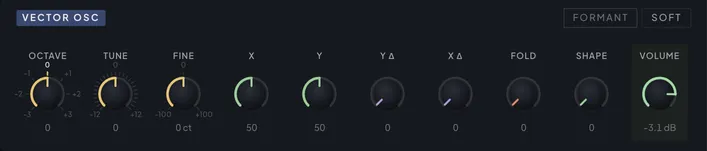
Two knobs take one wave from soft and hollow to snarling — and the same two knobs can park a vowel-like resonance on any harmonic you choose. That is VECTOR — vector phase shaping, a technique published by Kleimola, Lazzarini, Timoney and Välimäki in 2011, implemented here in double precision.
Instead of filtering a bright wave or crossfading between stored shapes, VECTOR bends the phase that reads the waveform. Picture the wave’s single cycle being traced by a clock hand: X and Y grab that clock hand and bend its path through one inflection point. X places the bend horizontally — how early or late in the cycle the distortion strikes — and Y sets its depth, which is the main timbre sweep. Low X with moderate Y is smooth and rounded; high X with low Y turns aggressive. Because you are shaping phase rather than amplitude, the sweep has a vocal, resonant quality that a filter sweep does not.
Formant mode. The FORMANT switch extends Y’s reach into true formant synthesis: the resonant peak locks onto a harmonic of the note, and sweeping Y walks it up the harmonic series. Peaks are strongest when they sit exactly on a harmonic, so slow Y sweeps produce the stepped, vowel-like character of a voice changing shape. Melodies keep their formants in tune because the peaks are multiples of the fundamental.
Stereo divergence. X Δ and Y Δ spread the bend coordinates symmetrically around the panel values: the left channel shifts down by the offset, the right channel up. Both channels run at identical frequency, but because their phase paths differ, they gradually drift apart and the stereo image evolves over the length of a note — width generated by the shaping itself, not by delay or detune. This is deliberate, and for pads it is the VECTOR section’s quietest strength.
Phase modes. A phase-mode parameter — host automation only, with no panel switch — chooses how each note begins. FREE starts each note at a slightly randomized phase, so repeated notes vary. SYNC resets the phase to zero at every note-on for a consistent, hard-sync-like attack on each note.
A sine-based wavefolder (FOLD, with a range switch that folds far deeper) and a waveshaper (SHAPE, with Soft, Hard and Fold curves) stack on top for saturation and buzz. Soft and Hard start at the clean wave and only get louder and denser as SHAPE rises — Soft eases in over the bottom quarter of the dial, Hard over the bottom eighth — so there is no quiet spot near zero and an LFO swinging through zero does not pulse the level. Fold folds both halves of the wave the same way, mirrored rather than flipped, so the negative half no longer jumps across the full range at its peak. At extreme X and Y settings the engine leans on its own alias suppression rather than on a global oversampling control: the source rate is capped at 2x (see Engine settings (Chapter 12 — Reference)), and the stages that need more than that — the ladder filter, the distortion, the sub saturator — oversample internally. Leave headroom under the folder and the mode stays clean.
Like MORPH, the VECTOR section carries TUNE and FINE: the interval in semitones and the cents either side of it, which is what you reach for when stacking VECTOR against another source and you want beating rather than a chord.
| Parameter | Range | Default | What it does |
|---|---|---|---|
| Vector X | 0 – 1 | 0.5 | Horizontal position of the phase bend — higher X distorts the phase harder for a fiercer, brighter tone. |
| Vector Y | 0 – 1 | 0.5 | Depth of the phase bend — the main timbre sweep; with FMT on it chooses the formant harmonic. |
| Vector Stereo Y Δ | 0 – 0.3 | 0 | Gives L and R different Y values — the channels shape apart and slowly drift for evolving width. |
| Vector Volume | -inf dB – 0.0 dB | -inf dB | VECTOR level in the oscillator mix. |
| Vector Pan | L100 – R100 | C | Stereo balance of the VECTOR oscillator — constant-power, transparent at centre, and a modulation destination. |
| Vector Octave | -3 · -2 · -1 · 0 · 1 · 2 · 3 | 0 | Octave transpose for the VECTOR oscillator. |
| Vector Tune | -12 … 12 (25 steps) | 0 | Semitone offset for the VECTOR oscillator. |
| Vector Fine | -100 ct – +100 ct | +0 ct | Fine detune within a semitone — slow beating against the other sources. |
| Vector Fold | 0 – 1 | 0 | Sine-based wavefolder on the VECTOR output — folds peaks back into buzzing harmonics. |
| Vector Stereo X Δ | 0 – 0.3 | 0 | Gives L and R different X values — stereo divergence from a single oscillator. |
| Vector Shape Type | Soft · Hard · Fold | Soft | Waveshaper curve used by Shape: Soft, Hard or Fold — each clips with a different edge. |
| Vector Shape Amount | 0 – 1 | 0 | Drives the selected waveshaper for extra saturation on top of the phase shaping. |
| Vector Formant | Off / On | Off | Extends Y into formant territory — resonant, vowel-like peaks parked on harmonics. |
| Vector Pitchbend | Off / On | On | Lets the pitch wheel bend the VECTOR oscillator; off, it holds the played pitch while the others bend. On by default. |
MORPH: twelve families on one knob
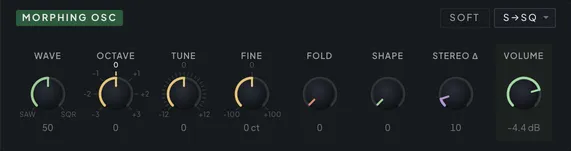
When a patch needs a saw that becomes a square, a vowel, a rising sync lead or a wall of detuned width, MORPH is where you go. It is the conventional-oscillator section — with the convention stretched: one knob, and a mode selector that decides which of twelve waveform families that knob travels through.
The six crossfade families blend their waveform pairs with equal-power crossfades, so perceived loudness stays even along the travel, and switching families mid-performance crossfades in a few milliseconds — no clicks, even with the knob under heavy modulation. The knob itself is a modulation destination, which is where this section gets fun.
The everyday crossfades. Saw to square, sine to saw, and triangle to square cover most bread-and-butter needs — pick the pair, set the knob, done. Saw-to-pulse narrows the pulse as it fades, turning increasingly nasal and resonant.
The sweeps. FULL runs five waveforms in a single travel — sine, triangle, half-rectified sine, saw, square — the complete gentle-to-bright range on one control, made for a slow LFO. RECT morphs sine through half- to full-rectified shapes: buzzy and organ-like, doubling in pitch at the top. HARM builds a saw additively, one harmonic at a time up to 64, and is inherently band-limited.
The performers. SYNC turns the knob into a hard-sync ratio — the classic rising harmonic sweep for leads, corrected at the sync point so it stays clean. SWRM (Swarm) is a detuned unison saw: seven voices per channel, the knob setting the detune spread, with the STEREO Δ control taking it from a true mono stack to full stereo width. STRS quantizes a sine into coarse steps for digital, retro grit.
The voice. FMNT is real formant synthesis: a bank of vocal-tract resonances shapes the oscillator the way a mouth shapes the vocal folds, and those resonances stay fixed in frequency no matter what note you play — so a vowel keeps its identity up and down the keyboard, and vibrato or glide sweeps the harmonics through the standing formants exactly the way a singer’s does. The knob sweeps the vowel — A, E, I, O, U — for vocal pads and leads; with the PITCH switch on, the played note also shifts the vowel position — higher notes land on later vowels — and the knob offsets from there, stopping at the last vowel. Two controls appear only in this mode: BREATH mixes in aspiration noise shaped by the same resonances — from a hint of air to a whispered pad — and SIZE scales the whole vocal tract, from big and dark to small and bright. Both are modulation destinations, so an LFO on SIZE talks and a slow ramp on BREATH exhales.
The wavetable. SPCL walks a spectral table from plain harmonics through tilted, combed and resonant spectra.
Around the morphing core: FOLD and SHAPE are the same wavefolder and waveshaper tools as the VECTOR section. TUNE and FINE set the interval and the cents — FINE is the control for the small detunes that thicken a stacked patch without pulling it out of key. STEREO Δ outside of Swarm detunes the left channel down and the right channel up for immediate width and slow chorus-like motion.
| Parameter | Range | Default | What it does |
|---|---|---|---|
| Morph Volume | -inf dB – 0.0 dB | -inf dB | MORPH level in the oscillator mix. |
| Morph Pan | L100 – R100 | C | Stereo balance of the MORPH oscillator — constant-power, transparent at centre, and a modulation destination. |
| Morph Octave | -3 · -2 · -1 · 0 · 1 · 2 · 3 | 0 | Octave transpose for the MORPH oscillator. |
| Morph Tune | -12 … 12 (25 steps) | 0 | Semitone offset for the MORPH oscillator. |
| Morph Fine | -100 ct – +100 ct | +0 ct | Fine detune within a semitone for slow beating. |
| Morph Fold | 0 – 1 | 0 | Sine-based wavefolder on the MORPH output — buzzy folded harmonics. |
| Morph Shape Type | Soft · Hard · Fold | Soft | Waveshaper curve used by Shape: Soft, Hard or Fold. |
| Morph Shape Amount | 0 – 1 | 0 | Drives the selected waveshaper for extra saturation after the morph. |
| Morph Amount | 0 – 1 | 0 | The morph slider — sweeps through the family Mode picks, holding an even level all the way across. |
| Morph Mode | Saw → Square … Spectral (12 steps) | Saw → Square | Picks which of the twelve waveform families the morph slider travels through. |
| Formant Pitch Track | Off · On | Off | The played note also slides the vowel — higher notes land on later vowels; the knob offsets from there. |
| Formant Breath | 0 – 100 | 0 | Aspiration noise shaped by the same vowel resonances — from a hint of air to a whispered pad. |
| Formant Size | -100 – 100 | 0 | Scales the whole vocal tract: big and dark below centre, small and bright above. |
| Morph Stereo Detune | 0 – 1 | 0 | Detunes L down and R up by up to 50 cents each — immediate width and unison-style thickness. |
| Morph Pitchbend | Off / On | On | Lets the pitch wheel bend the MORPH oscillator; off, it holds the played pitch while the others bend. On by default. |
The sub
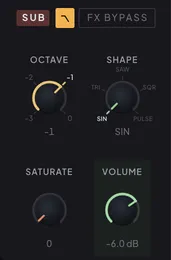
Anchor the low end with a source whose only job is weight. The sub tracks the played note at a whole-octave offset — the OCTAVE control chooses how far down, with its top position sitting at the played pitch itself. Like the other sources it is cabled into FILTER 1, so by default the filter shapes it along with everything else; when a screaming resonance sweep must not hollow out the foundation, the routing choices below keep the floor solid.
SHAPE morphs the sub’s waveform continuously through five stops: sine, triangle, saw, square, and a narrowing pulse. Leave it at sine for pure, invisible weight that a mix feels rather than hears; triangle and saw add just enough edge for the sub to read as a note, and square is the classic hollow foundation. Past square the pulse narrows continuously, down to a tenth of the cycle — reedy and nasal, with the energy moving up out of the fundamental. That last stretch is level-compensated, so the sub keeps its weight as the pulse thins instead of disappearing the moment you leave the square. SATURATE adds harmonics on top of whatever shape you chose — the practical effect is that the bass becomes audible on laptop speakers and earbuds, where the fundamental itself does not survive.
LOWPASS — the small falling-curve switch in the SUB section’s own header, the same glyph the mixer’s channel highpasses wear — is what keeps every one of those shapes a sub. It is a voicing filter that tracks the sub’s own fundamental, so whichever shape you pick, the energy above that fundamental sits at the same level. Off, the morph is a brightness control as much as a shape control: the narrow pulse carries roughly ten decibels more upper harmonic content than a saw, and the top of the dial reads as a buzz sitting on top of the mix rather than as low end. On, SHAPE picks character instead — saw, square and pulse differ in which harmonics they carry, not in how many. Weight does not move either way; the level compensation holds across the whole morph with the switch engaged.
Brightness then comes back from SATURATE rather than from SHAPE, and that is the more useful pairing: the lowpass sets a voicing floor the shape cannot climb over, and saturation adds harmonics on top of it, so what reaches small speakers is a bright sub instead of a thin one. The switch is on for new patches; a preset or project saved before this existed loads with the switch off, which keeps every sound you have already made exactly as you left it — turn it on to hear the difference, and it costs nothing at the sine end, where the filter has nothing to remove.
Routing is where the sub differs from the other three sources. On the patchbay the SUB → FILTER cable is the sub’s send into FILTER 1, with its own level like every other cable — pull it down to thin the sub out of the filtered path, or move it to FILTER 2 to give the low end a filter of its own. And an FX BYPASS switch in the SUB section’s own header — the same control as the FX BYPASS button on the mixer’s SUB strip and the patchbay’s SUB → OUT cable, all three mirrored — routes the raw sub around the tone-shaping chain entirely when engaged, injecting it near the output: heavy coloration, distortion and character stages on top, untouched fundamental underneath. Because the direct injection happens after the master high-pass, the bypass is also how a sub survives aggressive low-end cleanup. It is the difference between a bass patch that gets dirty and a bass patch that gets dirty while the floor stays solid.
| Parameter | Range | Default | What it does |
|---|---|---|---|
| Sub Volume | -inf dB – 0.0 dB | -inf dB | Sub level in the oscillator mix. |
| Sub Filter Route | off – 4.00 | 1.00 | Direct line for the sub into FILTER 1, through the same SUB DIRECT blend as FILTER 2's; the level sets how much. |
| Sub Octave | -3 · -2 · -1 · 0 | -1 | How far below the played note the sub sits, up to three octaves down. |
| Sub Shape | 0 – 4 | 0 | Morphs the sub through sine, triangle, saw, square and a narrowing, level-compensated pulse. With LOWPASS on it picks character rather than brightness. |
| Sub Lowpass | Off / On | On | A filter tracking the sub's own fundamental holds its harmonics at one level, so SHAPE picks character and SATURATE brings brightness back. Off in patches saved before it. |
| Sub Saturate | 0 – 1 | 0 | Saturates the sub — adds harmonics so the low end reads on small speakers; with LOWPASS on this is where brightness comes from. |
| Sub Pitchbend | Off / On | On | Lets the pitch wheel bend the sub oscillator; off, it holds the played pitch while the others bend. On by default. |
Glide and legato
Make lines slur, slide and breathe instead of stepping. Phaseburn One has two independent glide mechanisms, and knowing which one fires when is the whole trick.
GLIDE lives in the PLL section and is always-on portamento: every note transition slides, taking the time you set to reach the new pitch. At zero, pitch changes are instant. Because the PLL is a loop chasing a reference, glide interacts musically with TRACK and DAMP — a slow glide with light damping arrives at the note, overshoots it, and rings, which no ordinary portamento does.
Legato is conditional: it fires only when notes overlap — a new note-on before the previous note-off. Raise the Legato slider off its bottom Off detent — it lives in the GLOBAL module below the beat grid on the Groove page — and an overlapping note does not retrigger the envelope; the sustain carries through and the pitch glides over the time you set, independent of GLIDE. Each overlapping note still brings its own velocity with it; if you want a phrase to hold one loudness throughout, that is what Volume Velocity Lock (Chapter 10 — MIDI & Your DAW) is for.
The sequencer participates fully. When a step’s note length pushes past its beat division, consecutive sequenced notes overlap — and with legato mode on, they take the legato path automatically: no envelope retrigger, smooth glide. Shorter steps articulate normally. This means one sequence can mix tied, sliding passages and punchy re-attacks purely through the note-length lane.
When several MIDI notes are held at once, the note-priority setting decides which one sounds: the most recent, the lowest, or the highest. It has no panel control — it is exposed to the host rather than drawn on the window — and low priority with legato gives the classic bass-player behavior: hold the root, hammer notes above it, and the line always falls back home when you release.
Oscillator independence
Pull paraphonic chords out of a single-voice instrument. Each of the four sources — PLL, VECTOR, MORPH and the sub — can independently sit out a note, play a different pitch than the one the voice was given, or ignore the pitch wheel. The OSCILLATORS module on the Groove page’s Notes tab holds all of it: two knobs in the middle, and a column of switches on either side — Independence on one, Pitchbend on the other.
SKIP is a per-note probability that a source stays silent. When a note fires, every targeted oscillator rolls the dice separately: at moderate settings roughly half the sources sound on any given note, and the timbre thins and thickens from note to note. A four-source patch stops being one fused tone and becomes a small ensemble that does not always show up in full.
DRIFT is a per-note probability that a source plays a different note — chosen from the same note pool, with the same chance-and-strength weighting, that drives the sequencer’s own note selection. At low values, an occasional source leans away from the line and adds interval color. At high values, each oscillator effectively walks its own melody: moving harmony out of one voice.
The four Independence switches decide which sources participate. Anything untargeted always plays the base note at full presence, so the usual move is to protect the anchor — leave the sub untargeted so the low end never gambles — and let the upper sources skip and drift above it. Both knobs are modulation destinations, so an LFO or step modulator can push a sequence from disciplined to scattered and back across a phrase.
The four Pitchbend switches are a separate decision about the same four sources: whether each one follows the pitch wheel. All four start on, so a patch bends as a whole until you say otherwise. Turn the sub’s off and the bass stays nailed to the played pitch while everything above it bends — the pedal-point move that is otherwise impossible in one voice; turn three off and the wheel becomes a detune control for the one that is left. Flipping a switch while a note is sounding glides over about 20 ms rather than stepping. The wheel keeps reaching everything else it always did whatever these switches say — the filters’ key-track, the transient click’s tone and the BitCrusher’s pitch-tracked decimation all still follow it. How far the wheel reaches is the Pitch Bend Range in the keyboard row, covered in the MIDI chapter (Chapter 10 — MIDI & Your DAW).
Skip and drift are saved with the preset and roll fresh on every note, so no two passes through a sequence land identically — which is the point.
They roll on notes you play as well as notes the sequencer writes, which is what lets a held chord from a keyboard spread across the sources. That makes them part of Groove, and the SEQ switch on the Groove tab governs them: with SEQ off, every oscillator sounds on every note at the pitch it was sent. The instrument goes back to being a plain synth playing your keyboard, with nothing on the Groove page reaching the sound.